
Introduction
The Income Tax Department has become increasingly technology-driven in recent years. With the introduction of Artificial Intelligence (AI), data analytics, and digital reporting systems, taxpayers are now expected to disclose their income more accurately than ever before.
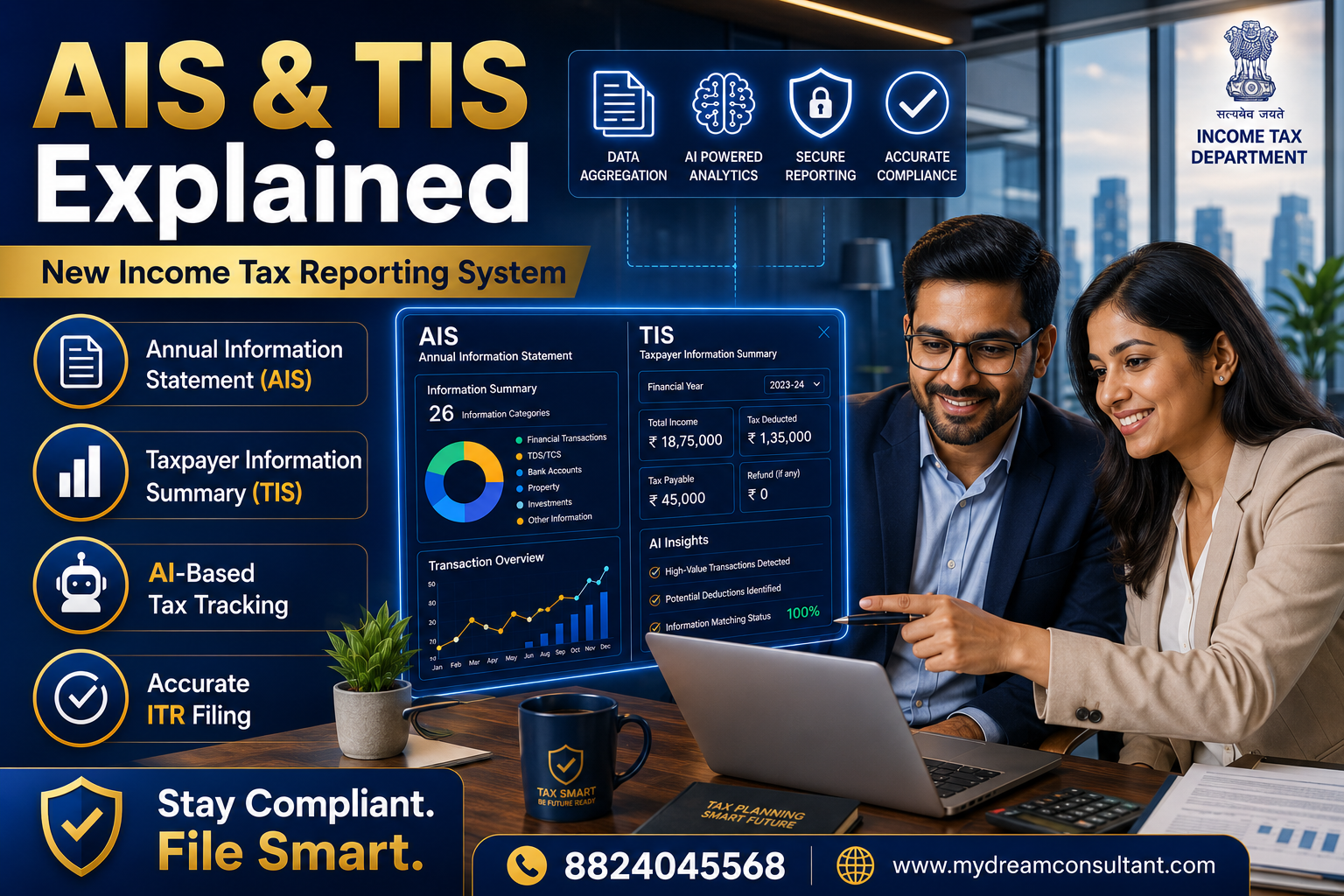
One of the most important developments in this transformation is the introduction of the Annual Information Statement (AIS) and Taxpayer Information Summary (TIS).
Many taxpayers are hearing these terms for the first time and often wonder:
- What is AIS?
- What is TIS?
- Why are they important?
- Can AIS help the Income Tax Department track my transactions?
- What happens if my ITR does not match AIS?
If you are planning for ITR Filing in Jaipur, searching for Income Tax Consultants, or looking for the Best CA in Jaipur, understanding AIS and TIS is essential for accurate tax compliance.
In this guide, we will explain AIS and TIS in simple language with practical examples.

What is AIS?
AIS stands for Annual Information Statement.
It is a comprehensive statement provided by the Income Tax Department that contains details of various financial transactions associated with your PAN.
The purpose of AIS is to give taxpayers complete visibility of information available with the Income Tax Department before filing Income Tax Returns.
Think of AIS as a financial report card that shows the department what it already knows about your income and transactions.
Start Your Company In Just A Click
—-! Click Here !—-
What Information Does AIS Contain?
AIS may contain details such as:
Salary Income
Salary reported by employers.
Bank Interest
Interest earned from:
- Savings accounts
- Fixed Deposits (FDs)
- Recurring Deposits
Dividend Income
Dividends received from shares and mutual funds.
Share Market Transactions
Information relating to:
- Purchase of shares
- Sale of shares
- Capital gains transactions
Mutual Fund Investments
Purchase and redemption of mutual fund units.
Property Transactions
Sale and purchase of immovable property.
TDS and TCS Details
Tax Deducted at Source and Tax Collected at Source.
Foreign Remittances
Certain international transactions and remittances.
High-Value Transactions
Significant financial activities reported by banks and financial institutions.
What is TIS?
TIS stands for Taxpayer Information Summary.
It is a summarized version of AIS.
While AIS provides detailed transaction-level information, TIS provides a simplified summary that taxpayers can use while preparing their Income Tax Return.
In simple words:
AIS = Detailed Financial Data
TIS = Simplified Tax Summary
Difference Between AIS and TIS
| AIS | TIS |
| Detailed transaction report | Summary of transactions |
| Shows complete information | Shows summarized values |
| Helps verify financial records | Helps in ITR filing |
| Includes transaction-wise details | Includes category-wise totals |
Both are important and should be reviewed before filing your return.
Why AIS and TIS Were Introduced
The Income Tax Department introduced these systems to:
- Improve transparency
- Reduce tax evasion
- Minimize reporting errors
- Simplify return filing
- Increase voluntary compliance
Today, advanced AI systems can compare your ITR with AIS data and identify mismatches instantly.
Real-Life Example 1: Unreported FD Interest
Rohit earns salary income and also has several Fixed Deposits.
While filing his return, he reports salary income but forgets to include FD interest.
However, the bank has already reported the interest income to the Income Tax Department.
The FD interest appears in AIS.
As a result, a mismatch occurs and Rohit may receive a communication from the department.
This is why reviewing AIS before filing is extremely important.
How AIS Helps Taxpayers
Many people assume AIS only helps the Income Tax Department.
In reality, it also benefits taxpayers.
Advantages include:
Better Accuracy
Helps ensure all income sources are reported.
Fewer Notices
Reduces chances of mismatches and scrutiny.
Easier Tax Filing
Provides a ready reference for income details.
Improved Compliance
Makes tax filing more transparent and accurate.
Real-Life Example 2: Capital Gains Reporting
Priya invested in shares and mutual funds.
During the year, she sold several investments and earned profits.
While preparing her ITR, she checked AIS and found all major transactions reflected there.
This helped her calculate capital gains accurately and avoid reporting mistakes.
What Happens if AIS and ITR Do Not Match?
A mismatch does not automatically mean a penalty.
However, it may lead to:
- Clarification requests
- Tax notices
- Additional verification
- Delayed refund processing
Common mismatch situations include:
- Unreported interest income
- Missing capital gains
- Incorrect dividend reporting
- Property transaction discrepancies
This is one reason many taxpayers seek assistance from the Top CA in Jaipur and experienced Income Tax Consultants.
Can AIS Track Your Transactions?
To a significant extent, yes.
Various institutions report information to the Income Tax Department, including:
- Banks
- Employers
- Mutual fund houses
- Stock brokers
- Property registrars
- Financial institutions
This information may eventually appear in AIS.
Therefore, taxpayers should ensure that all income and transactions are reported accurately.
Real-Life Example 3: Property Sale
Amit sold a property during the financial year.
The transaction was reported through property registration records.
When he checked AIS, the property transaction was already reflected.
This reminded him to calculate and report capital gains correctly while filing his return.
How to Check AIS and TIS
Taxpayers can access AIS and TIS through the Income Tax portal.
Generally, the process involves:
- Logging into the Income Tax portal.
- Accessing the AIS section.
- Reviewing detailed financial information.
- Comparing the data with personal records.
- Using TIS while preparing ITR.
If discrepancies are noticed, taxpayers can provide feedback through the portal.
Common Mistakes Taxpayers Make
Ignoring AIS Completely
Many people file returns without reviewing AIS.
Not Reporting Interest Income
Savings and FD interest are commonly missed.
Ignoring Dividend Income
Dividend income should be disclosed properly.
Wrong Capital Gains Reporting
Investors often make errors in gain calculations.
Depending Solely on Form 16
Form 16 may not include all income sources.
Why Professional Assistance Is Helpful
AIS can contain a large amount of financial data.
Many taxpayers find it difficult to understand:
- Capital gains reporting
- Mutual fund taxation
- Foreign income disclosures
- Property transactions
- Business income reporting
Professional guidance helps ensure accurate reporting.
This is why many people search for:
- Best CA in Jaipur
- Top CA in Jaipur
- ITR Filing in Jaipur
- Income Tax Consultants
- ITR Filing Near Me
before filing their returns.
Tips for Using AIS Effectively
Check AIS Before Filing ITR
Never file your return without reviewing AIS.
Verify All Income Sources
Ensure salary, interest, dividends, and gains are included.
Maintain Financial Records
Keep bank statements and investment reports safely.
Report Discrepancies
Provide feedback where information appears incorrect.
Consult Experts
Professional review can prevent future complications.
Conclusion
AIS and TIS have transformed the way taxpayers file Income Tax Returns in India.
These systems provide greater transparency and help both taxpayers and the Income Tax Department maintain accurate financial reporting.
Ignoring AIS may result in reporting mistakes, delayed refunds, or tax notices. Therefore, every taxpayer should review AIS and TIS carefully before filing their return.
Whether you are a salaried employee, investor, business owner, freelancer, or NRI, understanding AIS and TIS is now an essential part of responsible tax compliance.
If you require assistance with AIS review, tax planning, or ITR filing, consulting experienced Income Tax Consultants, the Best CA in Jaipur, or experts specializing in ITR Filing in Jaipur can make the process smooth and hassle-free.
Frequently Asked Questions (FAQs)
1. What is AIS in Income Tax?
AIS (Annual Information Statement) is a detailed report containing financial information available with the Income Tax Department.
2. What is TIS?
TIS (Taxpayer Information Summary) is a summarized version of AIS that helps taxpayers prepare their Income Tax Returns.
3. Is AIS mandatory to check before filing ITR?
While not legally mandatory, checking AIS is highly recommended to avoid mismatches and notices.
4. Can AIS show FD interest income?
Yes. Interest earned from Fixed Deposits is generally reflected in AIS.
5. Does AIS include share market transactions?
Yes. Many stock market and mutual fund transactions may appear in AIS.
6. What happens if AIS and ITR do not match?
The Income Tax Department may seek clarification or conduct additional verification.
7. Can AIS help in getting faster refunds?
Yes. Accurate reporting based on AIS can reduce processing delays and refund issues.
8. Who should review AIS?
Every taxpayer, including salaried employees, business owners, freelancers, investors, and NRIs, should review AIS before filing ITR.
#AIS
#TIS
#AnnualInformationStatement
#TaxpayerInformationSummary
#IncomeTaxAIS
#IncomeTaxIndia
#IncomeTaxReturn
#ITRFiling
#CAinJaipur
#BestCAinJaipur
#TopCAinJaipur
#ITRFilingInJaipur