How Long Does Company Registration Take in India?
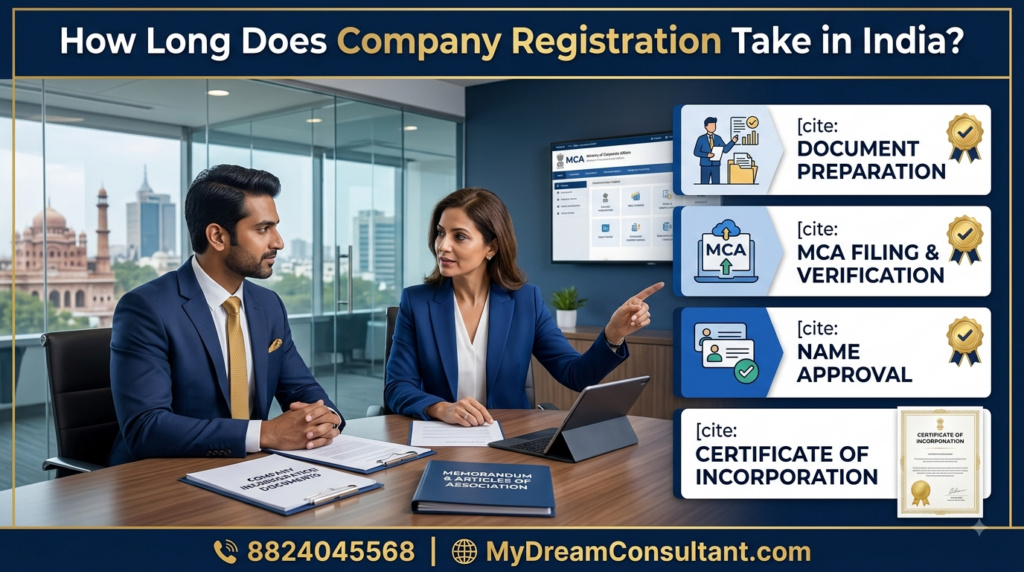
Starting a company is exciting, but one question almost every entrepreneur asks before beginning is: “How long will it take to register my company in India?” The answer is not the same for every business. The timeline depends on the type of business structure, availability of the proposed name, document readiness, MCA processing, government queries, and the complexity of the application. For many entrepreneurs, a straightforward incorporation application can be completed within a few working days after the required documents and filings are properly submitted, provided there are no objections, resubmissions, or additional approvals. However, it is better to treat this as an indicative timeline rather than a guaranteed deadline. If you are planning Company Registration in Jaipur, understanding the process beforehand can help you prepare your documents and avoid unnecessary delays. How Long Does Company Registration Usually Take? For a typical Private Limited Company, the incorporation process generally involves several stages. Stage Approximate Timeline* Document collection 1–3 working days Digital Signature Certificate (DSC) Usually 1–2 working days, subject to verification Name selection/application Depends on MCA processing and name availability Incorporation filing After documents and details are ready MCA review Generally a few working days if no clarification is required Certificate of Incorporation After successful approval *These are indicative timelines only. Actual processing time can vary depending on the application and government processing. The biggest advantage comes from being prepared before filing. Start Your Company In Just A Click —-! Click Here !—- Step-by-Step Company Registration Process Let’s understand what actually happens when you register a company. Decide Your Business Structure Before starting the registration process, decide which structure is suitable for your business. Common options include: Private Limited Company One Person Company (OPC) Limited Liability Partnership (LLP) Partnership Firm Proprietorship For startups and businesses planning to raise equity investment, a Private Limited Company is often considered. For certain professional or partner-driven businesses, an LLP may be worth considering. Choosing the structure first helps you understand the applicable documents, compliance requirements and costs. Collect the Required Documents Document preparation is one of the most important parts of the process. Depending on the structure and circumstances, documents may include: For Directors/Shareholders PAN card Identity proof Address proof Passport-size photograph Email ID Mobile number For foreign nationals or NRIs, additional documentation and compliance requirements may apply. Registered Office Documents You may need documents such as: Address proof Ownership proof or relevant property document Rent/lease agreement, where applicable Owner’s NOC, where applicable Utility bill as applicable If documents are incomplete or inconsistent, the incorporation process may take longer. Obtain Digital Signature Certificates Digital signatures are required for signing applicable electronic incorporation forms. The proposed directors/subscribers may need a Digital Signature Certificate (DSC) depending on the incorporation process. If KYC documents are properly prepared and verification is completed, this step can usually be handled relatively quickly. Choose a Company Name Choosing a suitable company name is more important than many entrepreneurs realise. The proposed name should comply with applicable naming rules and should not create conflicts with existing company names or trademarks. For example, if you want to start an IT company, simply choosing a name because it sounds attractive may not be enough. You should also consider: Existing company names Trademark conflicts Name availability Business activity Applicable naming requirements A rejected name can add time to the incorporation process. Prepare and File the Incorporation Application Once the structure, name and documents are ready, the incorporation application is prepared and submitted through the applicable MCA process. The filing may contain information relating to: Proposed company name Registered office Directors Subscribers/shareholders Share capital Business activity Constitutional documents Declarations and other required details Accuracy at this stage is extremely important. MCA Review After submission, the application is reviewed by the relevant authority. If everything is in order, the incorporation can proceed. However, the authority may raise a query or ask for clarification if something needs correction. For example: Document mismatch Incorrect information Name-related issue Incomplete address proof Incorrect attachments Other filing-related concerns If a resubmission is required, the overall timeline may increase. Certificate of Incorporation Once the application is successfully approved, the company receives its Certificate of Incorporation. This is an important milestone because it confirms the company’s incorporation. The company can then proceed with applicable post-incorporation activities and registrations. What Can Delay Company Registration? While many applications can move smoothly, several issues can increase the timeline. Incorrect Documents A mismatch between PAN, identity documents and other information can lead to problems. Name Rejection If the proposed name does not satisfy applicable requirements, another name may need to be selected. MCA Clarification If the authority raises a query, the application may require correction or resubmission. Registered Office Issues Incomplete or unsuitable address documentation can create delays. Foreign Director or Shareholder If an NRI or foreign national is involved, additional documentation and regulatory considerations may affect the timeline. Special Business Activities Certain businesses may require additional licences, approvals or regulatory permissions. Therefore, the incorporation timeline should not automatically be treated as the timeline for obtaining every business licence. Is Company Registration in Jaipur Faster? If you are searching for Company Registration in Jaipur, the core incorporation process is governed by the applicable MCA framework rather than being a separate Jaipur-only registration process. However, local professional support can be useful for: Document preparation Registered office documentation Application coordination Compliance planning Post-incorporation registrations The actual approval timeline still depends on the application and government processing. How Can You Make Registration Faster? You cannot control government processing time, but you can reduce avoidable delays. Keep Documents Ready Prepare identity, address and registered office documents before starting. Check the Name Carefully Research potential company names and consider trademark conflicts before filing. Verify Every Detail Check spelling of names, addresses, PAN details and other information. Understand Your Business Activity Clearly identify what the company will actually do. Plan Additional Registrations Depending on your business, you may also need: GST Registration MSME/Udyam Registration Trademark Registration FSSAI License Startup India recognition Other industry-specific
Best Business Structure for Freelancers, IT Companies & Startups
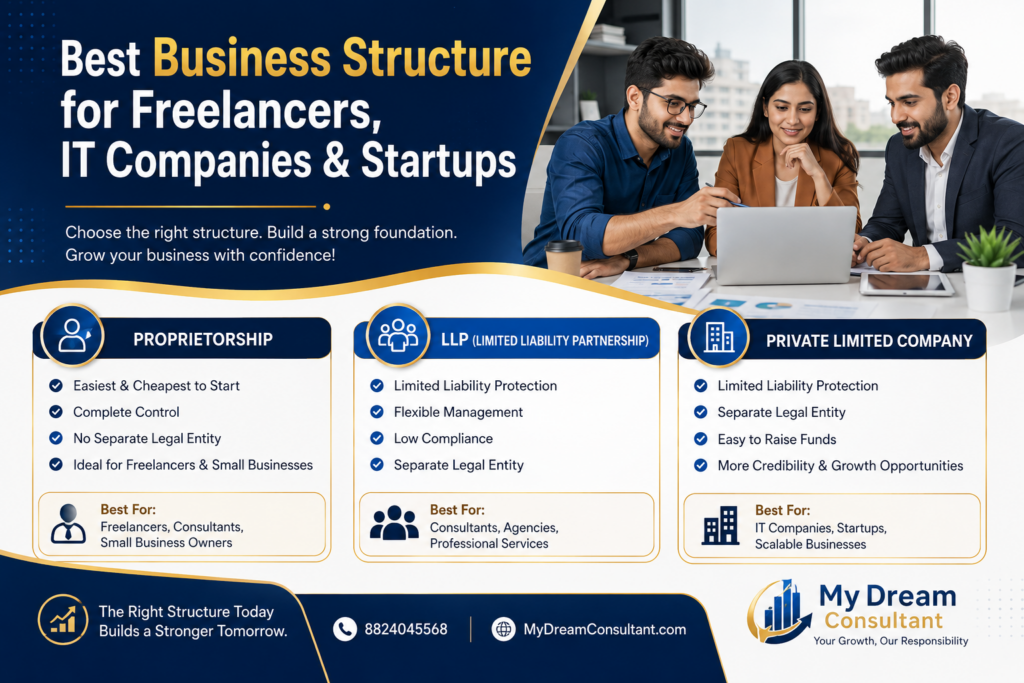
Starting a business is exciting, but one decision can have a long-term impact on your finances, compliance, liability, and growth: choosing the right business structure. A freelancer working alone may not need the same structure as a technology startup planning to raise investment. Similarly, two IT professionals starting together may find an LLP more suitable than operating as an informal partnership. So, what is the best business structure for freelancers, IT companies and startups in India? The answer depends on your number of founders, business activity, investment plans, liability concerns, taxation, compliance requirements and future growth plans. In this guide, let’s understand the major options in simple language. Why Choosing the Right Business Structure Matters Many entrepreneurs focus on getting their business started quickly and think about the structure later. This can create unnecessary complications. Your business structure can affect: Ownership and decision-making Personal liability Tax and accounting requirements Business credibility Ability to raise funds Investor participation Compliance requirements Banking and contracts Future expansion For example, a freelancer earning income from professional services may prefer a simpler structure, while a startup looking for investors may need a structure that can accommodate multiple shareholders. The right structure should match both your current business and your future plans. Main Business Structures in India For freelancers, IT companies and startups, the commonly considered structures include: Sole Proprietorship Partnership Firm Limited Liability Partnership (LLP) One Person Company (OPC) Private Limited Company Each has its own advantages and limitations. Start Your Company In Just A Click —-! Click Here !—- 1. Sole Proprietorship – Simple Option for Freelancers If you are working alone as a freelancer, consultant, designer, developer, content creator or independent professional, a sole proprietorship may be one of the simplest ways to start. There is no separate company entity in a traditional proprietorship. The business and owner are closely connected. Suitable for: Freelancers Individual consultants Independent professionals Small service providers Home-based businesses Small-scale entrepreneurs Advantages Simple setup Relatively fewer formalities Direct control over the business Suitable for small operations Limitations The proprietor generally has unlimited personal liability for business obligations. It may also be less suitable when you want to bring in equity investors or create a more formal corporate structure. Example Suppose Rahul is a freelance web developer in Jaipur. He works with several clients and does not have any partners or employees. His business is relatively small and he wants to keep administration simple. A proprietorship could be an option for him to consider. However, if Rahul plans to build a technology company and raise funding in the future, he should evaluate whether another structure would be more appropriate. 2. Partnership Firm – For Two or More People If two or more people want to start a business together, they can consider a partnership firm, subject to applicable law. It can be useful for businesses where the partners want to share: Investment Profits Responsibilities Business decisions Suitable for: Small businesses Family businesses Professional ventures Businesses with a small number of partners However, traditional partnerships generally do not provide the same limited-liability framework as an LLP. This is an important consideration when business risk is significant. 3. LLP – A Flexible Option for Professional Businesses A Limited Liability Partnership (LLP) combines elements of partnership-style management with limited liability. An LLP can be considered by businesses where two or more partners want to work together while maintaining a more formal structure. Suitable for: IT service companies Consulting firms Professional firms Agencies Small businesses with multiple founders Businesses where partners actively manage operations Key advantages Separate legal identity Limited liability, subject to applicable law Partnership-style flexibility Suitable for multiple partners Generally less complex than a private company in some respects Example Imagine two software developers and one UI/UX designer decide to start an IT services business. They want to share profits and responsibilities but don’t currently plan to raise venture capital. An LLP could be one structure they evaluate. However, if they plan to bring in multiple investors and issue equity shares, a Private Limited Company may be more suitable. 4. OPC – For a Solo Entrepreneur An One Person Company (OPC) is designed around a single member and can be considered by certain entrepreneurs who want a corporate structure while operating individually. It can be relevant for: Solo consultants Individual professionals Independent business owners Entrepreneurs who want a company structure An OPC can provide a separate legal identity and limited-liability framework, subject to applicable law. But there is an important point If your business is expected to add co-founders, shareholders or investors, you should compare OPC with a Private Limited Company before incorporation. Your business may start with one person today but look very different two or three years from now. 5. Private Limited Company – Popular for Growth-Oriented Startups For startups and businesses with ambitious growth plans, a Private Limited Company is often one of the structures considered. It can be particularly relevant when the founders want: Multiple shareholders Equity-based ownership External investment Structured management Long-term scalability Suitable for: Technology startups IT companies SaaS businesses Product companies E-commerce businesses Businesses planning external funding Growth-oriented startups Example Consider three founders developing a SaaS product. They expect to: Hire employees Acquire customers across India Raise angel investment Bring in institutional investors Expand internationally In such a situation, a Private Limited Company may be worth considering because its corporate structure can accommodate multiple shareholders and equity investment. Freelancers vs IT Companies vs Startups Here’s a simple comparison: Business Type Structure to Consider Solo freelancer Proprietorship / OPC Independent consultant Proprietorship / OPC Two-person IT venture LLP / Private Limited Professional partnership LLP Small IT service business LLP / Private Limited Technology startup Private Limited Startup seeking investors Private Limited SaaS/product startup Private Limited Solo founder with corporate structure OPC High-growth startup Private Limited This is only a starting point. The final choice should depend on the actual circumstances of the business. LLP vs Private Limited Company One of the most common questions from
🚀 Industries That Will Grow Fastest After Budget 2026 – Complete Business Guide

Introduction The Union Budget 2026 is not just about taxes and government spending—it is a roadmap for India’s future growth. Every budget creates winners and opportunities, but Budget 2026 has especially focused on industries that can drive economic development, employment, and innovation. For business owners, investors, and entrepreneurs, understanding which industries will grow fastest after Budget 2026 is crucial. It helps in making smart investment decisions, expanding businesses, and exploring new opportunities. In this blog, we will explore the top industries expected to grow rapidly after Budget 2026, supported by real-life examples and practical insights. We will also explain how guidance from a top CA in Jaipur or the best CA in Jaipur can help businesses maximize these opportunities. 🌟 Why Budget 2026 Is Important for Industry Growth Budget 2026 focuses on: Strengthening MSMEs and startups Boosting infrastructure and manufacturing Promoting digital economy and technology Encouraging green energy and sustainability Improving ease of doing business These initiatives directly support high-growth industries. Start Your Company In Just A Click —-! Click Here !—- 📈 Top Industries That Will Grow Fastest After Budget 2026 1. MSME & Small Business Sector MSMEs are the backbone of India’s economy, and Budget 2026 provides strong support to this sector. ✅ Why MSMEs will grow: Increased funding and credit support Government-backed MSME schemes Simplified GST and compliance Digital platforms for MSMEs 💡 Real-life example: A small furniture manufacturing unit in Jaipur gets easier access to loans after Budget 2026. With the help of a tax consultant in Jaipur, the business expands production and increases revenue. 📌 SEO keywords: MSME growth India, small business opportunities, MSME benefits Budget 2026, business funding India 2. Infrastructure & Construction Industry The government has allocated huge funds for infrastructure development. ✅ Key focus areas: Highways and railways Smart cities Industrial corridors Logistics parks 💡 Real-life example: A construction company in Rajasthan wins government contracts for highway projects. With support from the best CA in Jaipur, the company manages taxes and finances efficiently. 📌 SEO keywords: infrastructure growth India, construction industry India, smart cities India, logistics development 3. Manufacturing & Make in India Sector Budget 2026 strengthens the “Make in India” initiative. ✅ Why manufacturing will grow: Incentives for domestic production Export promotion schemes Support for electronics and semiconductor manufacturing 💡 Real-life example: A manufacturing startup in Jaipur receives incentives for local production and starts exporting products globally. 📌 SEO keywords: manufacturing industry India, Make in India benefits, export opportunities India, semiconductor industry India 4. Technology & Digital Economy Technology is one of the fastest-growing sectors after Budget 2026. ✅ Key growth areas: Artificial Intelligence (AI) Data centers Fintech and digital payments IT services 💡 Real-life example: A fintech startup in Jaipur grows rapidly due to increased digital adoption and government support for technology innovation. 📌 SEO keywords: digital economy India, IT industry growth, fintech India, AI industry India 5. Renewable Energy & Green Economy Budget 2026 focuses on sustainable development. ✅ Growth drivers: Solar and wind energy projects Electric vehicles (EVs) Green hydrogen initiatives 💡 Real-life example: A solar energy company in Rajasthan expands operations due to government incentives and rising demand for clean energy. 📌 SEO keywords: renewable energy India, EV industry India, green energy India, sustainable business India 6. Startup & Innovation Ecosystem Startups are major beneficiaries of Budget 2026. ✅ Why startups will grow: Government funding support Tax incentives Easier regulatory environment 💡 Real-life example: A startup incubator in Jaipur attracts more investors and entrepreneurs after Budget 2026. 📌 SEO keywords: startup ecosystem India, startup funding India, innovation India, entrepreneurship India 7. Logistics & Supply Chain Industry Improved infrastructure boosts logistics and supply chains. ✅ Key benefits: Faster transportation Lower logistics costs New freight corridors 💡 Real-life example: A logistics company in Jaipur reduces delivery time and increases profitability. 📌 SEO keywords: logistics industry India, supply chain India, freight corridors India 8. Real Estate & Housing Sector Budget 2026 supports affordable housing. ✅ Growth factors: Government housing schemes Infrastructure development Urbanization 💡 Real-life example: A real estate developer in Jaipur launches affordable housing projects with better financing options. 📌 SEO keywords: real estate India, housing sector India, affordable housing India 9. Agriculture & Agri-Business Budget 2026 promotes agri-business and rural development. ✅ Key initiatives: Agri-tech startups Cold storage and warehousing Farmer support schemes 💡 Real-life example: A food processing company in Rajasthan expands due to improved cold storage facilities. 📌 SEO keywords: agriculture industry India, agri-business India, food processing India 10. Healthcare & Pharmaceutical Industry Healthcare is another high-growth sector. ✅ Growth drivers: Increased healthcare spending Pharma manufacturing support Digital health initiatives 💡 Real-life example: A pharma company in Jaipur expands production due to government incentives. 📌 SEO keywords: healthcare industry India, pharma industry India, digital health India 📊 How Businesses Can Benefit from These Growing Industries To take advantage of these opportunities, businesses should: ✔ Identify high-growth sectors ✔ Invest in technology and innovation ✔ Optimize tax planning ✔ Use government schemes ✔ Consult a top CA in Jaipur or best CA in Jaipur ❓ FAQs – Industries After Budget 2026 Q1. Which industry will grow the fastest after Budget 2026? Technology, renewable energy, MSMEs, infrastructure, and manufacturing are expected to grow the fastest. Q2. Is Budget 2026 good for startups? Yes. Budget 2026 provides funding support, tax benefits, and a favorable environment for startups. Q3. How can small businesses benefit from Budget 2026? Small businesses can access easier loans, government schemes, and simplified tax compliance. Q4. Why should businesses consult a CA after Budget 2026? A Chartered Accountant helps businesses optimize taxes, ensure compliance, and utilize government benefits effectively. Q5. How can a top CA in Jaipur help businesses? A top CA in Jaipur provides services like: Tax planning GST registration and compliance Business advisory Financial planning Legal compliance ✅ Conclusion The Union Budget 2026 opens massive opportunities for businesses across multiple industries. MSMEs, infrastructure, manufacturing, technology, renewable energy, startups, logistics, real estate, agriculture, and healthcare are expected to grow rapidly in the coming
Step-by-Step Process to Apply for a SAFTA Certificate…!

Introduction The South Asian Free Trade Area (SAFTA) Certificate is a badge which,according to authorities , allows firms to import their goods utilizing preferential tariffs when they export their goods within the SAARC region. By obtaining this certificate, are granted reduced or zero customs duties, that could ease and reduce the cost of trade. In case your business deals with other SAARC nations, you would be needing a SAFTA Certificate is order to maximize these benefits. Below is a step-by-step procedure for making your application process smoother. Step 1: Verify Eligibility for SAFTA Benefits Before applying for the SAFTA Certificate, it’s important to check whether your goods meet the eligibility criteria. Generally, the following conditions apply: Manufactured Products: Your products must be manufactured or produced in the exporting country. Rules of Origin Compliance: The product must adhere to the “rules of origin” stipulated under the SAFTA agreement, which often means a certain percentage of the product’s content must come from the exporting country. You should review the specific trade laws in your country to confirm whether your product qualifies for preferential treatment under SAFTA. Step 2: Collect the Required Documents Once you determine that your business and products meet the eligibility criteria, you can start gathering the necessary documents for the application. Key documents typically required include: Business Registration Documents: Proof of your company’s legitimacy. Export Invoice: Detailing the value and description of the exported goods. Packing List: Lists how the goods are packed. Bill of Lading: Proof that the goods are shipped. Certificate of Origin (COO): Verifies the origin of the goods being exported. SAFTA Declaration Form: A specific form required for your country’s application process. At My Dream Consultant, we assist businesses in preparing these documents, ensuring everything is accurate and compliant with regulatory standards. Step 3: Submit the Application Once you have gathered all the necessary documents, it’s time to submit the application. Most countries, including India, allow businesses to apply online through their respective trade portals. For instance, in India, businesses can apply through the Directorate General of Foreign Trade (DGFT) portal. Steps to submit the application: Login to the relevant trade portal (DGFT for India). Complete the SAFTA Certificate Application Form with details of your export consignment. Upload the Necessary Documents as required by the authorities. Review and Submit the application. If you need any help with the application process, My Dream Consultant can guide you step-by-step to ensure smooth and efficient submission. Step 4: Pay the Processing Fees Some countries require a nominal fee for processing the SAFTA Certificate. The payment is usually done online, and the amount will vary depending on your country’s regulations. Once you make the payment, ensure that you retain the payment receipt as proof of transaction. Step 5: Wait for Verification and Certification After you submit your application and make the payment, the authorities will verify the information and documents provided. The verification process may take anywhere from a few days to a few weeks, depending on the country and the complexity of the application. Once the verification is complete, you will receive the SAFTA Certificate. This certificate will enable you to enjoy the preferential tariff treatment when exporting to other SAARC countries. Step 6: Maintain Records for Future Reference After receiving the SAFTA Certificate, it’s essential to keep a copy of the certificate and all associated documentation for record-keeping and future audits. Maintaining accurate records is not only beneficial for your business but also necessary for regulatory compliance. Why Choose My Dream Consultant for SAFTA Certification? At My Dream Consultant, we deal with the SAFTA Certificate acquisition process for businesses. Our team is here to help businesses prepare all the necessary documents, ensure that they get submitted,and are in compliance with all regulations, making the entire process smooth and hassle-free. We help you navigate the complexity of international trade so that you can focus on growing your business while we take care of the paperwork. Our team will help you in each step so that your application does not suffer any delays and in processed promptly. My Dream Consultant assures you of a smooth, compliant, and beneficial export transaction .
Everything You Need to Know About SAFTA Certificate…!

Introduction Expanding your business across South Asia can open the world of opportunities, especially with the South Asian Free Trade Area (SAFTA) Certificate. This is because the certificate allows businesses to enjoy reduced tariffs and other trade benefits among SAARC countries for enhanced economic integration and trade facilitation. In this blog, we’ll dive deep into what a SAFTA Certificate is, its importance, the eligibility criteria, the application process, and how My Dream Consultant, a top consultant in India, can simplify the process for you. What is a SAFTA Certificate? The SAFTA Certificate is a trade document issued to exporters from SAARC member countries. It certifies that the goods being exported comply with the rules of origin under the South Asian Free Trade Agreement (SAFTA), enabling businesses to claim preferential tariff rates when trading within SAARC nations. SAARC Member Countries: Afghanistan Bangladesh Bhutan India Maldives Nepal Pakistan Sri Lanka Get Your Firm Registered @60% Discounting Price —-! Click Here ! Importance of SAFTA Certificate A SAFTA Certificate offers numerous benefits, making it an essential document for businesses engaging in trade across South Asia: Reduced Tariffs: Enjoy lower or zero customs duties on eligible goods. Enhanced Competitiveness: Boost your competitiveness in the South Asian market. Market Access: Gain access to over 1.7 billion consumers in the SAARC region. Cost-Effective Trade: Minimize export costs, leading to higher profits. Strengthened Trade Ties: Promote economic cooperation and integration within SAARC nations. Who Needs a SAFTA Certificate? Any exporter from a SAARC country who wants to avail preferential tariffs under the SAFTA agreement needs this certificate. Common industries that benefit include: Textiles and garments Pharmaceuticals Agricultural products Handicrafts Industrial machinery Eligibility Criteria for SAFTA Certificate In order to be awarded a SAFTA Certificate, the business must ensure its products comply with the Rules of Origin (ROO) requirements. Key considerations include: Originating Goods: Products have to be originating from the exporting SAARC country. Value Addition: A minimum percent of the value must be added within the exporting country. Direct Consignment: Goods must be shipped directly between SAARC countries. Documents Required for SAFTA Certificate To apply for a SAFTA Certificate, you’ll need the following documents: Commercial Invoice Bill of Lading or Airway Bill Packing List Export Declaration Form Manufacturing Process Flowchart Product Specification Sheet Declaration of Origin Get Your Firm Registered @60% Discounting Price —-! Click Here ! How to Apply for a SAFTA Certificate The process of obtaining a SAFTA Certificate involves several steps: Register Your Business: Make sure your business is registered as an exporter with the relevant authority in your country. Prepare Documentation: Collect all required documents, such as proof of origin. Apply Online or Offline: Use the relevant trade authority or chamber of commerce as an applicant. Verification: Authorities shall verify documents and inspect goods when necessary. Certificate Issuance: Upon approval, the SAFTA Certificate will be issued, are you can avail of the tariff benefits. How My Dream Consultant Can Help The process of acquiring a SAFTA Certificate is quite involved, but that’s where My Dream Consultant can help.As one of India’s top consultants with over ten years of experience,we provide: Expert Guidance: Comprehensive assistance in preparing and submitting your application. Document Verification: Ensuring all required documents are accurate and complete. Hassle-Free Process: Managing communication with authorities for timely certificate issuance. Customized Solutions: Tailored support for businesses across various industries. With 500+ positive Google reviews, My Dream Consultant is your trusted partner for trade certifications and compliance services. Get Your Firm Registered @60% Discounting Price —-! Click Here ! FAQ What is the validity period of a SAFTA Certificate? The validity of the certificate depends on the shipment and is usually applicable per consignment. Exporters need to apply for a new certificate for each shipment. Can SAFTA benefits be claimed for all products? No, only products listed in the agreement and meeting the rules of origin criteria are eligible for tariff benefits. Is the SAFTA Certificate mandatory for all exports within SAARC countries? It is mandatory only if you wish to avail preferential tariff rates under the SAFTA agreement. How long does it take to get a SAFTA Certificate? The processing time varies but typically takes a few working days, depending on the authority and completeness of your application. Can My Dream Consultant assist with post-application queries? Yes, our team provides end-to-end support, including resolving any post-application issues or queries. Conclusion The SAFTA Certificate is an important document for businesses that want to take advantage of the trade benefits of the SAFTA agreement. It reduces tariffs and makes trade across SAARC nations smoother, opening up immense opportunities for growth and collaboration. If you are prepared to take your business to the next level,then let My Dream Consultant walk you through the entire process. Contact us today to have an effortless experience and unlock the potential of trade in South Asia.
Company Closure vs. Company Formation: Which Involves More Compliance?

Introduction Starting a business is often a moment of glory and aspiration. It costs most entrepreneurs significant resources in terms of time, energy, and finances. Few consider the other side of this process-the closure of a business. Ironically, the compliance rules governing the closure of a business are usually more cumbersome than those for starting one. This blog will explore the reasons why company closure is associated with more compliance than company formation and how My Dream Consultant, one of the top consultancy firms in Jaipur, can help you make the process seamless. Compliance Requirements During Company Formation Forming a company is a structured and straightforward process, provided you follow the legal steps meticulously. Key compliance steps for company registration include: Choosing the Right Business Structure: Private limited company, LLP, sole proprietorship, etc. Name Approval: Filing an application with the MCA for name availability. Obtaining DIN and DSC: Director Identification Number (DIN) and Digital Signature Certificate (DSC) are mandatory. Drafting Legal Documents: Memorandum of Association (MOA) and Articles of Association (AOA). Company Registration: Filing incorporation documents with the Registrar of Companies (ROC). PAN, TAN, and GST Registration: Ensuring tax compliance. Even if these stages may seem lengthy, they are not infinite and will provide an unmistakable map. Consultancies like My Dream Consultant, one of the leading consultancy firms with a close of a decade-long experience and 500-plus Google reviews positively talking about its works, make it lucidly easy to navigate through this process Get Your Firm Registered @60% Discounting Price —-! Click Here ! Why Company Closure Involves More Compliance Closing a company is a complex and time-intensive process due to the numerous legal and financial obligations involved. Here are the primary reasons: Settling Financial Obligations Before closing, all financial liabilities, including loans, employee dues, and pending payments, must be cleared. This involves: Detailed audits Clearance of tax dues (GST, TDS, etc.) Settlement of employee PF and ESIC accounts Regulatory Approvals Company closure requires multiple regulatory approvals: Filing Form STK-2 for voluntary closure (if applicable) Clearance from tax departments ROC approval after reviewing all filings and reports Filing Pending Compliance Any pending annual compliance, including financial statements and annual returns, must be completed before closure. Failure to do so can result in penalties. Public Notice For voluntary closures, a public notice must be issued to inform creditors and stakeholders, providing them an opportunity to raise objections. Document Preservation The company must preserve key documents like accounting records, board meeting minutes, and tax filings for a stipulated period post-closure. Involvement of Creditors and Stakeholders Closure often involves creditors, shareholders, and other stakeholders. Consent from them is mandatory in many cases, adding another layer of complexity. Comparing the Two Processes Aspect Company Formation Company Closure Time Required 15-20 days 6-12 months or more Cost Moderate (depending on structure) High (due to audits, penalties, etc.) Complexity Defined steps, straightforward Multiple layers of compliance Regulatory Bodies Primarily MCA MCA, tax departments, creditors, stakeholders Documentation Standard (MOA, AOA, etc.) Extensive (audits, public notices, etc.) How My Dream Consultant Can Help Navigating the compliance maze of company closure requires expertise. This is where My Dream Consultant, Jaipur’s best consultancy firm, can make a difference. Here’s how we assist: End-to-End Support: From filing closure forms to obtaining regulatory approvals, we handle it all. Tax and Financial Compliance: Our experts ensure that all financial obligations and taxes are cleared without penalties. Regulatory Approvals: We liaise with government departments to obtain necessary permissions. Cost and Time Efficiency: Our streamlined processes save you time and reduce unnecessary expenses. Expert Guidance: With a decade of experience, our team ensures that you meet all compliance requirements seamlessly. Conclusion While forming a company is exciting and relatively straightforward, closing one demands meticulous attention to compliance. With multiple legal, financial, and regulatory obligations, company closure can be a daunting task. However, with the right guidance from a top consultancy firm like My Dream Consultant, you can simplify this complex process. Whether it’s formation or closure, trust us to be your reliable partner in ensuring hassle-free compliance every step of the way.
Tax-Free Countries vs. Tax Havens: Understanding the Difference..!

Introduction When you’re planning to expand your business internationally, you might hear terms like “tax-free countries” and “tax havens” being used. While these terms may sound similar, they actually refer to two different types of business environments. Understanding the difference between them is crucial, as it can help you make the right decisions for your business. At My Dream Consultant, one of the top best consultants for international business and tax planning, we simplify these concepts to help you grow your business in the best way possible. What Are Tax-Free Countries? Tax-free countries are places where businesses and individuals do not have to pay corporate or personal income taxes. These countries usually make money through other sources like tourism, trade, or natural resources. Examples of Tax-Free Countries: United Arab Emirates (UAE): No corporate or personal taxes, especially attractive for businesses in free zones. Bermuda: No income tax, but it raises money through duties and other taxes. Monaco: No personal income tax, which attracts wealthy individuals and businesses. Cayman Islands: No corporate taxes, popular for financial services. Why Choose Tax-Free Countries? Clear Regulations: These countries have straightforward laws that are easy to follow. Business-Friendly: They create an environment where businesses can thrive, making them attractive for expansion. Reputation: Operating in a tax-free country is seen as legitimate and legal. Get Your Firm Registered @60% Discounting Price —-! Click Here !—- What Are Tax Havens? Tax havens are countries or territories where businesses can take advantage of very low taxes, often with financial secrecy. These places are often used to reduce tax payments. Examples of Tax Havens: Panama: Known for its low taxes and privacy in business dealings. Luxembourg: Offers tax advantages, especially for large corporations. Switzerland: Famous for its privacy laws and tax incentives for businesses. Key Features of Tax Havens: Confidentiality: These countries offer privacy, keeping financial information secret. Low Taxes: They often offer extremely low taxes on profits and income. Risks: These places can sometimes be seen as controversial and are under greater international scrutiny. Tax-Free Countries vs. Tax Havens: Key Differences Feature Tax-Free Countries Tax Havens Tax Rates No income or corporate taxes. Very low taxes on income and profits. Economic System Stable and diverse economies. Often rely on attracting foreign businesses for tax benefits. Transparency Clear rules and regulations. Can have less transparency and more secrecy. Reputation Seen as legitimate and compliant. Sometimes linked with tax avoidance and secrecy. Example Countries UAE, Monaco, Cayman Islands. Panama, Switzerland, Luxembourg. Which Option Is Best for Your Business? When to Choose Tax-Free Countries: You want a stable environment for long-term growth. You value transparency and following clear rules. You are looking to expand into a business-friendly market. When to Consider Tax Havens: You want to take advantage of low taxes for your business operations. You don’t mind dealing with some level of confidentiality and risk. Your business needs more flexibility in how it handles taxes. How My Dream Consultant Can Help At My Dream Consultant, we are one of the top best consultants helping businesses expand internationally. We can: Help you decide between tax-free countries and tax havens based on your business needs. Guide you through the legal and tax rules in different countries. Set up your business in the best possible way to save on taxes and reduce risks. Provide expert advice to ensure you follow all the necessary rules and avoid any problems. Frequently Asked Questions (FAQ) Are tax-free countries the same as tax havens? No. Tax-free countries have no taxes, but they are transparent and business-friendly. Tax havens offer very low taxes but are often linked to secrecy and risk. Can my business benefit from tax-free countries? Yes. Tax-free countries are perfect for businesses looking for a stable, transparent place to grow, without worrying about high taxes. Are tax havens legal? Yes, using tax havens is legal, but they often come with privacy laws that can make them controversial. They are under more scrutiny from global regulators. How can My Dream Consultant help me? We can help you choose the right place to expand your business, make sure you stay compliant, and guide you in reducing tax costs. Conclusion Choosing between tax-free countries and tax havens is an important decision when expanding your business internationally. While both options offer tax advantages, they come with different levels of transparency, risk, and reputation. In this blog, you’ve learned about the difference between tax-free countries and tax havens and how they impact international business expansion. At My Dream Consultant, we are one of the top best consultants in India, specializing in helping entrepreneurs navigate global tax planning and business registrations. With our extensive experience in handling international tax matters, we’ve earned a reputation as Jaipur’s trusted business consulting firm. If you have any questions or need assistance with your international business strategy, we’re here to guide you. Contact us today and take the first step toward growing your business globally!
“How to Register in Tax-Free Countries / Tax-Free Business Setup Kya Hota Hai / Global Expansion Ke Fayde

Introduction Expanding to tax-free countries is a smart strategy for Indian entrepreneurs looking to optimize taxes and access global markets. These jurisdictions, often called tax havens, offer significant financial and operational benefits. In this guide, we’ll explore the process of registration, its advantages, and how My Dream Consultant can help you every step of the way. What Are Tax-Free Countries? Tax-free countries, such as the UAE and Cayman Islands, impose little to no taxes on income or profits. They attract businesses with incentives like simplified processes and global market access. However, compliance with both local and Indian laws is crucial. Popular Tax-Free Countries for Indian Entrepreneurs UAE: Zero corporate and personal income tax; Free Zones allow 100% foreign ownership. Cayman Islands: No corporate or capital gains tax, ideal for financial services. Bermuda: No income tax, popular among insurance and reinsurance businesses. Singapore (Low Tax): Offers low corporate tax rates and startup-friendly incentives. Get Your Firm Registered @60% Discounting Price —-! Click Here !—- Steps to Register Your Business Research Jurisdictions: Identify a country that aligns with your business goals. Consult Experts: Partner with My Dream Consultant to ensure seamless registration and compliance. Register Your Business: Submit essential documents like ID proofs, business plans, and pay applicable fees. Open a Local Bank Account: Manage operations effectively with a local corporate account. Ensure Compliance: Follow local laws and international regulations, such as anti-money laundering rules. Benefits of Registering in Tax-Free Countries Tax Savings: Reduce your tax liability and reinvest savings in business growth. Global Market Access: Leverage trade agreements and proximity to key markets. Ease of Operations: Tax-free jurisdictions simplify setup and compliance. Enhanced Credibility: Establish your business in globally reputed tax havens. Key Considerations Indian Tax Laws: Understand how global income is taxed in India and utilize Double Taxation Avoidance Agreements (DTAAs). Setup Costs: Evaluate the costs of registration and annual maintenance. Jurisdiction Stability: Choose a country with strong legal and political frameworks. Conclusion Registering in tax-free countries offers immense opportunities for Indian entrepreneurs to save on taxes and scale globally.Get your assistance with My Dream Consultant Today. With careful planning and expert guidance, you can unlock the benefits of these jurisdictions. In this blog, you have learned about “How Indian Entrepreneurs Can Register in Tax-Free Countries.” At My Dream Consultant, we are one of India’s top searchable legal consultants, assisting entrepreneurs in expanding globally. With expertise in handling international registrations and tax compliance, we’ve become Jaipur’s trusted name for business consulting. If you have any queries or need assistance with global business registration, we are always here to help. Click here to Contact us today and take the first step towards your international success! Income Tax Consultant in Jaipur. Income Tax Consultant in Jodhpur. Income Tax Consultant in Alwar. Income Tax Consultant in Udaipur. Income Tax Consultant in Kota. Income Tax Consultant in Bikaner. Income Tax Consultant in Jhalawar. Income Tax Consultant in Dholpur Income Tax Consultant in Churu Income Tax Consultant in Pali Income Tax Consultant in Baran Income Tax Consultant in Karauli Income Tax Consultant in Tonk Income Tax Consultant in Sawai Madhupur Income Tax Consultant in Bharatpur Income Tax Consultant Nagaur Income Tax Consultant in Beawar Income Tax Consultant in Jaisarmer. Income Tax Consultant in Ajmer Income Tax Consultant in Bhilwara. Income Tax Consultant in Bharatpur. Income Tax Consultant in Jhunjhunu. Income Tax Consultant in Barmer. Income Tax Consultant in Sikar. Income Tax Consultant in Chittorgarh Income Tax Consultant in Sri Ganganagar Income Tax Consultant in Nagaur Income Tax Consultant in Dausa Income Tax Consultant in Hanumangarh Income Tax Consultant in Sirohi Income Tax Consultant in Pratapgarh Income Tax Consultant in Banswara Income Tax Consultant in Bundi Income Tax Consultant in Rajsamand Income Tax Consultant in Bhiwadi
Key Tax Benefits of Setting Up a Business in the UAE…..!

Setting up a business in the UAE has become a popular choice for entrepreneurs and companies worldwide. This is due not only to its strategic location and strong economy but also to its favorable tax structure, which attracts business owners looking to optimize profits and minimize expenses. At My Dream Consultant, we specialize in helping businesses make the most of these opportunities. Here’s a look at the key tax benefits available in the UAE. Zero Corporate Tax for Many Sectors One of the biggest draws for foreign investors is the UAE’s zero corporate tax policy on most types of businesses. While certain sectors, like oil and gas, may have corporate taxes, the vast majority of businesses can operate tax-free. This allows companies to reinvest their profits directly into growth, product development, and market expansion. No Personal Income Tax In the UAE, individuals are not required to pay income tax. This makes it an ideal location for entrepreneurs and expatriates who want to retain more of their personal earnings. No personal income tax means that business owners and employees can keep more of their earnings, improving quality of life and making UAE a highly attractive place for top talent. Free Zones with Additional Tax Benefits The UAE is home to over 45 “Free Zones,” special economic areas where companies can benefit from additional tax advantages. Key benefits of setting up in a Free Zone include: 100% Foreign Ownership: Unlike mainland businesses, which may require a local partner, Free Zone companies allow full foreign ownership. Exemption from Import and Export Taxes: Businesses in Free Zones are often exempt from import and export taxes, which reduces operational costs. No Corporate Tax for 15-50 Years: Many Free Zones provide corporate tax exemptions for up to 50 years, making it easier for businesses to forecast expenses and plan for long-term growth. Customs Duty Exemptions on Goods Goods that are imported, stored, or exported from UAE Free Zones are generally exempt from customs duties. Additionally, companies that import goods to the UAE from outside the region for re-export do not pay customs duty on these products. This benefit particularly appeals to import-export businesses looking to maximize profit margins. Low VAT Rate Compared to Other Countries In 2018, the UAE introduced a value-added tax (VAT) at a rate of 5%, one of the lowest rates globally. The VAT applies only to certain goods and services, and certain categories like education, healthcare, and some financial services are exempt. Moreover, businesses that generate less than the VAT threshold do not need to register, which makes compliance easier for small businesses. Double Taxation Treaties for Global Expansion The UAE has entered into double taxation treaties with over 115 countries, allowing businesses to avoid being taxed twice on the same income. This is especially beneficial for businesses looking to expand globally, as it helps reduce tax burdens and prevents double taxation on income generated abroad. Profit Repatriation with No Restrictions Businesses in the UAE, especially those in Free Zones, enjoy unrestricted repatriation of profits. This means that companies can transfer profits to their home countries without paying additional taxes or fees, which is a significant advantage for foreign investors. Ease of Tax Registration and Compliance Compared to many other countries, the UAE has a streamlined and straightforward tax registration process, especially for VAT. The VAT registration process is user-friendly, and businesses have access to clear guidance on compliance. This means that even foreign investors unfamiliar with UAE’s tax laws can easily understand and adhere to requirements, reducing administrative burden and compliance costs. Get Your Firm Registered @60% Discounting Price —-! Click Here !—- FAQs Do all businesses in the UAE benefit from zero corporate tax? While most sectors enjoy zero corporate tax, certain industries, such as oil and gas, may have corporate tax obligations. However, Free Zone companies generally have tax exemptions that can last up to 50 years. Are UAE Free Zones suitable for all types of businesses? Yes, there are Free Zones catering to various industries, including tech, logistics, media, and finance. Each Free Zone offers specialized incentives and infrastructure suited to different business types. Is there a VAT threshold for UAE businesses? Yes, businesses with an annual taxable turnover of AED 375,000 or more are required to register for VAT. Those below this threshold are not obligated to register, easing compliance for smaller businesses. How do double taxation treaties benefit businesses in the UAE? Double taxation treaties prevent businesses from being taxed twice on the same income. This is especially beneficial for UAE-based companies that operate in multiple countries. Is personal income tax likely to be introduced in the UAE? The UAE currently has no plans to introduce personal income tax, making it one of the most tax-friendly locations globally for both business owners and employees. Conclusion The UAE offers one of the most attractive tax environments globally, with a range of benefits designed to support business growth, enhance profit margins, and simplify compliance. Whether you’re an entrepreneur, a multinational company, or a small business owner, the UAE provides a supportive tax framework that allows businesses to flourish. At My Dream Consultant, we help you navigate these benefits and find the best setup for your business in the UAE. With our expertise, you can rest assured that you’re making the most of these tax advantages to grow your business successfully. In this blog, you’ve just learned about the “Key Tax Benefits of Setting Up a Business in the UAE.” My Dream Consultant, India’s top consultancy firm with over 10 years of experience, is here to guide you through your UAE business setup while ensuring compliance with local regulations. As Jaipur’s leading tax advisory firm, we are always available to assist with any questions regarding UAE tax benefits and business strategies. For expert advice on navigating your UAE business setup effectively, click here to get in touch with us today!
How to Choose the Best Country for Your International Business Expansion….!

Expanding your business internationally is an exciting venture that opens up a world of opportunities. However, choosing the right country for expansion can be a daunting task. In this blog, we’ll explore the key factors to consider when selecting the best country for your international business, with insights from My Dream Consultant. Market Potential Before diving into a new country, it’s crucial to evaluate the market potential. Look for countries with a growing economy and a demand for your product or service. Research market trends, customer preferences, and competition. Countries like Singapore, Germany, and Canada often rank among the top best options due to their robust economies and consumer purchasing power. Regulatory Environment Understanding the regulatory environment is essential for smooth business operation. Each country has its own set of laws and regulations governing foreign investments, taxes, and labor. A favorable regulatory framework can significantly enhance your business’s success. Countries such as the United States and the Netherlands have transparent regulations that encourage foreign investment. Tax Incentives Taxation can greatly impact your bottom line. Look for countries offering tax incentives for foreign businesses. Countries like Ireland and Switzerland are known for their attractive corporate tax rates, making them top choices for tax-savvy entrepreneurs. Consulting with a firm like My Dream Consultant can provide you with tailored advice on navigating tax laws and maximizing savings. Infrastructure and Connectivity Strong infrastructure is vital for business operations. Consider countries with developed transportation, communication, and technological infrastructure. Nations such as Japan and Singapore boast efficient logistics networks and advanced technology, making them ideal for international expansion. Cultural Compatibility Cultural factors can significantly influence your business’s acceptance in a new country. Understanding the local culture, customs, and business practices will help you build strong relationships with clients and partners. Countries with a similar cultural background to your home country may offer a smoother transition. For instance, countries in the European Union can provide a familiar business environment for companies from other EU nations. Labor Market Evaluate the labor market in your target country. Look for countries with a skilled workforce that can meet your business needs. Additionally, consider labor costs and the ease of hiring and firing employees. Nations like Canada and Australia offer a skilled labor pool and relatively straightforward hiring processes. Political Stability Political stability is a key factor in choosing a country for expansion. Countries with stable governments and low levels of corruption provide a safer environment for investment. Countries like Switzerland and other consistently rank high in terms of political stability and transparency. Supportive Business Environment Finally, consider the overall business environment. Look for countries that offer support to foreign businesses, such as investment promotion agencies, networking opportunities, and access to funding. Countries like Singapore and the UAE provide extensive support for entrepreneurs, making them top best choices for business expansion. Get Your Firm Registered @60% Discounting Price —-! Click Here !—- FAQs How do I start researching potential countries for expansion? Begin by assessing your industry and target audience. Utilize market research reports, industry publications, and online resources to gather data on potential markets. What are some reliable sources for market data? Consider using resources like the World Bank, International Monetary Fund (IMF), and trade associations that focus on your industry. Additionally, consult local chambers of commerce and government trade departments. How important is language when expanding internationally? Language can play a significant role in business operations and customer relations. While many countries have English-speaking populations, understanding the local language can enhance communication and foster stronger relationships. Should I consult with local experts when expanding abroad? Absolutely! Local experts, such as legal advisors and business consultants, can provide valuable insights into the regulatory environment and cultural nuances, helping you avoid potential pitfalls. How can My Dream Consultant assist with my expansion plans? My Dream Consultant offers tailored consulting services, including market analysis, tax planning, and regulatory guidance, ensuring that your international expansion is as smooth and successful as possible. Conclusion Choosing the best country for your international business expansion requires careful consideration of various factors. From market potential and tax incentives to political stability and cultural compatibility, every element plays a crucial role in your decision-making process. Consulting with professionals, like those at My Dream Consultant, can help you navigate these complexities and make informed choices. Expanding your business internationally is not just about finding a new market; it’s about choosing the right environment for success. With the right planning and strategy, you can position your business for growth in a global marketplace. In this blog, you’ve just learned about “How to Choose the Best Country for Your International Business Expansion.” My Dream Consultant, India’s top consultancy firm with over 10 years of experience, is here to guide you through your global expansion while ensuring compliance with local regulations. As Jaipur’s leading global tax advisory firm, we are always available to assist with any questions regarding international business strategies. For expert advice on navigating your international expansion effectively, click here to get in touch with us today!