
Revised Return vs Updated Return (ITR-U) – What’s the Difference?

Introduction Have you ever realized after filing your Income Tax Return (ITR) that you forgot to mention an income, claimed the wrong deduction, or even missed filing the return altogether? If yes, don’t panic. The Income Tax Department provides two different options to correct such situations: Revised Return Updated Return (ITR-U) Many taxpayers think both are the same, but they serve completely different purposes. Choosing the wrong option can lead to penalties, notices, or rejection of your return. In this detailed guide, we’ll explain the difference between Revised Return vs Updated Return (ITR-U) in simple language, along with practical examples, eligibility, deadlines, benefits, and FAQs. Whether you’re a salaried employee, freelancer, business owner, or professional, understanding these provisions can save you from unnecessary tax issues. Understanding a Revised Return A Revised Return is filed when you have already submitted your Income Tax Return but later discover a genuine mistake. These mistakes may include: Forgot to report interest income Wrong bank account details Incorrect deduction claimed Salary entered incorrectly Missing capital gains Wrong TDS details Errors in personal information The purpose of a Revised Return is to replace the originally filed return with the corrected version. Start Your Company In Just A Click —-! Click Here !—- Example 1 Rahul, a software engineer from Jaipur, filed his ITR in July. Later, he realized that he forgot to include ₹35,000 interest earned from his Fixed Deposit. Instead of ignoring the mistake, he filed a Revised Return and corrected the income. This helped him avoid future notices from the Income Tax Department. What is Updated Return (ITR-U)? An Updated Return (ITR-U) was introduced under Section 139(8A) of the Income Tax Act. It allows taxpayers to voluntarily update their tax return even after the normal filing period has expired. This provision mainly benefits taxpayers who: Forgot to file ITR Missed reporting certain income Underreported income Want to pay additional tax voluntarily However, ITR-U cannot be used to reduce tax liability or claim extra refunds. Example 2 Priya runs an online business. She forgot to include ₹5 lakh received from freelance projects while filing her ITR. A year later, during financial planning, she realized the mistake. Instead of waiting for an Income Tax notice, she filed an Updated Return (ITR-U) and paid the additional tax along with applicable interest. This helped her remain compliant and reduced the chances of future penalties. Major Difference Between Revised Return and Updated Return Particular Revised Return Updated Return (ITR-U) Purpose Correct mistakes in filed return Update income or file missed return Applicable When Original return already filed Original or belated return may or may not be filed Can Reduce Tax? Yes No Can Increase Refund? Yes (if eligible) No Can Claim Additional Loss? Yes No Additional Tax Required No Yes Time Limit As prescribed under Income Tax Act Within prescribed period under Section 139(8A) Best For Correction of errors Voluntary disclosure of missed income When Should You File a Revised Return? A Revised Return is suitable when: Wrong income reported Wrong deduction claimed TDS mismatch Wrong bank details Missing investment details Salary calculation error Incorrect personal information Forgot to claim eligible exemption When Should You File ITR-U? ITR-U is useful when: You forgot to file your ITR. Certain income was left out. Income was underreported. You want to voluntarily pay additional tax. You wish to avoid future tax notices. Cases Where ITR-U Cannot Be Filed You cannot file an Updated Return if: It reduces your tax liability. It increases your refund. It converts tax payable into a refund. It increases carried forward losses. Search or survey proceedings have already started (subject to applicable provisions). Certain legal restrictions under the Income Tax Act apply. Real-Life Example Comparison Case 1 – Revised Return A salaried employee claimed an incorrect deduction under Section 80C. After realizing the mistake, he corrected the deduction through a Revised Return. No additional tax penalty was required. Case 2 – Updated Return (ITR-U) A doctor forgot to disclose consultation income worth ₹12 lakh. Two years later, before receiving any notice, she filed an Updated Return and paid the applicable tax and additional amount. This helped maintain tax compliance. Benefits of Filing a Revised Return Correct genuine mistakes Avoid Income Tax notices Accurate tax records Claim eligible deductions (where permitted) Peace of mind Benefits of Filing an Updated Return (ITR-U) Opportunity to voluntarily disclose missed income Reduces litigation Improves tax compliance Avoids future disputes Builds a better compliance history Common Mistakes Taxpayers Make Many taxpayers unknowingly: Ignore bank interest. Forget rental income. Miss freelance income. Claim incorrect deductions. Forget capital gains. Ignore dividend income. Delay correction until a tax notice arrives. Timely correction through the appropriate return can save both money and stress. Which One Should You Choose? Choose a Revised Return if: You have already filed your ITR. You only need to correct mistakes. No additional tax disclosure is involved. Choose Updated Return (ITR-U) if: You missed filing your return. You forgot to disclose income. You want to voluntarily pay additional tax and become compliant. How a Chartered Accountant Can Help Income tax laws can be complex, and selecting the correct type of return is crucial. A professional Chartered Accountant can: Review your tax records. Identify filing errors. Advise whether a Revised Return or ITR-U is appropriate. Calculate additional tax, interest, and applicable charges. Ensure timely and accurate compliance. Represent you in case of notices from the Income Tax Department. If you’re looking for the Top CA in Jaipur, the Best CA in Jaipur, experienced Income Tax Consultants, or professional assistance for ITR Filing in Jaipur or searching online for ITR Filing Near Me, expert guidance can help you avoid costly mistakes and ensure your return is filed correctly. Conclusion Understanding the difference between a Revised Return and an Updated Return (ITR-U) is essential for every taxpayer. A Revised Return is meant for correcting genuine mistakes in an already filed return, while an Updated Return offers a valuable opportunity to voluntarily report missed income or file
Capital Gains Tax on Property Sale Explained

Introduction Selling a property is one of the biggest financial transactions most people make in their lifetime. Whether you’re selling your home, a residential plot, commercial property, or an inherited asset, understanding Capital Gains Tax is essential before completing the sale. Many property owners assume that once the property is sold and the payment is received, the process is complete. However, the Income Tax Department also requires you to correctly calculate and report the profit earned from the sale while filing your Income Tax Return (ITR). A lack of knowledge about capital gains often leads to mistakes such as incorrect tax calculations, failure to claim eligible exemptions, ignoring TDS requirements, or filing the wrong ITR form. These mistakes may result in notices, delayed refunds, or additional tax liability. The good news is that with proper planning and professional guidance, property transactions can be managed smoothly while ensuring compliance with the Income Tax Act. If you’re searching for the Top CA in Jaipur, Best CA in Jaipur, experienced Income Tax Consultants, or expert assistance with ITR Filing in Jaipur, this guide will help you understand the basics of capital gains taxation in simple language. What is Capital Gains Tax? Capital Gains Tax is the tax that may arise on the profit earned from selling a capital asset such as property. Simply put, Capital Gain = Sale Value − Eligible Cost of Acquisition − Eligible Expenses (as per applicable tax provisions) The exact tax treatment depends on the applicable provisions of the Income Tax Act and the facts of your transaction. Start Your Company In Just A Click —-! Click Here !—- Which Properties are Covered? Capital gains provisions generally apply to the sale of: Residential House Commercial Property Plot or Land Office Space Shop Inherited Property Gifted Property (subject to applicable provisions) Different categories of property may have different tax implications. Factors That Affect Capital Gains Tax Your tax liability depends on several important factors, including: Purchase Price Sale Price Holding Period Improvement Expenses Transfer Expenses Nature of Property Applicable exemptions under the Income Tax Act Current tax provisions Every property transaction is unique, so proper computation is essential. Understanding Long-Term and Short-Term Capital Gains Property gains may be classified as either Long-Term Capital Gains (LTCG) or Short-Term Capital Gains (STCG) depending on the applicable holding-period rules under the Income Tax Act. The classification is important because the tax treatment, reporting requirements, and potential exemptions may differ. Real-Life Example 1 Rahul purchased a residential apartment several years ago and later sold it to upgrade to a larger home. Initially, he believed that tax would simply be calculated on the difference between the purchase price and sale price. After consulting a Chartered Accountant, he learned that factors such as eligible acquisition costs, documented improvement expenses, and available exemptions could affect the final tax computation. Proper guidance helped him complete the transaction with confidence. Expenses That May Influence Capital Gains Calculation Subject to the Income Tax Act and supporting documentation, certain costs may be relevant while computing capital gains, such as: Purchase Cost Registration Charges Stamp Duty Brokerage Eligible Improvement Expenses Transfer-related Expenses Maintain proper records and invoices to support your calculations. Importance of Maintaining Documents Always keep copies of: Purchase Deed Sale Deed Stamp Duty Receipts Registration Documents Improvement Bills Brokerage Receipts Bank Statements Property Tax Records TDS Certificate (where applicable) These documents are extremely useful during ITR filing or if any clarification is sought by the Income Tax Department. Real-Life Example 2 Priya sold a residential plot after carrying out boundary wall construction and other improvements. Because she had preserved invoices and payment records, her Chartered Accountant could accurately consider the eligible costs while preparing her Income Tax Return. Keeping proper documentation saved both time and unnecessary complications. Check AIS Before Filing Your ITR Before filing your Income Tax Return, review: Annual Information Statement (AIS) Taxpayer Information Summary (TIS) Form 26AS Compare these with your property documents and bank records to ensure consistency. TDS on Property Transactions Certain property transactions may attract Tax Deducted at Source (TDS) under applicable provisions of the Income Tax Act. Both buyers and sellers should verify whether TDS provisions apply to their transaction and ensure that the necessary compliance is completed. Common Mistakes Property Sellers Make Not Reporting Property Sale Some taxpayers believe that if TDS has already been deducted, no further reporting is required. Property transactions should still be reported correctly in the Income Tax Return wherever applicable. Ignoring Improvement Costs Failure to preserve eligible improvement bills may affect the capital gains computation. Poor Documentation Missing sale agreements, purchase deeds, or payment records can make tax filing more difficult. Not Reviewing AIS Always compare your records with the Annual Information Statement before filing your return. Filing the Wrong ITR Form Choosing the appropriate ITR form is equally important for accurate compliance. Real-Life Example 3 Amit inherited a family property and sold it after several years. Since inherited property involves additional considerations, he consulted a tax professional before filing his return. With expert assistance, he maintained the required documentation, completed the necessary calculations, and filed his ITR correctly. Can You Save Tax on Property Sale? The Income Tax Act provides certain exemptions and reliefs for eligible taxpayers, subject to prescribed conditions. Eligibility depends on factors such as: Nature of the property Type of investment made after the sale Time limits Applicable legal provisions Always consult a qualified Chartered Accountant before making financial decisions based on tax benefits. Tips to Reduce Errors While Filing Maintain complete property records. Preserve all invoices and receipts. Verify AIS and Form 26AS. Keep TDS details ready. Calculate capital gains carefully. File your ITR before the due date. Seek professional guidance for complex transactions. Why Professional Tax Guidance Matters Property taxation is one of the most technical areas of Income Tax compliance. Professional guidance helps you: Calculate capital gains accurately. Review property documents. Verify TDS credits. Check AIS and Form 26AS. Identify applicable exemptions. File the correct ITR form. Reduce the
LTCG & STCG – Latest Tax Rules Every Investor Must Know (2026 Guide)

Introduction Investing in shares, mutual funds, exchange-traded funds (ETFs), and other financial assets has become increasingly popular in India. While earning good returns is every investor’s goal, understanding the tax implications of these investments is equally important. One of the most confusing topics for investors is the difference between Long-Term Capital Gain (LTCG) and Short-Term Capital Gain (STCG). Many people know they have to pay tax on profits from investments, but they are often unsure about how those profits are classified, how they should be reported in the Income Tax Return (ITR), and what records they should maintain. Incorrect reporting of capital gains can result in errors in your Income Tax Return, delayed refunds, or notices from the Income Tax Department. With the Income Tax Department using advanced digital reporting systems like AIS (Annual Information Statement), TIS (Taxpayer Information Summary), and Form 26AS, it has become more important than ever to disclose investment income accurately. Whether you’re a first-time investor or an experienced trader, understanding LTCG and STCG will help you make informed investment decisions and remain tax compliant. If you’re searching for the Top CA in Jaipur, Best CA in Jaipur, expert Income Tax Consultants, or professional assistance for ITR Filing in Jaipur, this guide will help you understand the basics before filing your return. What are Capital Gains? A capital gain is the profit earned when you sell a capital asset for more than its purchase price. Capital assets may include: Listed Shares Mutual Funds Exchange Traded Funds (ETFs) Bonds Property Gold Other eligible investments If you sell an asset at a loss, it is generally referred to as a capital loss. Start Your Company In Just A Click —-! Click Here !—- What is Short-Term Capital Gain (STCG)? A Short-Term Capital Gain arises when a capital asset is sold within the holding period prescribed under the Income Tax Act for that category of asset. The exact holding period depends on the nature of the investment. Short-term gains are taxed according to the applicable provisions of the Income Tax Act. What is Long-Term Capital Gain (LTCG)? A Long-Term Capital Gain arises when an asset is sold after completing the prescribed holding period under the Income Tax Act. Long-term investments generally receive different tax treatment from short-term investments, subject to the applicable law. Why Should Investors Understand LTCG & STCG? Understanding the difference helps you: File your ITR correctly. Avoid incorrect tax calculations. Plan investments efficiently. Maintain proper tax records. Reduce the chances of Income Tax notices. Make informed financial decisions. Real-Life Example 1 Rahul purchased shares of a listed company and sold them after a relatively short holding period. He assumed that all investment profits were taxed in the same manner. After consulting a tax professional, he learned that the tax treatment depends on the holding period and the type of investment. This helped him file his Income Tax Return correctly. Investments Covered Under Capital Gains Capital gains taxation may apply to: Equity Shares Mutual Funds ETFs Bonds Debentures Property Gold Investments Other capital assets Different assets may have different holding periods and tax rules. Documents Required Before Filing Your ITR Before preparing your return, keep the following documents ready: Broker’s Capital Gains Statement Contract Notes Demat Account Statement Mutual Fund Statement AIS TIS Form 26AS Bank Statements These records help ensure accurate reporting. Importance of AIS & TIS AIS and TIS provide information about many financial transactions reported to the Income Tax Department. Before filing your ITR: Compare your broker’s reports with AIS. Verify capital gains entries. Check TDS details in Form 26AS. Reconcile all investment transactions. This helps reduce errors and improves compliance. Real-Life Example 2 Priya invested in several mutual funds through SIPs. During the financial year, she redeemed units from different schemes. Initially, she planned to report only one transaction. After checking her AIS and capital gains statement, she identified all the transactions and filed an accurate return. Common Mistakes Investors Make Not Reporting Capital Gains Many taxpayers believe that only salary income needs to be reported. Capital gains should also be disclosed in the Income Tax Return. Ignoring AIS Ignoring AIS can result in mismatches between your return and the Income Tax Department’s records. Using Incorrect Purchase Cost Always rely on authentic investment records. Forgetting Dividend Income Dividend income should also be considered wherever applicable. Filing the Wrong ITR Form Selecting the correct ITR form is equally important. Tips for Accurate Capital Gains Reporting Maintain complete investment records. Download annual capital gains statements. Keep all contract notes safely. Verify transactions with AIS and TIS. Reconcile Form 26AS. File your ITR before the due date. Consult a Chartered Accountant whenever required. Real-Life Example 3 Amit regularly invested in shares and ETFs. At the end of the financial year, he had hundreds of transactions. Instead of calculating everything manually, he downloaded his broker’s capital gains report and consulted a tax professional. This saved time and helped him file an accurate ITR. Why Professional Tax Guidance Matters Capital gains taxation can become complicated when you have: Multiple investment accounts SIP investments Frequent share trading Dividend income Different categories of capital assets Large transaction volumes An experienced tax consultant can help you: Calculate capital gains accurately. Review broker statements. Verify AIS and TIS. Choose the correct ITR form. Report all transactions properly. Claim eligible tax benefits wherever applicable. Avoid Income Tax notices. This is why many taxpayers search online for: Top CA in Jaipur Best CA in Jaipur ITR Filing in Jaipur Income Tax Consultants ITR Filing Near Me Professional assistance ensures accurate compliance while reducing filing errors. Tax Planning Tips for Investors Good tax planning starts before selling your investments. Consider these practices: Keep records updated. Review your portfolio regularly. Track every purchase and sale. Preserve contract notes. Check AIS before filing. Maintain dividend records. Consult professionals before making major financial decisions. Conclusion Understanding the difference between LTCG and STCG is essential for every investor. Correct reporting of capital gains helps you remain compliant, avoid
Property Sale Tax Rules in India (2026 Update)

Introduction Selling a property is a significant financial decision, whether it’s your first home, an inherited property, a plot of land, or a commercial building. While most people focus on finding the right buyer and negotiating the best price, many overlook one crucial aspect—the tax implications of selling property. Property transactions in India are subject to Income Tax provisions, and failing to understand these rules can lead to unexpected tax liabilities, penalties, or notices from the Income Tax Department. The tax payable depends on several factors, including the type of property, the holding period, the sale consideration, the cost of acquisition, and the applicable provisions of the Income Tax Act. Many taxpayers also make mistakes such as not reporting capital gains, ignoring TDS requirements, or missing available tax exemptions. These errors can result in unnecessary complications during Income Tax Return (ITR) filing. This is why many property owners seek guidance from experienced Income Tax Consultants, the Top CA in Jaipur, or the Best CA in Jaipur for accurate ITR Filing in Jaipur, capital gains computation, and tax planning. In this comprehensive guide, we’ll explain the property sale tax rules in simple language, common mistakes to avoid, and practical tips to help you stay compliant. What is Property Sale Tax? When you sell a property and earn a profit, that profit is generally known as Capital Gain. Depending on the nature of the transaction and applicable tax provisions, capital gains may be taxable under the Income Tax Act. Simply selling a property does not automatically mean you’ll pay tax. The tax liability depends on several factors. Types of Properties Covered Property taxation generally applies to: Residential House Commercial Property Plot or Land Agricultural Land (depending on applicable conditions) Inherited Property Gifted Property Each type of property may have different tax implications. Start Your Company In Just A Click —-! Click Here !—- Factors That Affect Property Taxation The amount of tax payable depends on: Sale Value Purchase Cost Holding Period Improvement Expenses Eligible Exemptions Applicable Tax Provisions Proper calculation is essential for accurate ITR filing. Real-Life Example 1 Rahul purchased a residential flat several years ago. When he decided to sell it, he assumed that only the sale price mattered for tax purposes. After consulting a tax professional, he learned that factors such as purchase cost, eligible expenses, and applicable exemptions could affect his tax liability. Proper planning helped him complete the transaction smoothly. Capital Gains on Property Sale The profit earned from selling a property is generally classified as Capital Gain. The tax treatment depends on: Holding Period Nature of Asset Applicable Income Tax Rules Correct computation is essential while filing the Income Tax Return. TDS on Property Sale In certain property transactions, Tax Deducted at Source (TDS) provisions may apply. Many buyers and sellers are unaware of these requirements, leading to compliance issues. Always verify whether TDS is applicable before completing the transaction. Importance of Proper Documentation Maintain records such as: Sale Deed Purchase Deed Registration Documents Improvement Bills Stamp Duty Records Brokerage Bills Bank Statements Payment Receipts These documents help support your tax calculations if required. Real-Life Example 2 Priya sold a residential plot and had carried out significant improvements over the years. Fortunately, she had preserved invoices and payment records for the work. These documents helped her accurately calculate the cost related to the property and complete her tax filing with confidence. Report Property Sale in Your ITR Many taxpayers believe that if TDS has been deducted, there is no need to report the transaction. This is incorrect. Property sale details should be disclosed appropriately while filing your Income Tax Return. Failure to report the transaction can result in mismatches with Income Tax records. Check AIS Before Filing Before filing your ITR, review: AIS (Annual Information Statement) TIS (Taxpayer Information Summary) Form 26AS These reports may reflect your property transaction and related tax information. Common Mistakes Property Sellers Make Not Reporting Capital Gains Every eligible property sale should be reported correctly. Ignoring TDS Always verify TDS credit before filing your return. Poor Documentation Missing documents can create difficulties during tax assessment. Wrong Cost Calculation Incorrect computation may increase tax liability. Missing Eligible Exemptions Many taxpayers miss available relief due to lack of awareness. Professional guidance can help identify applicable exemptions. Real-Life Example 3 Amit inherited a family property and later sold it. Initially, he was unsure how to calculate the taxable gain and what documents would be required. With professional assistance, he completed the calculations accurately and filed his ITR without any compliance issues. Can You Save Tax on Property Sale? Yes, in certain situations, the Income Tax Act provides eligible exemptions subject to prescribed conditions. However, these benefits depend on: Nature of Property Type of Investment Applicable Legal Provisions Time Limits Other Eligibility Conditions Always consult a qualified tax professional before making any decisions. Why Accurate Tax Planning Matters Property transactions usually involve substantial amounts. Proper tax planning helps you: Reduce errors Avoid notices Improve documentation Plan investments Ensure legal compliance File your ITR correctly Documents Required for Property Tax Filing Keep the following ready: PAN Card Aadhaar Card Sale Agreement Purchase Agreement Bank Statements TDS Certificate (if applicable) Improvement Bills Property Registration Documents AIS TIS Form 26AS Real-Life Example 4 Rohit sold a commercial property during the financial year. Instead of waiting until the last minute, he gathered all property-related documents before filing his return. As a result, his tax filing process was smooth, accurate, and completed without delays. Why Professional Tax Guidance is Important Property taxation is one of the most complex areas under the Income Tax Act. Professional tax consultants can help you: Calculate capital gains accurately Review property documents Verify TDS credits Identify applicable exemptions Prepare supporting documentation Select the correct ITR form File an accurate Income Tax Return Respond to Income Tax notices if required This is why many taxpayers search online for: Top CA in Jaipur Best CA in Jaipur ITR Filing in Jaipur Income Tax Consultants ITR Filing
Income Tax on Mutual Fund Income Explained (Complete Guide 2026)

Introduction Mutual funds have become one of the most popular investment options in India. Whether you’re a salaried employee, business owner, freelancer, or retiree, investing in mutual funds can help you build long-term wealth while benefiting from professional fund management. However, many investors focus only on earning returns and often overlook one important aspect—Income Tax on Mutual Fund Income. A common misconception is that mutual fund investments are completely tax-free. In reality, the tax treatment depends on the type of mutual fund, the holding period, and the nature of income, such as capital gains or dividends. Failing to report mutual fund income correctly while filing your Income Tax Return (ITR) can result in incorrect tax calculations, delayed refunds, or even notices from the Income Tax Department. This is why many investors seek guidance from experienced Income Tax Consultants, the Top CA in Jaipur, or the Best CA in Jaipur for accurate ITR Filing in Jaipur and tax planning. In this guide, we’ll explain how mutual fund income is taxed, common mistakes to avoid, and how you can file your ITR correctly in simple, easy-to-understand language. What is Mutual Fund Income? When you invest in a mutual fund, your money is pooled with other investors and managed by professional fund managers. You may earn income from: Capital Gains on redemption of units Dividend Income (if applicable) Appreciation in the value of your investment Different types of income may have different tax implications. Start Your Company In Just A Click —-! Click Here !—- Types of Mutual Funds Before understanding taxation, it’s important to know the common categories of mutual funds. Equity Mutual Funds These funds primarily invest in shares of listed companies. Suitable for long-term wealth creation. Debt Mutual Funds These invest mainly in government securities, corporate bonds, and fixed-income instruments. Often preferred by conservative investors. Hybrid Mutual Funds These invest in a combination of equity and debt instruments. They aim to balance risk and returns. Index Funds & ETFs These track a market index and are increasingly popular due to their lower costs. How is Mutual Fund Income Taxed? The taxation of mutual fund income depends on: Type of mutual fund Holding period Nature of gains Applicable provisions of the Income Tax Act Since tax rules are subject to change through amendments and Finance Acts, it’s important to refer to the latest provisions or consult a tax professional before filing your return. Real-Life Example 1 Rahul invested in an equity mutual fund and redeemed his units after holding them for several years. He assumed that the profit was completely tax-free and did not report it in his ITR. Later, while reviewing his AIS, he realized that the redemption transaction had already been reported to the Income Tax Department. With professional assistance, he corrected his return and avoided future compliance issues. Dividend Income from Mutual Funds If you receive dividend income from mutual funds, it should generally be reported while filing your Income Tax Return. Many investors forget to include this income, leading to mismatches in their tax records. Capital Gains on Mutual Fund Redemption When you sell or redeem mutual fund units, you may earn a profit known as Capital Gains. Capital gains should be calculated accurately and reported in your ITR. Why Reporting Mutual Fund Income is Important Reporting your mutual fund income correctly helps you: Stay compliant with tax laws Avoid Income Tax notices Claim eligible tax benefits where applicable Maintain accurate financial records Receive refunds without delays Real-Life Example 2 Priya invested through a Systematic Investment Plan (SIP). During the year, she redeemed some units to pay for higher education expenses. While preparing her ITR, she forgot to include the redemption details. Fortunately, she reviewed her broker’s capital gains statement and updated her return before submission. Documents You Should Keep Ready Before filing your ITR, keep the following documents available: Capital Gains Statement Mutual Fund Account Statement AIS (Annual Information Statement) TIS (Taxpayer Information Summary) Form 26AS Bank Statements Dividend Statements These documents help ensure accurate reporting. Check AIS Before Filing Your ITR AIS contains information about many financial transactions, including mutual fund transactions reported to the Income Tax Department. Always compare your records with AIS before filing. Common Mistakes Investors Make Not Reporting Capital Gains Many investors assume only salary income needs to be reported. Capital gains should also be disclosed. Ignoring Dividend Income Dividend income is often forgotten while filing returns. Not Checking AIS Ignoring AIS can result in mismatches. Using Incorrect Capital Gains Figures Always rely on your broker’s official capital gains statement. Filing the Wrong ITR Form Selecting the appropriate ITR form is equally important. Real-Life Example 3 Amit regularly invested through SIPs for several years. When he redeemed units, he assumed the mutual fund company would calculate everything automatically. While filing his ITR, he sought professional guidance and ensured that all transactions were correctly reported, helping him avoid future notices. Tips for Accurate Mutual Fund Tax Reporting Follow these best practices: Maintain investment records. Download annual capital gains statements. Review AIS, TIS, and Form 26AS. Keep dividend records. Report every redemption transaction. File your ITR before the due date. Consult a tax professional whenever required. Benefits of Professional Tax Guidance Mutual fund taxation can become complicated if you have: Multiple SIPs Different fund categories Regular redemptions Dividend income Investments across platforms Professional tax experts can help you: Calculate capital gains accurately Verify AIS and TIS Select the correct ITR form Claim eligible tax benefits File your return correctly Avoid Income Tax notices This is why many taxpayers search online for: Top CA in Jaipur Best CA in Jaipur ITR Filing in Jaipur Income Tax Consultants ITR Filing Near Me Experienced professionals ensure your ITR is filed accurately and in compliance with the latest tax regulations. Conclusion Mutual funds are an excellent investment option for long-term financial growth, but understanding their tax implications is equally important. Every investor should maintain proper records, review AIS and other tax documents, and report mutual fund
AIS & TIS Explained – New Income Tax Reporting System (Complete Guide 2026)
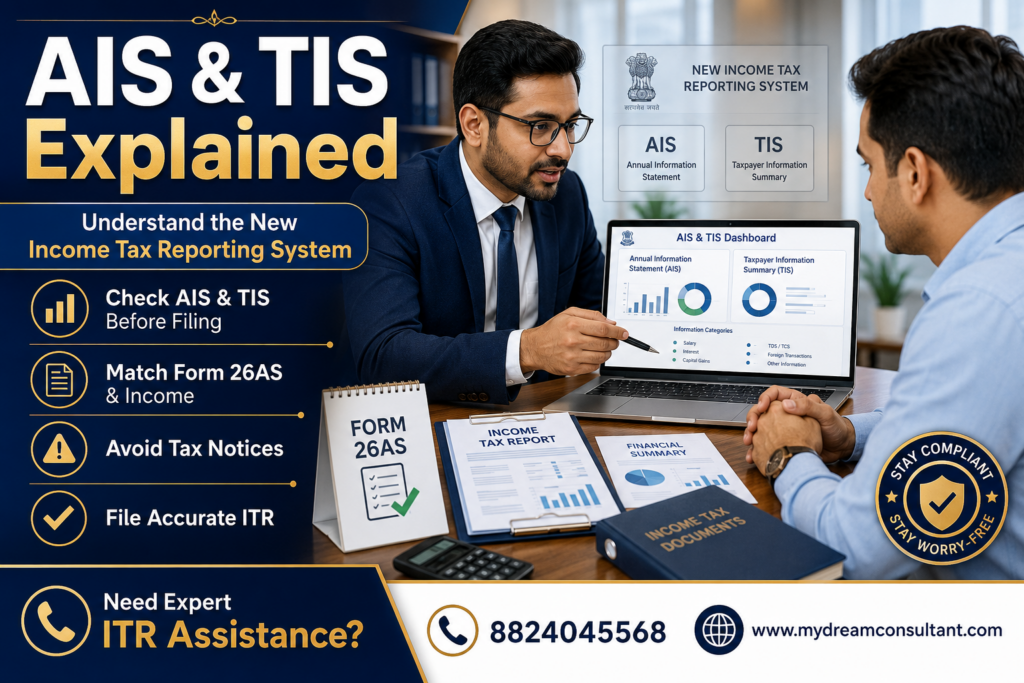
Introduction Have you ever wondered how the Income Tax Department knows about your bank interest, stock market investments, mutual fund transactions, property purchases, or high-value financial activities? The answer lies in the Annual Information Statement (AIS) and Taxpayer Information Summary (TIS)—two powerful tools introduced by the Income Tax Department to improve transparency and make tax filing more accurate. Many taxpayers still rely only on Form 16 or Form 26AS while filing their Income Tax Return (ITR). However, with the introduction of AIS and TIS, taxpayers now have access to a much more detailed record of their financial transactions. Ignoring these reports while filing your ITR can lead to income mismatches, delayed refunds, or even Income Tax notices. Whether you are a salaried employee, business owner, freelancer, investor, or professional, understanding AIS and TIS has become essential for accurate tax compliance. This is why many taxpayers prefer taking guidance from experienced Income Tax Consultants, the Top CA in Jaipur, or the Best CA in Jaipur for accurate ITR Filing in Jaipur and hassle-free tax compliance. In this blog, we’ll explain AIS and TIS in simple language, their differences, why they matter, and how they help you file an accurate Income Tax Return. What is AIS (Annual Information Statement)? The Annual Information Statement (AIS) is a detailed statement available on the Income Tax e-Filing Portal. It contains information about your financial transactions reported by various organizations during the financial year. AIS provides a comprehensive view of your financial activities beyond just TDS information. It may include details related to: Salary Income Interest from Savings Accounts Fixed Deposit Interest Dividend Income Mutual Fund Transactions Share Market Transactions Property Purchase & Sale Rent Received Foreign Income (where applicable) Tax Deducted at Source (TDS) Tax Collected at Source (TCS) High-Value Financial Transactions Refund Information AIS helps taxpayers verify whether all income has been reported correctly while filing their ITR. Start Your Company In Just A Click —-! Click Here !—- What is TIS (Taxpayer Information Summary)? The Taxpayer Information Summary (TIS) is a simplified version of AIS. Instead of showing every transaction in detail, TIS provides summarized values of your income and financial information. It is mainly used by taxpayers to estimate their taxable income before filing their return. TIS helps reduce confusion by presenting consolidated information in an easy-to-understand format. Difference Between AIS and TIS AIS TIS Detailed financial information Summarized financial information Shows individual transactions Shows consolidated figures Helps verify reported transactions Helps calculate taxable income Useful for reconciliation Useful for tax planning More comprehensive Easier to understand Both reports complement each other and should be reviewed before filing your Income Tax Return. Why Are AIS and TIS Important? The Income Tax Department uses advanced technology and Artificial Intelligence (AI) to compare the information available in AIS and TIS with the Income Tax Return filed by taxpayers. If there is any mismatch, the department may issue a notice asking for clarification. Checking these statements before filing your ITR helps you: Report accurate income Claim correct TDS credit Avoid tax notices Receive faster refunds Maintain proper tax compliance Real-Life Example 1 Rahul is a salaried employee. He filed his Income Tax Return using only Form 16 provided by his employer. Later, he received an Income Tax notice because he forgot to include Fixed Deposit interest reflected in his AIS. If he had checked AIS before filing, he could have avoided the notice. Information Available in AIS AIS contains information from multiple reporting sources. Some common entries include: Salary Salary reported by your employer. Bank Interest Interest earned on savings accounts and fixed deposits. Dividend Income Dividends received from shares or mutual funds. Capital Gains Transactions related to shares and mutual funds. Property Transactions Purchase or sale of immovable property. Foreign Remittances Certain foreign transactions wherever applicable. Tax Payments Advance tax, self-assessment tax, TDS, and TCS. Information Available in TIS TIS generally summarizes: Salary Interest Income Dividend Income Capital Gains Business Income Rental Income Foreign Income Taxes Paid Refund Details It provides estimated values that can be used while preparing the Income Tax Return. How to Access AIS and TIS Taxpayers can access both reports through the Income Tax e-Filing Portal after logging into their account. Before filing your ITR, download and review these statements carefully. Real-Life Example 2 Priya invested in mutual funds during the financial year. She redeemed a few units and earned capital gains. Since she forgot about the transaction, she initially excluded it while preparing her ITR. Fortunately, she reviewed her AIS before filing and noticed the reported transaction. She updated her return accordingly and avoided future complications. Common Mistakes Taxpayers Make Ignoring AIS Many taxpayers never check AIS before filing. This increases the risk of missing income. Reporting Only Form 16 Income Salary is not always your only income. Interest, dividends, and investments should also be reported. Missing Capital Gains Many investors forget to disclose gains from shares and mutual funds. Incorrect TDS Claims Always verify TDS with AIS, TIS, and Form 26AS. Ignoring High-Value Transactions Large financial transactions appearing in AIS should not be ignored. Benefits of Reviewing AIS and TIS Before Filing ITR Reviewing these reports helps you: Avoid Income Tax notices Identify missing income Verify TDS credits Reduce filing errors Receive refunds faster Improve tax accuracy Maintain complete compliance Real-Life Example 3 Amit runs a consulting business. He receives payments from multiple clients. One client deducted TDS but forgot to provide the certificate immediately. While reviewing AIS, Amit noticed the TDS entry and claimed the credit correctly while filing his ITR. Without checking AIS, he could have missed the tax credit. AIS vs Form 26AS Many taxpayers think AIS has replaced Form 26AS. This is incorrect. Form 26AS mainly contains: TDS TCS Advance Tax Self-Assessment Tax AIS provides much more information, including: Investments Interest Dividends Property Transactions Foreign Income High-Value Transactions Both reports should be reviewed together before filing your return. How Professional Tax Consultants Help Understanding AIS and TIS can sometimes be confusing, especially when
ITR Filing for Freelancers, Consultants & Professionals: Complete Guide for Hassle-Free Tax Filing

Introduction The way people work has changed dramatically in recent years. Today, thousands of Indians are earning independently as freelancers, consultants, doctors, architects, lawyers, designers, software developers, digital marketers, YouTubers, influencers, content creators, photographers, and other professionals. While being self-employed offers flexibility and higher earning potential, it also comes with the responsibility of managing taxes. Unlike salaried employees, freelancers and professionals do not receive Form 16 from an employer, and in most cases, no one calculates their taxes for them. They must maintain income records, calculate taxable income, pay advance tax (where applicable), claim eligible deductions, and file their Income Tax Return (ITR) correctly. Many freelancers unknowingly make mistakes such as underreporting income, ignoring TDS credits, missing business expense deductions, or filing the wrong ITR form. These errors can lead to notices, penalties, delayed refunds, and unnecessary stress. This is why many self-employed individuals consult experienced Income Tax Consultants, the Top CA in Jaipur, or the Best CA in Jaipur for accurate ITR Filing in Jaipur and proper tax planning. In this guide, we’ll explain everything freelancers, consultants, and professionals need to know about ITR filing in simple, easy-to-understand language. Who is Considered a Freelancer or Professional? A freelancer or professional is someone who earns income independently instead of working as a full-time employee. Common examples include: Software Developers Graphic Designers Digital Marketers Chartered Accountants Lawyers Doctors Architects Interior Designers Business Consultants Financial Advisors Content Writers Photographers Videographers YouTubers Social Media Influencers Online Trainers Coaches Bloggers If you receive payments directly from clients, you’re generally responsible for your own tax compliance. Start Your Company In Just A Click —-! Click Here !—- Why is ITR Filing Important? Many freelancers believe that if tax has been deducted by clients, they don’t need to file an ITR. This is incorrect. Filing your Income Tax Return offers several benefits: Legal tax compliance Claim tax refunds Carry forward eligible business losses Easier loan approvals Better visa documentation Improved financial credibility Avoid Income Tax notices Even if your income is below the taxable limit in certain situations, filing an ITR can still be beneficial. Real-Life Example 1 Rahul is a freelance graphic designer who works with clients in India and abroad. Some clients deducted TDS before making payments. Initially, Rahul assumed the deducted TDS settled all his tax obligations, so he skipped filing his ITR. Later, he discovered he was eligible for a refund because excess TDS had been deducted. After filing his return with professional assistance, he successfully claimed his refund. Sources of Income for Freelancers Freelancers may earn income from multiple sources, including: Client Projects Professional Consultancy Online Platforms Foreign Clients Affiliate Marketing Blogging YouTube Digital Courses Commission Income Advertising Revenue Speaking Assignments Every source of income should be reported correctly while filing the ITR. Maintain Proper Books of Accounts One of the biggest mistakes freelancers make is not maintaining proper financial records. Keep records of: Client invoices Payment receipts Bank statements Business expenses GST records (if applicable) TDS certificates Investment details Good documentation makes tax filing much easier. Business Expenses You May Be Able to Claim Freelancers often incur genuine business expenses that may reduce taxable income. Examples include: Laptop and computer expenses Internet bills Mobile bills Office rent Electricity Software subscriptions Professional memberships Business travel Office supplies Marketing expenses Website maintenance Domain and hosting charges Accounting fees Only claim expenses that are genuine, properly documented, and allowable under the Income Tax Act. Real-Life Example 2 Priya is a freelance digital marketing consultant. Earlier, she paid tax on her entire income because she wasn’t aware that several business-related expenses could be considered while calculating taxable income. After consulting a tax professional, she maintained proper expense records and significantly optimized her tax liability through legitimate deductions. Choosing the Correct ITR Form Selecting the correct Income Tax Return form is extremely important. The appropriate form depends on factors such as: Nature of profession Total income Business income Presumptive taxation eligibility Other income sources Using the wrong ITR form may result in a defective return or delays in processing. Understand Presumptive Taxation Certain eligible professionals and businesses may benefit from the presumptive taxation scheme, which simplifies tax compliance by reducing bookkeeping requirements. However, eligibility depends on the nature of the profession and applicable provisions of the Income Tax Act. Consulting a tax expert can help determine whether this option is suitable for your situation. Advance Tax Responsibility Unlike salaried employees, freelancers generally do not have employers deducting tax every month. If your estimated tax liability exceeds the prescribed limit, you may need to pay Advance Tax during the financial year. Failure to do so may result in interest under the Income Tax Act. Planning your taxes throughout the year helps avoid surprises. Real-Life Example 3 Amit is an IT consultant earning from multiple corporate clients. He ignored advance tax payments because no one reminded him. At year-end, he not only had to pay the pending tax but also additional interest. Since then, he has been planning his taxes quarterly with professional guidance. Check TDS Before Filing Many clients deduct TDS before making payments. Before filing your ITR, verify: Form 26AS AIS TIS TDS certificates This ensures you receive proper tax credit. Report Foreign Income Correctly Many freelancers receive payments from overseas clients through platforms or direct bank transfers. If you earn foreign income: Maintain payment records Keep foreign remittance details Report income correctly wherever applicable Professional guidance is especially useful in such cases. Common Mistakes Freelancers Make Avoid these common errors: Not Reporting All Income Include income from every client. Mixing Personal & Business Expenses Maintain separate records. Ignoring TDS Credit Always reconcile with Form 26AS. Choosing the Wrong ITR Form Verify eligibility before filing. Not Paying Advance Tax May lead to additional interest. Poor Documentation Maintain invoices and receipts. Filing at the Last Minute Increases the risk of mistakes. Real-Life Example 4 Rohit is a freelance software developer who received payments from several clients throughout the year. He kept no invoices and relied
High-Value Transactions Tracked by the Income Tax Department

Introduction Have you ever wondered how the Income Tax Department knows about your large financial transactions? Many taxpayers believe that if they don’t mention certain transactions in their Income Tax Return (ITR), the department won’t know about them. However, that is no longer true. Today, the Income Tax Department uses advanced technology, Artificial Intelligence (AI), the Annual Information Statement (AIS), Taxpayer Information Summary (TIS), Form 26AS, and data received from banks, financial institutions, stock exchanges, mutual fund companies, property registrars, and other reporting entities to monitor high-value financial transactions. Whether you purchase a luxury property, invest heavily in mutual funds, deposit large amounts of cash, or spend significantly using your credit card, these transactions may be reported to the Income Tax Department. If the reported transactions do not match your declared income, you may receive an Income Tax notice asking for clarification. This does not mean every high-value transaction is illegal. The purpose is to promote transparency, reduce tax evasion, and ensure taxpayers accurately report their income. This is why many individuals and businesses consult experienced Income Tax Consultants, the Top CA in Jaipur, or the Best CA in Jaipur for expert ITR Filing in Jaipur and tax planning. Proper reporting helps you avoid unnecessary notices and maintain complete tax compliance. In this blog, we will explain what high-value transactions are, how the Income Tax Department tracks them, and how you can stay compliant. What Are High-Value Transactions? High-value transactions are financial activities involving significant amounts of money. Various institutions are required to report these transactions to the Income Tax Department under applicable reporting rules. These transactions help the department compare your financial activities with the income disclosed in your Income Tax Return. If there is a significant mismatch, the department may seek clarification. Start Your Company In Just A Click —-! Click Here !—- Why Does the Income Tax Department Track High-Value Transactions? The objective is not to trouble honest taxpayers. The department tracks these transactions to: Detect undisclosed income Prevent tax evasion Improve tax transparency Verify income reported in ITR Identify suspicious financial activities Encourage voluntary tax compliance With AI-based analytics, the department can quickly identify inconsistencies between your spending and reported income. Common High-Value Transactions Monitored by the Income Tax Department Large Cash Deposits Large cash deposits made into bank accounts may be reported to the Income Tax Department. If the deposited amount does not match your reported income, you may receive a notice seeking an explanation. Real-Life Example 1 Rahul deposited a substantial amount of cash into his savings account after selling ancestral jewellery. Since the transaction appeared in the department’s reporting system but wasn’t properly explained in his tax records, he received a notice asking for supporting documents. Fortunately, he maintained proper records and was able to justify the source of funds. Purchase or Sale of Property Real estate transactions are among the most closely monitored financial activities. Whether you purchase a residential flat, commercial property, or plot, the transaction details may be reported through the property registration system. Always ensure the source of funds is properly documented. High-Value Credit Card Payments Large payments towards credit card bills may also be monitored. If your spending is significantly higher than your reported income, the department may seek clarification. Large Investments in Mutual Funds or Shares Investments made in: Mutual Funds Equity Shares Bonds Securities are generally reflected in financial reporting systems. Capital gains and investment income should always be reported correctly while filing your ITR. Real-Life Example 2 Priya invested a significant amount in equity mutual funds during the financial year. While filing her ITR, she reported only her salary income and forgot to disclose capital gains from redeemed units. Since the transactions were already available in her AIS, she later received an Income Tax notice requesting clarification. Fixed Deposit Investments Banks report certain high-value fixed deposit transactions. Interest earned on these deposits should also be reported in your Income Tax Return. Ignoring interest income is one of the most common filing mistakes. Purchase of Luxury Assets Purchasing expensive assets such as luxury cars, jewellery, or other high-value items may attract reporting requirements. Always maintain proper invoices and payment records. Foreign Travel Expenses Significant spending on foreign travel may also be reflected in financial reporting systems. If your reported income appears insufficient compared to your travel expenses, the department may request clarification. Foreign Investments and Overseas Income Taxpayers earning foreign income or holding overseas assets should disclose them wherever applicable under the Income Tax Act. Failure to report foreign income may result in serious compliance issues. Real-Life Example 3 Amit worked abroad for a few years before returning to India. While filing his ITR, he overlooked certain foreign investment disclosures. After receiving professional guidance, he filed the necessary corrections and ensured compliance. Business Transactions Business owners should accurately report: Business receipts Cash sales Digital transactions Purchases Expenses Discrepancies between GST records and Income Tax filings can trigger scrutiny. Large Loan Transactions Borrowing or repaying significant loans without adequate documentation may also invite questions from tax authorities. Maintain proper agreements and bank records. How Does the Income Tax Department Track These Transactions? The department receives information from multiple sources, including: Banks Financial Institutions Property Registration Authorities Mutual Fund Companies Stock Exchanges Employers Insurance Companies Government Departments This information is consolidated into: Annual Information Statement (AIS) Taxpayer Information Summary (TIS) Form 26AS These systems allow the department to compare your financial activities with your declared income. Common Mistakes That Trigger Notices Avoid these common errors: Not Reporting All Sources of Income Include salary, business income, interest, rental income, capital gains, and other taxable income. Ignoring AIS and TIS Always verify your reported transactions before filing your ITR. Incorrect Capital Gains Reporting Investment transactions should be reported accurately. Claiming Unsupported Deductions Only claim deductions backed by proper documentation. Filing the Wrong ITR Form Choose the correct ITR form based on your income sources. Real-Life Example 4 Rohit purchased a property during the financial year using income accumulated over
Best Tax Saving Investments Under Income Tax Act

Introduction Every taxpayer wants to save tax legally while growing wealth for the future. Whether you are a salaried employee, business owner, freelancer, or self-employed professional, proper tax planning can help you reduce tax liability and improve financial security. Unfortunately, many people start looking for tax-saving options only when the ITR filing deadline comes near. By that time, they often rush into investments without understanding whether those options actually suit their financial goals. The good news is that the Income Tax Act provides several investment options that can help reduce taxable income while also helping you build long-term wealth. Smart tax-saving investments can help you achieve multiple goals: Reduce income tax legally Build long-term wealth Create emergency savings Secure retirement Protect family financially This is why many taxpayers consult experienced Income Tax Consultants, the Best CA in Jaipur, or experts offering ITR Filing in Jaipur to plan tax-efficient investments. In this blog, we will understand the best tax-saving investments available under the Income Tax Act in simple and practical language. Why Tax Saving Investments Matter Tax-saving investments do more than reduce taxes. They help with: Wealth creation Financial discipline Future planning Retirement security Risk management The right investment depends on your: Age Income Risk appetite Financial goals Liquidity needs Choosing blindly may not be beneficial. Start Your Company In Just A Click —-! Click Here !—- Real-Life Example 1 Rahul, a salaried employee, used to invest randomly at the end of every financial year just to save tax. After consulting a professional tax advisor, he selected better tax-saving investments aligned with his long-term goals. As a result, he saved tax and created wealth simultaneously. Best Tax Saving Investments Under Income Tax Act Let’s discuss the most popular options. Public Provident Fund (PPF) PPF is one of the most trusted long-term tax-saving investments in India. Key benefits: Government-backed security Long-term savings Tax-efficient returns Suitable for conservative investors It is popular among taxpayers seeking low-risk wealth creation. Best for: Salaried individuals Long-term investors Retirement planning Employee Provident Fund (EPF) EPF is a common tax-saving tool for salaried employees. Benefits include: Regular retirement savings Employer contribution advantage Long-term compounding Many salaried taxpayers already benefit from this automatically. Real-Life Example 2 Priya worked in a private company and relied only on salary income. After reviewing her financial plan, she realized EPF was helping build retirement savings while also providing tax efficiency. This improved her long-term financial planning. ELSS (Equity Linked Savings Scheme) ELSS is a popular mutual fund-based tax-saving investment. Advantages include: Market-linked growth Wealth creation potential Suitable for long-term investors Better growth potential than traditional fixed-income products Best for investors comfortable with market fluctuations. Ideal for: Young professionals Growth-oriented investors Long-term wealth builders Life Insurance Life insurance helps with both: Financial protection Tax planning Benefits include: Family protection Risk coverage Tax-saving opportunities Insurance should primarily be viewed as protection, not just tax saving. National Pension System (NPS) NPS is a strong retirement-focused investment option. Benefits: Retirement corpus creation Long-term disciplined investing Tax-efficient contributions Useful for taxpayers planning retirement early. Real-Life Example 3 Amit, a business owner, wanted retirement planning but had no structured investment. His tax consultant suggested NPS for disciplined long-term wealth creation. This helped him save tax while planning retirement. Tax-Saving Fixed Deposits Tax-saving FDs remain popular among conservative investors. Advantages: Fixed returns Lower risk Predictable maturity value Suitable for taxpayers preferring stability over market risk. Best for: Senior citizens Risk-averse investors Short-to-medium planning Home Loan Benefits Buying a home may also provide tax-saving opportunities. Possible benefits may arise through: Principal repayment Interest payments Home ownership can provide both financial and emotional security. However, property purchase should not be done only for tax saving. Health Insurance Health insurance offers dual benefits: Medical protection Tax efficiency Rising healthcare costs make this highly important. Suitable for: Individuals Families Senior citizens This is one of the smartest financial decisions beyond tax saving. Real-Life Example 4 Rohit delayed purchasing health insurance for years. After a medical emergency in the family, he understood its importance. A consultant helped him choose a suitable health policy that also provided tax benefits. This protected both finances and family. Education Loan Benefits If you are repaying an education loan, tax benefits may be available on eligible interest payments. Useful for: Students Working professionals Parents supporting higher education This reduces financial burden during repayment. Retirement-Oriented Investments Long-term retirement planning instruments often provide tax efficiency. Benefits include: Future income security Inflation-adjusted planning Wealth accumulation Retirement planning should start early. How to Choose the Right Tax Saving Investment Do not invest only for tax saving. Ask these questions first: What is my financial goal? Retirement, home, child education, wealth creation? How much risk can I take? Low, medium, or high? Do I need liquidity? Can funds stay locked for years? What return do I expect? Growth vs stability matters. Choosing the right product matters more than choosing the most popular one. Common Mistakes in Tax Saving Avoid these mistakes: Investing at Last Minute Leads to poor decisions. Following Friends Blindly Personal finances differ. Ignoring Risk Profile Wrong products create stress. Buying Products Only for Tax Saving Financial goals matter more. Not Consulting Experts Professional guidance improves planning. Why Professional Guidance Matters Tax planning is not just about deductions. It involves: Investment planning Risk assessment Tax optimization Wealth management Retirement planning This is why many people search online for: Top CA in Jaipur Best CA in Jaipur ITR Filing in Jaipur Income Tax Consultants ITR Filing Near Me before making major financial decisions. Experienced professionals help align tax-saving investments with financial goals. Conclusion Tax-saving investments are powerful tools when used wisely. The best investment is not necessarily the one offering the highest deduction—it is the one that matches your financial goals, risk profile, and future needs. Whether you choose PPF, ELSS, NPS, insurance, or other tax-saving options, proper planning is essential. Avoid last-minute investment decisions and focus on long-term financial growth. If you are looking for the Best CA in Jaipur, Top CA
Income Tax on Mutual Fund Income Explained

Introduction Mutual funds have become one of the most popular investment options in India. Whether you are a salaried employee, business owner, freelancer, or retiree, mutual funds offer an easy way to grow wealth without directly managing stocks or bonds. Today, many investors invest through: SIPs (Systematic Investment Plans) Lump-sum investments Equity mutual funds Debt mutual funds Hybrid funds While earning good returns feels exciting, many investors ignore one important aspect — taxation on mutual fund income. A common question people ask is: “Do I need to pay income tax on mutual fund profits?” The answer is Yes, but the tax depends on how you earn from mutual funds and how long you hold them. Without proper understanding, many investors either pay excess tax or make mistakes while filing ITR. This is why many taxpayers consult experienced Income Tax Consultants, the Best CA in Jaipur, or professionals offering ITR Filing in Jaipur to ensure proper tax reporting. In this blog, we will understand mutual fund taxation in simple language with practical examples. What is Mutual Fund Income? Mutual fund income generally comes from two major sources: Capital Gains Profit earned when you sell mutual fund units at a higher price than purchase price. Dividend / IDCW Income Income received when mutual fund schemes distribute earnings. Both are taxed differently. Understanding this distinction is very important. Start Your Company In Just A Click —-! Click Here !—- Types of Mutual Funds for Tax Purposes For taxation, mutual funds are broadly categorized into: Equity Mutual Funds These funds invest primarily in shares or equity-related instruments. Examples: Large cap funds Mid cap funds Index funds ELSS funds Tax rules for equity funds are generally different. Debt Mutual Funds These funds mainly invest in: Bonds Government securities Money market instruments Fixed-income assets Tax treatment differs from equity funds. Hybrid Mutual Funds These funds invest in both equity and debt. Tax depends on portfolio composition. How Capital Gains Tax Works on Mutual Funds When you sell mutual fund units at profit, capital gains arise. Capital gains are usually classified into: Short-Term Capital Gains (STCG) Long-Term Capital Gains (LTCG) Tax depends largely on holding period. Short-Term Capital Gains (STCG) If mutual fund units are sold within a shorter holding period, gains are treated as short-term capital gains. STCG usually attracts higher taxation compared to long-term gains. Short-term investing often creates higher tax burden. Real-Life Example 1 Rahul invested ₹5 lakh in an equity mutual fund. Within a few months, the fund value increased to ₹5.8 lakh. He redeemed units and earned profit. Since holding period was short, profit became short-term capital gain and attracted applicable tax. Long-Term Capital Gains (LTCG) If units are held for a longer period, profits may qualify as long-term capital gains. Long-term investing generally provides better tax efficiency. This encourages long-term wealth creation. Real-Life Example 2 Priya invested in mutual funds through SIP for several years. When she redeemed units after long-term holding, her gains qualified for long-term tax treatment. Because of better tax efficiency, her post-tax returns improved significantly. Tax on Dividend / IDCW Income Many investors assume dividend income from mutual funds is tax-free. That is not always true. Dividend or IDCW income is generally taxable according to applicable tax rules. This means dividend income must be reported while filing ITR. Ignoring it can create income mismatch. Why Mutual Fund Investors Receive Tax Notices Many taxpayers forget to report mutual fund income. Common mistakes include: Not reporting capital gains Ignoring dividend income Wrong gain calculation Missing TDS details Choosing wrong ITR form These mistakes may trigger Income Tax notices. Real-Life Example 3 Amit regularly invested through SIP. He redeemed some units during the year but assumed small gains were not important. Later, his AIS reflected mutual fund transactions. Since gains were not reported in ITR, he received a notice. A tax consultant helped correct the issue. Important Documents Needed for Mutual Fund Tax Filing Keep these documents ready before ITR filing: Capital gain statement CAS statement Broker reports Dividend statement PAN details Bank statements AIS / TIS Form 26AS Proper documentation simplifies tax calculation. How Mutual Fund Income Affects ITR Filing Mutual fund income must be reported correctly in ITR. Depending on your transactions, you may need to disclose: Capital gains Dividend income Loss adjustments TDS credits Incorrect reporting can lead to: Tax notices Penalties Refund delays Additional tax demand This is why many people search online for: Top CA in Jaipur Best CA in Jaipur ITR Filing in Jaipur Income Tax Consultants ITR Filing Near Me before filing investment-related returns. Can Mutual Fund Losses Help Save Tax? Yes, in many situations losses can be useful. Investment losses may help reduce taxable gains through set-off provisions. This can lower tax liability. However, rules can be complex. Professional guidance helps maximize benefit. Real-Life Example 4 Rohit earned profit in one mutual fund but incurred loss in another. Initially, he planned to pay tax on the full profit. After consulting a professional tax advisor, he learned eligible losses could reduce taxable gains. This lowered his final tax burden. Common Mistakes Mutual Fund Investors Make Avoid these common mistakes: Ignoring Capital Gains Even small redemptions matter. Not Reporting Dividend Income Can cause mismatch. Filing Wrong ITR Form Creates compliance issues. Ignoring AIS Reported transactions must be verified. Poor Record Keeping Makes tax calculation difficult. Tips to Reduce Tax on Mutual Fund Income Here are smart tax planning tips: Hold Investments for Long Term Long-term investing is often more tax efficient. Plan Redemptions Carefully Timing affects tax liability. Track Capital Gains Regularly Avoid year-end confusion. Maintain Records Documentation matters. Consult Tax Experts Professional planning helps save tax legally. Why Professional Guidance Matters Mutual fund taxation becomes complicated when dealing with: Multiple SIPs Frequent redemptions Hybrid funds Capital loss set-off Dividend reporting High-value portfolios Experienced professionals help with: Accurate tax calculation Capital gain computation ITR filing Tax planning Compliance management Professional advice can save both money and stress. Conclusion Mutual funds are excellent wealth-building