
TDS on Property Purchase & Sale Explained

Introduction Buying or selling property is one of the biggest financial transactions in a person’s life. Whether it is a residential flat, commercial office, plot, or investment property, most people focus on price negotiation, legal paperwork, and registration. However, one very important tax compliance area that many buyers and sellers ignore is TDS (Tax Deducted at Source). A small mistake in TDS compliance during a property transaction can lead to: Penalties Interest charges Tax notices Delay in tax credit Compliance issues Many property buyers and sellers are unaware that under certain conditions, the buyer is legally required to deduct TDS before making payment to the seller. This is why many taxpayers seek guidance from experienced Income Tax Consultants, the Best CA in Jaipur, or professionals offering ITR Filing in Jaipur to ensure smooth property transactions and avoid future tax complications. In this blog, we will understand TDS on property purchase and sale in simple language with practical examples. What is TDS? TDS stands for Tax Deducted at Source. It means tax is deducted at the time of payment itself and deposited with the government. Instead of waiting for year-end tax payment, the government collects tax at the source of income. TDS applies to many transactions such as: Salary Interest income Rent Professional payments Property transactions In property transactions, TDS acts as a tax tracking mechanism. Start Your Company In Just A Click —-! Click Here !—- Why TDS Applies on Property Transactions Property deals often involve large amounts. To ensure transparency and reduce tax evasion, the Income Tax Department tracks property transactions through TDS provisions. TDS helps the government monitor: High-value transactions Seller income reporting Capital gains compliance Tax collection This improves tax compliance in the real estate sector. When is TDS Applicable on Property Purchase? TDS generally becomes applicable when the property transaction value crosses the prescribed threshold. The buyer may need to deduct TDS before paying the seller. Important factors include: Sale consideration Nature of property Residential status of seller Payment structure TDS rules may differ for resident and NRI sellers. Understanding this distinction is very important. Real-Life Example 1 Rahul purchased a flat worth ₹85 lakh. He paid the seller the full amount without deducting TDS because he was unaware of the rule. Later, he discovered that TDS deduction was mandatory. This resulted in additional compliance burden, interest, and penalties. A simple consultation with a tax expert could have avoided the issue. Who is Responsible for Deducting TDS? In most property purchase transactions, the buyer is responsible for deducting TDS. The buyer must: Deduct applicable TDS Deposit it with the government Complete compliance formalities Provide proof to seller This is important because many buyers mistakenly think the seller handles everything. That is not always true. TDS on Property Purchase from Resident Seller When buying property from a resident seller, TDS provisions generally depend on transaction value. Key compliance steps include: Deduct TDS Before Payment TDS is deducted from payment made to seller. Deposit TDS with Government Deposit within the prescribed timeline. Maintain Payment Records Keep challans and transaction records safely. Issue TDS Certificate Seller needs proof of tax deduction. Proper documentation is essential. TDS on Property Purchase from NRI Seller Transactions involving NRI sellers are more complex. Why? Because taxation for NRIs may involve: Capital gains computation Special TDS rates Surcharge considerations Additional compliance In NRI property transactions, TDS may be significantly higher. Professional assistance becomes highly recommended. Real-Life Example 2 Priya purchased property from an NRI seller. She assumed the same TDS rules applied as resident transactions. Later, she discovered special NRI taxation rules applied. Without expert advice, she could have faced major compliance issues. Important Documents Required for TDS Compliance During property transactions, keep the following documents ready: PAN of buyer PAN of seller Property sale agreement Payment records Bank statements Tax deposit challans Registration documents Missing records can create future tax issues. Common Mistakes in Property TDS Many taxpayers make avoidable mistakes. Let’s look at the most common ones. Not Deducting TDS The most common mistake. Some buyers simply do not know TDS applies. Late Deposit of TDS Delayed deposit can attract: Interest Penalty Notices Timely compliance matters. Wrong TDS Calculation Incorrect calculation can create tax shortfall. Professional verification helps. PAN Errors Wrong PAN details cause credit mismatch. Always verify carefully. Ignoring NRI Rules This is one of the costliest mistakes. NRI property transactions need expert handling. Real-Life Example 3 Amit bought land and deducted TDS, but used incorrect PAN details while filing. As a result, seller could not claim tax credit immediately. Correcting the issue took considerable time. How TDS Affects Property Seller TDS deducted by buyer is not necessarily extra tax. Instead, it acts as tax already paid on behalf of the seller. The seller can usually claim credit while filing ITR. This is why correct reporting becomes important. Seller must ensure: TDS credit reflects properly Income is reported accurately Capital gains are calculated correctly This helps avoid disputes. TDS and Capital Gains Tax Many people confuse TDS with final tax liability. They are not always the same. TDS is tax deducted at transaction stage. Final tax depends on actual income and capital gains calculation. This means: TDS may be more than final tax TDS may be less than final tax Refund may arise Additional tax may become payable Proper tax planning matters. Real-Life Example 4 Rohit sold a property and TDS was deducted by buyer. After final capital gains calculation, actual tax liability was lower. He claimed refund while filing ITR. Without proper filing, he could have lost the refund. How Property Transactions Affect ITR Filing Property purchase and sale can impact your Income Tax Return. You may need to report: Sale consideration Capital gains TDS credit Exemptions claimed Tax paid Wrong reporting can trigger: Income Tax notices Refund delays Penalties Compliance issues This is why many people search for: Top CA in Jaipur Best CA in Jaipur ITR Filing in Jaipur Income Tax Consultants ITR Filing Near Me before
How Hiring a Professional Tax Consultant Saves Money

Introduction Many people believe that hiring a professional tax consultant is an extra expense. They often think, “Why should I pay a consultant when I can file my Income Tax Return myself?” At first glance, this may sound practical. However, in reality, handling taxes without proper knowledge can often cost you far more than professional consultation fees. Tax laws in India are becoming more complex every year. With changing tax rules, AI-based tracking by the Income Tax Department, AIS/TIS reporting, capital gains taxation, and strict compliance requirements, even a small mistake can lead to: Extra tax payment Missed deductions Refund delays Tax notices Penalties This is why many individuals and businesses prefer working with experienced Income Tax Consultants, the Best CA in Jaipur, or professionals specializing in ITR Filing in Jaipur. The truth is simple — a good tax consultant does not just help you file returns; they help you save money, avoid risks, and plan smarter. In this blog, we will understand exactly how hiring a professional tax consultant can save you money. Why Tax Filing Has Become More Complex Earlier, tax filing was comparatively simple. Today, taxpayers need to deal with multiple reporting systems such as: AIS (Annual Information Statement) TIS (Taxpayer Information Summary) Form 26AS TDS Reconciliation Capital Gains Reporting High-Value Transaction Monitoring Income sources have also become diverse. Many people now earn from: Salary Business income Freelancing Share market Mutual funds Rental income Foreign income Digital businesses Managing all this correctly requires expertise. Helps You Save More Tax Legally One of the biggest benefits of hiring a tax consultant is legal tax saving. A professional consultant understands: Tax deductions Exemptions Rebates Loss adjustments Tax-saving investments Many taxpayers unknowingly pay more tax simply because they miss legitimate deductions. Start Your Company In Just A Click —-! Click Here !—- Real-Life Example 1 Rahul, a salaried employee, used to file his ITR on his own. He only reported salary income and ignored several eligible deductions related to insurance, investments, and home loan benefits. After consulting a tax expert, he discovered tax-saving opportunities that reduced his tax liability significantly. The tax saved was much higher than the consultant’s fee. Prevents Costly Filing Errors Small filing mistakes can become expensive. Common errors include: Wrong ITR form Incorrect income reporting Missing TDS claims Calculation mistakes Incorrect deduction claims These mistakes may lead to: Penalties Interest Tax notices Refund delays A professional consultant minimizes such risks. Maximizes Tax Deductions Many taxpayers are unaware of all deductions they can claim. Professionals help identify deductions related to: Insurance premiums Home loans Education loans Medical expenses Retirement planning Business expenses Without expert guidance, these benefits often go unused. Real-Life Example 2 Priya runs a small consulting business. Earlier, she filed taxes herself and missed multiple business expense claims. After hiring a professional tax consultant, her taxable income reduced because legitimate expenses were properly claimed. This directly saved money. Helps with Faster Tax Refunds A properly filed return improves refund processing. Refund delays often happen because of: Bank detail errors TDS mismatch Incorrect calculations Documentation issues Professional filing reduces these problems. Faster filing often means faster refunds. Protects You from Income Tax Notices Income Tax notices are becoming more common. The department now tracks: Bank transactions Investments Property purchases Credit card spending Foreign travel Stock market activity Mismatch between your ITR and reported data can trigger notices. Professional consultants ensure better compliance. Real-Life Example 3 Amit received an Income Tax notice because dividend income was missing from his return. He had assumed small investment income did not matter. A consultant reviewed AIS and corrected the issue. This prevented further complications. Saves Time and Reduces Stress Tax filing requires: Data collection Document verification Tax calculations Portal compliance Record maintenance This process consumes time. For business owners and professionals, time is valuable. Hiring a consultant allows you to focus on your work while experts manage tax compliance. Time saved is also money saved. Better Tax Planning for Business Owners Business taxation is far more complex than salary taxation. Business owners need planning for: Expense claims GST coordination Cash flow management Advance tax Audit compliance Professional guidance can substantially reduce tax burden. Real-Life Example 4 Rohit owns a trading business. He handled taxes internally for years. Due to poor planning, he paid excess tax and faced compliance issues. After consulting a tax expert, better expense classification and planning reduced his overall tax burden. The savings exceeded professional fees multiple times. Expert Support During Complex Transactions Certain financial situations require specialized expertise. Examples include: Property sale Capital gains Share trading Mutual funds Foreign income NRI taxation Business restructuring Wrong reporting in such cases can become costly. Professional support becomes highly valuable. Helps Choose the Right Tax Regime Many taxpayers struggle with: Old Tax Regime New Tax Regime Choosing the wrong regime can increase tax unnecessarily. A tax consultant compares both and recommends the better option. Even this single decision can save substantial money. Long-Term Financial Planning Benefits A good tax consultant does more than annual filing. They help with: Tax-efficient investing Wealth planning Retirement planning Business structuring Capital gain planning Long-term tax planning creates long-term savings. Common Situations Where You Should Hire a Tax Consultant Professional help is highly recommended if you have: Multiple income sources Capital gains Rental income Business income NRI income Foreign assets High-value transactions Complex finances need expert handling. Why People Search for Professional Tax Experts Because tax mistakes can be expensive, many people search online for: Top CA in Jaipur Best CA in Jaipur ITR Filing in Jaipur Income Tax Consultants ITR Filing Near Me Professional guidance brings confidence and accuracy. Cost vs Savings: Is It Worth It? This is the most important question. Suppose a tax consultant charges a professional fee. But because of better planning, they help you: Save more tax Avoid penalties Prevent notices Claim deductions Speed up refunds In many cases, savings exceed fees by a large margin. That makes professional consultation an investment—not an expense. Conclusion Hiring a professional
How to Save Tax After Selling Property Introduction

Introduction Selling a property is often one of the biggest financial decisions in a person’s life. Whether you sell a residential house, commercial property, plot, or inherited property, one important question always arises: “How much tax do I need to pay after selling my property?” Many people are surprised to learn that selling property can create a significant tax liability in the form of Capital Gains Tax. Without proper planning, a large portion of your profit may go toward taxes. The good news is that Indian tax laws provide several legal ways to reduce or save tax after selling property. With proper planning and professional guidance, you can significantly lower your tax burden. This is why many property owners search for experienced Income Tax Consultants, the Best CA in Jaipur, or experts offering ITR Filing in Jaipur before finalizing property transactions. In this blog, we will understand how to save tax after selling property in simple language with real-life examples. Start Your Company In Just A Click —-! Click Here !—- Why Tax Applies on Property Sale When you sell property at a profit, the profit is generally treated as Capital Gain. Capital Gain is calculated as: Capital Gain = Sale Price – Purchase Cost – Eligible Expenses Tax depends on: Purchase value Sale value Holding period Improvement expenses Tax exemptions claimed Understanding this calculation is the first step in tax planning. Types of Capital Gains Property gains are generally classified into: Short-Term Capital Gain (STCG) If property is sold within the short-term holding period, profit is treated as Short-Term Capital Gain. These gains are generally taxed according to applicable income tax slab rates. Long-Term Capital Gain (LTCG) If property is held for a longer period, gains may qualify as Long-Term Capital Gain. Long-term gains often offer better tax-saving opportunities. This is where tax planning becomes very important. Real-Life Example 1 Rahul bought a flat for ₹35 lakh several years ago. Later, he sold it for ₹90 lakh. After calculation, a substantial capital gain arose. Initially, Rahul assumed he had to pay full tax on the gain. After consulting a professional tax expert, he learned multiple legal ways to save tax. This reduced his tax burden significantly. Ways to Save Tax After Selling Property Let’s discuss the most effective tax-saving strategies. 1. Reinvest in Another Residential Property One of the most popular tax-saving methods is reinvesting gains into another eligible residential property. This helps many taxpayers reduce taxable capital gains. Conditions and timelines are important, so proper planning is necessary. This option is especially useful for homeowners upgrading or relocating. Real-Life Example 2 Priya sold her old apartment and purchased a new house within the eligible period. Because of proper reinvestment planning, she reduced a major portion of her capital gains tax legally. 2. Invest in Capital Gain Bonds Certain government-notified bonds may help save tax on long-term capital gains. These investments generally come with: Lock-in period Investment limits Specific timelines This option is useful for taxpayers who do not want to buy another property immediately. 3. Include Eligible Expenses in Cost Calculation Many sellers pay excess tax because they ignore eligible deductions. Expenses that may reduce capital gains include: Brokerage Commission paid to agents. Legal Charges Documentation and legal fees. Transfer Expenses Expenses directly related to sale. Improvement Costs Renovation or structural improvements. Maintaining records is very important. Real-Life Example 3 Amit sold a commercial property. Initially, he calculated capital gains using only purchase and sale value. Later, his consultant added brokerage, renovation expenses, and legal fees. This significantly reduced taxable gain. 4. Plan Sale Timing Carefully Timing can impact tax liability. Selling too early may result in: Higher tax burden Fewer exemptions Less tax efficiency Strategic timing often improves tax outcomes. Proper tax planning before sale matters. 5. Maintain Proper Documentation Documentation is essential. Keep these records safely: Purchase deed Sale deed Payment proofs Renovation bills Brokerage invoices Loan documents Missing documents can increase taxable gains. 6. Understand TDS on Property Sale Property transactions may involve TDS deductions. TDS rules may vary depending on: Property value Seller status Transaction structure Ignoring TDS rules creates complications in tax filing. Real-Life Example 4 Rohit sold property and noticed that the buyer deducted TDS. He was confused about whether the deducted amount was additional tax. After consulting a professional tax advisor, he understood how to claim TDS credit in his ITR. 7. Consider Tax Planning Before Finalizing Sale This is where most people make mistakes. They think about tax only after completing the sale. By then, many tax-saving opportunities may already be gone. Proper tax planning should ideally start before signing the deal. Common Mistakes Property Sellers Make Avoid these common mistakes: Ignoring Capital Gains Calculation Can lead to incorrect tax payment. Missing Improvement Expenses Increases taxable gain. Delayed Tax Planning Reduces exemption opportunities. Improper Documentation Creates proof-related issues. Wrong ITR Reporting May trigger notices. How Property Sale Affects ITR Filing Property sale must usually be reported in your Income Tax Return. You may need to disclose: Sale consideration Capital gains Exemptions claimed TDS credit Reinvestment details Incorrect reporting can lead to: Tax notices Penalties Refund delays Additional tax demand This is why many people search online for: Top CA in Jaipur Best CA in Jaipur ITR Filing in Jaipur Income Tax Consultants ITR Filing Near Me before filing returns after property sale. Why Professional Guidance Matters Property taxation can become complicated when dealing with: Multiple properties Joint ownership Inherited property NRI transactions Commercial properties Capital gain exemptions Experienced professionals help with: Accurate tax calculation Exemption planning TDS compliance Proper ITR filing Tax saving strategies Professional guidance often saves more money than the consultation fee. Conclusion Selling property can generate substantial profits, but without tax planning, those profits can reduce significantly due to capital gains tax. The good news is that Indian tax laws provide multiple legal ways to save tax after selling property. The key is early planning, proper documentation, and correct tax reporting. Whether you plan to reinvest
Top Tax Saving Tips Before Filing Your ITR

Introduction As the Income Tax Return (ITR) filing season approaches, many taxpayers start searching for ways to reduce their tax burden legally. Whether you are a salaried employee, business owner, freelancer, professional, or investor, proper tax planning before filing your ITR can help you save a significant amount of money. Unfortunately, many people wait until the last moment to think about tax saving. By then, they often miss important deductions, exemptions, and planning opportunities. The good news is that tax saving does not mean tax evasion. It simply means understanding the available provisions under the Income Tax Act and using them wisely. That is why many taxpayers prefer consulting experienced Income Tax Consultants, the Best CA in Jaipur, or professionals specializing in ITR Filing in Jaipur to ensure maximum tax savings and smooth compliance. In this blog, we will discuss practical tax saving tips that can help you reduce taxes legally before filing your Income Tax Return. Why Tax Planning is Important Proper tax planning helps you: Reduce tax liability legally Maximize deductions Improve financial planning Avoid penalties and notices Increase savings and investments Without planning, you may end up paying more tax than required. Start Your Company In Just A Click —-! Click Here !—- Real-Life Example 1 Rahul, a salaried employee, usually filed his ITR without proper tax planning. One year, after consulting a professional tax advisor, he discovered multiple deductions related to insurance, investments, and housing loan benefits. As a result, he saved a substantial amount in taxes. This clearly shows how planning makes a difference. Choose the Right Tax Regime One of the most important decisions is selecting the right tax regime. Taxpayers generally have options between: Old Tax Regime New Tax Regime Each regime offers different tax benefits. The right choice depends on: Salary structure Investments Deductions Financial goals A wrong choice may increase tax liability unnecessarily. Claim All Eligible Deductions Many taxpayers fail to claim deductions simply because they are unaware. Common deductions may include: Insurance Premium Premium paid for eligible policies. Home Loan Benefits Tax benefits on principal and interest. Education Loan Interest Available under applicable conditions. Retirement Savings Long-term investments may provide tax benefits. Always review all eligible deductions before filing. Real-Life Example 2 Priya had health insurance and home loan benefits but forgot to claim them while preparing documents. After reviewing her records with a tax consultant, she reduced her tax liability significantly. Verify Form 16 Carefully Salaried employees should review Form 16 carefully. Check for: Salary details TDS deducted Exemptions claimed Employer declarations Errors in Form 16 can affect ITR accuracy. Never assume everything is automatically correct. Check AIS, TIS & Form 26AS This is one of the most important steps before filing. Review: AIS (Annual Information Statement) TIS (Taxpayer Information Summary) Form 26AS These records show income and transactions reported to the Income Tax Department. Mismatch can lead to notices. Always cross-check before filing. Report All Income Sources Many taxpayers report only salary income and forget other earnings. Common missed income sources include: FD Interest Savings Interest Rental Income Dividend Income Capital Gains Freelance Income Failure to disclose all income can trigger notices. Real-Life Example 3 Amit filed his return using only salary details. He forgot to include bank interest income. Later, AIS reflected the missing amount and created a mismatch. This led to an avoidable notice. Plan Capital Gains Properly If you sold: Shares Mutual Funds Property Gold Capital gains taxation becomes important. You should understand: Short-Term Capital Gains (STCG) Long-Term Capital Gains (LTCG) Loss adjustment opportunities Proper planning can reduce tax burden legally. Use Capital Loss Set-Off If you incurred losses in investments, they may help reduce taxable gains. Examples: Share market loss Mutual fund loss Property loss Many taxpayers ignore this tax-saving opportunity. Professional guidance helps maximize benefit. Maintain Proper Investment Proofs Keep all supporting documents ready. Important documents include: Insurance receipts Investment proofs Loan statements Rent receipts Donation receipts Poor documentation can lead to deduction rejection. File ITR Before Deadline Late filing may cause: Penalty Interest Delayed refunds Compliance issues Timely filing avoids unnecessary financial burden. That is why many people search online for ITR Filing Near Me before deadlines. Consult a Professional Tax Expert Perhaps the smartest tax-saving tip is getting professional guidance. Experienced tax experts help with: Tax planning Deduction optimization Error checking Capital gain calculation Compliance management This is why people search for: Top CA in Jaipur Best CA in Jaipur Income Tax Consultants ITR Filing in Jaipur before filing returns. Real-Life Example 4 Rohit owns a small business. Earlier, he handled taxes on his own and missed several legitimate expense claims. After hiring a tax consultant, he optimized deductions and reduced taxable income substantially. The savings exceeded the consultation fee. Common Mistakes to Avoid Avoid these common mistakes: Filing at Last Minute Leads to rushed errors. Ignoring AIS/TIS Can cause mismatches. Missing Deductions Results in excess tax. Wrong ITR Form Can trigger notices. Not Taking Professional Advice Complex cases often need expert guidance. Benefits of Early Tax Planning Early tax planning provides: Better financial decisions More investment options Lower tax liability Less stress during filing season Tax saving works best when planning starts early. Conclusion Tax saving is not about finding shortcuts—it is about understanding the law and using available benefits wisely. Before filing your ITR, review your income, deductions, investment proofs, capital gains, and tax regime carefully. Even small planning decisions can create meaningful tax savings. Whether you are salaried, self-employed, a business owner, or an investor, professional tax guidance can help you maximize savings and avoid costly mistakes. If you are looking for the Best CA in Jaipur, Top CA in Jaipur, Income Tax Consultants, or expert assistance for ITR Filing in Jaipur, professional support can make tax filing simpler and more rewarding. Smart tax planning today can improve your financial future tomorrow. Frequently Asked Questions (FAQs) When should I start tax planning? Ideally, tax planning should begin at the start of the financial year. Can tax planning
Why You Received an Income Tax Notice & What to Do Next

Introduction Receiving an Income Tax notice can make anyone anxious. The moment people see an email or message from the Income Tax Department, questions immediately arise: Did I make a mistake? Am I being penalized? Will I have to pay extra tax? What should I do now? The first thing to understand is this — receiving an Income Tax notice does not always mean you have done something wrong. In many cases, notices are issued for simple reasons like missing information, mismatch in income reporting, incorrect ITR filing, delayed filing, or verification issues. With the Income Tax Department using advanced AI-based tracking systems, AIS, TIS, Form 26AS, and digital compliance tools, income mismatches are detected faster than ever. This is why many taxpayers now seek guidance from experienced Income Tax Consultants, the Best CA in Jaipur, or experts offering ITR Filing in Jaipur to avoid notices and stay compliant. In this blog, we will understand why you may receive an Income Tax notice and what steps you should take next. What is an Income Tax Notice? An Income Tax notice is an official communication sent by the Income Tax Department to a taxpayer. The notice may ask you to: Provide clarification Correct information Submit missing documents Pay pending tax Respond to mismatched transactions Not every notice is a penalty notice. Some are simply informational or compliance-related. Start Your Company In Just A Click —-! Click Here !—- Common Reasons for Receiving an Income Tax Notice Let’s understand the most common reasons. Mismatch Between ITR and AIS / Form 26AS One of the most common reasons is mismatch in reported income. Your filed ITR may not match data available with the department from: AIS TIS Form 26AS Banks Employers Brokers If income shown in these records differs from your ITR, a notice may be generated. Real-Life Example 1 Rahul filed his ITR using only Form 16. However, he forgot to include FD interest income. Since the bank had already reported the interest to the Income Tax Department, AIS showed extra income. Result: Rahul received a notice asking for clarification. High-Value Transactions The Income Tax Department tracks major financial transactions such as: Large cash deposits Property purchases Credit card spending Foreign travel expenses Stock market transactions Mutual fund investments If your transactions appear high compared to declared income, the department may seek clarification. Real-Life Example 2 Priya reported annual income of ₹8 lakh. During the same year, she purchased property worth ₹70 lakh. The transaction triggered scrutiny because declared income did not justify the purchase. She received a notice requesting source details. Not Filing ITR Even if tax is deducted through TDS, non-filing can attract notices. This especially happens when: TDS exists in Form 26AS Large transactions are recorded Income exceeds filing threshold The department may ask why the return was not filed. Incorrect ITR Form Choosing the wrong ITR form is a common mistake. For example: Business income filed in salary form Capital gains ignored Rental income incorrectly reported Wrong filing can trigger compliance issues. Claiming Excess Deductions Claiming deductions without valid proof can attract scrutiny. Examples include: Fake investment declarations Incorrect HRA claims Inflated deductions Unsupported exemptions Always keep documentation ready. Mismatch in TDS Credit Many taxpayers claim TDS credit incorrectly. Common issues include: Wrong TAN Missing TDS entries Duplicate claims Incorrect amount claimed This often leads to tax notices. Real-Life Example 3 Amit claimed full TDS credit based on salary records. However, employer reporting had errors. The mismatch resulted in an automated notice. After correction, the issue was resolved. Late ITR Filing Late filing can trigger: Penalty Interest Compliance notices Timely filing reduces risk. This is why many people search for ITR Filing Near Me or professional tax assistance before deadlines. Income from Shares, Crypto, or Mutual Funds Not Reported Many taxpayers forget to disclose: Capital gains Dividend income Trading income Crypto profits Since brokers report many transactions digitally, omissions can trigger notices. Types of Income Tax Notices Different notices serve different purposes. Common notice categories include: Defective Return Notice Errors found in filed return. Scrutiny Notice Detailed examination of return. Demand Notice Tax payable after assessment. Refund Adjustment Notice Refund adjusted against dues. Non-Filing Notice ITR not filed despite taxable income. What Should You Do After Receiving a Notice? Do not panic. Follow these steps. Step 1: Read the Notice Carefully Check: Notice section Assessment year Response deadline Reason for notice Understanding the exact issue is critical. Step 2: Verify Whether Notice is Genuine Always verify notices through the official Income Tax portal. Avoid fraud emails or fake messages. Step 3: Gather Required Documents Collect relevant documents such as: PAN Aadhaar Form 16 Bank statements AIS Form 26AS Investment proofs Property records Documentation helps build your response. Step 4: Compare Data with Your ITR Review your filed return. Check for: Missing income Wrong deduction TDS mismatch Calculation errors Many issues can be identified quickly. Step 5: Consult a Professional Tax Expert This is often the safest step. Experienced Income Tax Consultants can help: Understand the notice Draft replies Prepare documentation Respond accurately Avoid penalties That is why many taxpayers search for: Top CA in Jaipur Best CA in Jaipur ITR Filing in Jaipur Income Tax Consultants before replying to notices. What Happens If You Ignore a Tax Notice? Ignoring a notice can lead to serious consequences. Possible outcomes include: Penalties Interest Refund blockage Additional tax demand Assessment proceedings Legal complications Responding on time is very important. Real-Life Example 4 Rohit ignored a notice thinking it was unimportant. Months later, penalty and interest were added. A small mismatch became a bigger financial issue. Professional help could have saved him time and money. How to Avoid Income Tax Notices You can reduce notice risk by following simple habits. File ITR on Time Avoid last-minute filing. Report All Income Include every income source. Check AIS & TIS Cross-verify before filing. Use Correct ITR Form Wrong form causes issues. Maintain Documents Keep proofs safely. Seek Expert Guidance Professional filing reduces mistakes.
Income Tax on Share Market & Mutual Fund Income Explained

Introduction Investing in the share market and mutual funds has become increasingly popular in India. Today, salaried employees, business owners, professionals, freelancers, and even students are investing to build long-term wealth. However, while many people focus on earning profits from investments, they often ignore one important aspect—taxation. A common question investors ask is: Is profit from shares taxable? How are mutual fund gains taxed? What is LTCG and STCG? Is dividend income taxable? How should these incomes be reported in ITR? Understanding taxation on investments is extremely important because incorrect reporting can lead to notices, penalties, or excess tax payments. This is why many investors seek help from Income Tax Consultants, the Best CA in Jaipur, or professionals offering ITR Filing in Jaipur to ensure proper tax compliance. In this guide, we will explain taxation on share market and mutual fund income in simple language with practical examples. Start Your Company In Just A Click —-! Click Here !—- Types of Income from Shares & Mutual Funds Income from investments generally comes from two sources: 1. Capital Gains Profit earned when you sell shares or mutual fund units at a higher price than purchase cost. 2. Dividend Income Income received when companies or mutual funds distribute profits to investors. Both are taxed differently. What is Capital Gain? Capital gain means profit earned from selling an asset. Formula Capital Gain = Selling Price – Purchase Price – Eligible Expenses Capital gains are divided into: Short-Term Capital Gain (STCG) Long-Term Capital Gain (LTCG) Tax treatment depends on the holding period. Short-Term Capital Gain (STCG) on Shares If listed equity shares or equity mutual funds are sold within the short-term holding period, profit is treated as Short-Term Capital Gain (STCG). STCG is generally taxed at a special rate under applicable tax laws. Real-Life Example 1 Rahul bought shares worth ₹2,00,000. After 8 months, he sold them for ₹2,60,000. Profit earned = ₹60,000 Since he sold within a short period, this gain is treated as STCG and taxed accordingly. Long-Term Capital Gain (LTCG) on Shares If shares or equity mutual funds are held beyond the prescribed long-term holding period, profits are classified as Long-Term Capital Gain (LTCG). LTCG often receives more favorable tax treatment compared to STCG. Real-Life Example 2 Priya invested ₹5,00,000 in equity mutual funds. After 3 years, the investment grew to ₹8,50,000. Profit = ₹3,50,000 Since the holding period qualifies as long-term, the gains are taxed under LTCG rules. Tax on Mutual Funds Mutual fund taxation depends on the type of fund. Different categories include: Equity Mutual Funds Debt Mutual Funds Hybrid Funds International Funds Tax treatment differs based on fund structure and holding period. This is where many investors get confused and seek guidance from experienced Income Tax Consultants. Tax on Dividend Income Earlier, dividend income enjoyed different tax treatment. Now, dividend income is generally taxable in the hands of the investor. Dividend income received from: Shares Mutual Funds Corporate Investments must be reported while filing Income Tax Return. Real-Life Example 3 Amit owns shares in multiple listed companies. During the year, he received ₹45,000 as dividends. Initially, he ignored this income while filing ITR. Later, AIS reflected dividend details, creating a mismatch. After consulting a tax professional, he corrected his return. Intraday Trading Income Intraday trading has separate tax treatment. Buying and selling shares on the same day is generally treated differently from normal investment activity. Income from intraday trading may be treated as speculative business income depending on transaction nature. Proper reporting becomes crucial. Futures & Options (F&O) Taxation Income from derivatives like: Futures Options is generally considered business income rather than capital gains. Tax calculation for F&O can become complex due to: Turnover calculation Expense claims Audit applicability Loss adjustment Professional assistance is highly recommended. Can You Set Off Losses? Yes, investment losses may help reduce taxable income subject to tax rules. Examples include: Share market losses Mutual fund losses Capital losses Proper tax planning can help optimize gains and losses. Real-Life Example 4 Rohit earned: Profit from shares: ₹1,50,000 Loss from mutual funds: ₹40,000 With proper tax planning, eligible losses helped reduce taxable gains. Without guidance, he could have paid unnecessary tax. Common Mistakes Investors Make Many investors make errors such as: Not Reporting Capital Gains Even small profits should be reviewed carefully. Ignoring Dividend Income Dividend income is often forgotten. Wrong Gain Classification Confusing STCG and LTCG is common. Ignoring AIS/TIS Investment transactions often reflect in AIS. Incorrect ITR Form Wrong ITR selection creates filing issues. How Share Market Income Affects ITR Filing Investment income impacts ITR filing significantly. You may need to disclose: Capital gains Dividend income Trading income Losses carried forward Business income (for traders) Incorrect disclosure can lead to: Notices Refund delays Tax demand Penalties This is why many taxpayers search for: Top CA in Jaipur Best CA in Jaipur ITR Filing in Jaipur Income Tax Consultants ITR Filing Near Me before filing returns. Why Professional Guidance Matters Taxation on investments can become complicated when you have: Multiple demat accounts SIP investments F&O trading International investments Dividend income Frequent trading A professional tax consultant helps with: Accurate tax calculation Gain classification Loss adjustment Compliance planning Correct ITR filing Documents Required for Tax Filing Keep these ready: Broker statements Capital gain statements Mutual fund reports Dividend statements Bank statements AIS Form 26AS These documents help ensure accurate filing. Tax Saving Tips for Investors Hold Investments Longer Long-term investing may provide better tax efficiency. Plan Profit Booking Timing matters in taxation. Use Loss Harvesting Strategic loss booking can optimize taxes. Maintain Proper Records Documentation avoids future disputes. Consult Experts Professional planning saves tax legally. Conclusion Investing in shares and mutual funds can help create wealth, but understanding taxation is equally important. Ignoring tax implications may lead to penalties, notices, or unnecessary tax payments. Whether your income comes from capital gains, dividends, trading, or mutual fund redemptions, proper reporting in ITR is essential. If you invest actively in the stock market or mutual funds,
Why Hiring a Professional Tax Consultant Saves Money

Introduction Many people believe that hiring a professional tax consultant is an extra expense. They often think, “Why pay someone when I can file taxes myself?” While this may sound practical, the reality is often very different. Tax laws in India are becoming more detailed and dynamic every year. Whether you are a salaried employee, business owner, freelancer, investor, doctor, lawyer, or NRI, even a small mistake in tax filing can lead to unnecessary tax payments, penalties, notices, or delayed refunds. This is where a professional tax consultant becomes valuable. Instead of being an expense, a good tax consultant often helps you save more money than the fee you pay. That is why many taxpayers search online for the Top CA in Jaipur, Best CA in Jaipur, Income Tax Consultants, ITR Filing in Jaipur, and ITR Filing Near Me before filing their returns. In this blog, we will understand how hiring a professional tax consultant can save you money, reduce stress, and improve financial planning. What Does a Professional Tax Consultant Do? A professional tax consultant helps individuals and businesses with: Income Tax Return (ITR) Filing Tax Planning Tax Saving Strategies GST Compliance Refund Claims Capital Gains Tax Calculation Tax Notice Handling Financial Advisory Compliance Management Their work goes far beyond just filing returns—they help you make smarter financial decisions. Start Your Company In Just A Click —-! Click Here !—- Why People Lose Money Without Professional Tax Advice Many taxpayers unknowingly lose money because they: Miss tax deductions Choose the wrong ITR form Pay excess taxes Fail to claim refunds Ignore reporting requirements Make filing mistakes These errors can cost thousands—or even lakhs—over time. Real-Life Example 1: Salaried Employee Missed Deductions Rahul works in a private company and files his taxes on his own every year. He only relied on Form 16 and never explored additional deductions available to him. After consulting a tax professional, he discovered several eligible deductions related to investments, insurance, and loans. Result? His tax liability reduced significantly, and the tax savings were much higher than the consultant’s fee. Helps You Claim Maximum Tax Deductions One of the biggest advantages of hiring a professional tax consultant is proper tax planning. Many taxpayers miss deductions because they are unaware of them. Common deductions may include: Health Insurance Premium Tax benefits on medical insurance premiums. Home Loan Benefits Benefits on both principal repayment and interest. Education Loan Interest Tax benefits on eligible education loans. Retirement Investments Long-term savings and pension-related benefits. A professional consultant ensures no legitimate deduction is missed. Prevents Costly Filing Mistakes Even small mistakes can become expensive. Common filing mistakes include: Incorrect PAN details Wrong bank account information Missing income sources Wrong ITR form Capital gains reporting errors Such mistakes can cause: Tax notices Penalties Delayed refunds Additional tax demand Professional review minimizes these risks. Real-Life Example 2: Refund Delay Due to Error Priya filed her ITR herself but entered incorrect bank details. Her refund was processed but failed to credit to her account. The correction process took several months. The next year, she hired a professional consultant and received her refund smoothly. Helps Reduce Taxes Legally A tax consultant knows legal strategies to reduce tax liability. They help with: Smart investment planning Timing of transactions Expense optimization Tax-efficient structuring This ensures you save tax legally without violating compliance rules. Helps Investors Calculate Capital Gains Correctly Investors often struggle with taxation on: Shares Mutual Funds Property Sales Bonds Dividends Capital gains taxation can be confusing. Professional consultants help calculate: Long-Term Capital Gains (LTCG) Short-Term Capital Gains (STCG) Applicable exemptions Tax-saving opportunities Real-Life Example 3: Investor Avoided Tax Notice Amit sold shares and mutual funds during the year. He was confused about capital gains calculation. A professional tax advisor helped him calculate gains correctly and file accurate returns. As a result, he avoided future notices and penalties. Saves Valuable Time Tax filing is time-consuming. You may need to review: AIS TIS Form 26AS Bank statements Investment proofs Salary records A tax consultant simplifies the process and saves valuable time. For business owners and professionals, time saved is money saved. Helps During Tax Notices Receiving an Income Tax notice can be stressful. Professional tax consultants help by: Reviewing notices Preparing responses Gathering documents Managing compliance This reduces anxiety and improves response quality. Business Owners Save Even More Business taxation is more complex than salaried taxation. Business owners need help with: Expense claims GST filing Audits Business tax planning Profit optimization This is why many entrepreneurs search for the Best CA in Jaipur and Top CA in Jaipur. Real-Life Example 4: Small Business Owner Reduced Tax Rohit owns a trading business. Initially, he was not claiming several legitimate business expenses. After consulting a tax professional, he properly claimed: Office rent Salaries Electricity bills Internet charges Professional expenses This reduced taxable income significantly. Keeps You Updated with New Tax Rules Tax laws change frequently. Changes may affect: Tax slabs Deductions TDS rules ITR forms Capital gains taxation Professional tax consultants stay updated and guide clients accordingly. Faster Refund Processing Many refunds get delayed due to: Incorrect bank details AIS mismatch Unverified returns Filing errors A consultant helps ensure accurate filing, improving refund speed. Gives Peace of Mind One of the biggest benefits is peace of mind. Knowing that a professional is handling your taxes allows you to focus on: Career growth Business expansion Investments Family priorities without stress. Signs You Need a Tax Consultant You should consider hiring one if: You have multiple income sources You invest in stocks or mutual funds You own property You run a business You receive foreign income You received a tax notice You want better tax planning Conclusion Hiring a professional tax consultant is not an expense—it is an investment. A qualified consultant helps you: Save tax legally Maximize deductions Avoid penalties Ensure compliance Process refunds faster Reduce stress Whether you are a salaried employee, business owner, investor, freelancer, or NRI, professional tax guidance can save significant money in the long
Property Sale Tax Rules in India (2026 Update)

Introduction Selling a property is one of the biggest financial transactions most people make in their lifetime. Whether you are selling a residential house, commercial property, plot, inherited property, or investment property, understanding the tax implications is extremely important. Many property owners focus only on the sale value and often overlook the taxes that may arise after the transaction. This can result in unexpected tax liabilities, notices from the Income Tax Department, and missed opportunities for tax savings. With several changes in taxation rules over the years, property sellers need to stay updated on the latest provisions applicable in 2026. In this guide, we will explain the latest property sale tax rules in simple language, along with practical examples and tax-saving options available under Indian tax laws. If you are looking for guidance from the Best CA in Jaipur, Top CA in Jaipur, Income Tax Consultants, or professionals specializing in ITR Filing in Jaipur, this article will help you understand the basics before making a property transaction. Why Property Sale Tax Matters When you sell a property, the profit earned is generally treated as a Capital Gain. The Income Tax Department taxes this gain based on: Purchase price Sale price Holding period Type of property Applicable tax provisions Understanding these rules before selling can help you plan your taxes more effectively. Start Your Company In Just A Click —-! Click Here !—- What is Capital Gain? Capital Gain is the profit earned from selling a capital asset such as: Residential House Commercial Property Land Plot Inherited Property Formula Capital Gain = Sale Price – Cost of Acquisition – Eligible Expenses The resulting gain may be classified as either: Short-Term Capital Gain (STCG) Long-Term Capital Gain (LTCG) depending on the holding period. Short-Term Capital Gain (STCG) If a property is sold within the prescribed short-term holding period under current tax laws, the gain is generally treated as Short-Term Capital Gain. Short-term gains are usually added to the seller’s total income and taxed according to the applicable income tax slab rates. Long-Term Capital Gain (LTCG) If the property is held beyond the prescribed holding period, the gain is generally considered Long-Term Capital Gain. Long-term gains may be taxed differently and may also qualify for certain exemptions and relief provisions. Tax rates and conditions should always be verified as per the latest Finance Act and Income Tax provisions applicable at the time of sale. Real-Life Example 1 Ramesh purchased a residential property several years ago for ₹30 lakh. He sold the property in 2026 for ₹75 lakh. After considering eligible costs and applicable provisions, the difference resulted in a significant capital gain. Since the property was held for a long period, the gain qualified as Long-Term Capital Gain, making him eligible to explore tax-saving options available under the law. Expenses Allowed While Calculating Capital Gains Many taxpayers are unaware that certain expenses can reduce taxable gains. Common deductible expenses include: Brokerage Charges Commission paid to property agents. Legal Fees Professional fees paid for documentation and legal work. Transfer Expenses Expenses incurred during property transfer. Improvement Costs Major renovations or improvements made to the property. Proper documentation should always be maintained. Tax on Inherited Property Many people believe inherited property is tax-free when sold. This is not entirely correct. While receiving inherited property may not trigger capital gains tax, selling the inherited property can result in taxable capital gains. The holding period and acquisition cost are generally determined based on specific tax provisions applicable to inherited assets. Real-Life Example 2 Priya inherited a house from her father. A few years later, she sold the property. Although she did not pay tax when she inherited the house, she was required to calculate and report capital gains at the time of sale. Professional guidance helped her claim available benefits and reduce tax liability legally. Tax Saving Options on Property Sale One of the most important aspects of property taxation is understanding how to reduce taxes legally. Several exemptions may be available under the Income Tax Act subject to conditions. Reinvestment in Residential Property In certain situations, taxpayers may claim relief by reinvesting capital gains into another eligible residential property. Specific conditions and timelines must be satisfied. Investment in Specified Bonds Certain notified bonds may offer tax-saving benefits for eligible long-term capital gains. Investments generally need to be made within prescribed timelines. Proper Tax Planning Early planning before selling a property can significantly reduce tax liability. This is why many property owners consult experienced Income Tax Consultants before finalizing transactions. TDS on Property Sale Property transactions may attract Tax Deducted at Source (TDS) requirements. Buyers are often responsible for deducting TDS before making payment to the seller. The applicable rules may vary based on: Property value Seller’s residential status Applicable tax provisions Both buyers and sellers should verify compliance requirements carefully. Real-Life Example 3 Amit sold a property without understanding the TDS implications. A portion of the sale proceeds was deducted as TDS by the buyer. Initially, he was confused about how to claim credit. After consulting a professional tax advisor, he correctly reflected the TDS in his Income Tax Return and avoided unnecessary complications. Common Mistakes Property Sellers Make Ignoring Capital Gains Tax Many sellers focus only on sale proceeds and forget future tax liabilities. Not Maintaining Purchase Records Original purchase documents are essential for tax calculations. Missing Tax Saving Opportunities Failure to plan reinvestments may result in higher taxes. Incorrect Capital Gain Calculation Errors often occur while calculating acquisition and improvement costs. Delayed Tax Planning Waiting until after the sale is often too late for optimal tax planning. Importance of Professional Tax Advice Property taxation can become complicated, especially when dealing with: Multiple properties Inherited assets Joint ownership NRIs Commercial properties Capital gains exemptions Professional assistance helps ensure compliance and tax efficiency. This is why people often search for: Best CA in Jaipur Top CA in Jaipur Income Tax Consultants ITR Filing Near Me ITR Filing in Jaipur before completing major property transactions.
Why Hiring a Professional Tax Consultant Saves Money

Introduction Many people think hiring a tax consultant is an additional expense. However, in reality, a qualified tax consultant often helps taxpayers save significantly more money than the fee they charge. Whether you are a salaried employee, business owner, freelancer, investor, professional, or NRI, tax laws can be complicated and constantly changing. A small mistake in tax filing can lead to penalties, notices, delayed refunds, or missed tax-saving opportunities. This is why many individuals and businesses prefer working with experienced Income Tax Consultants, the Best CA in Jaipur, and professionals specializing in ITR Filing in Jaipur. In this blog, we will explore how hiring a professional tax consultant can actually save you money, time, and unnecessary stress. What Does a Tax Consultant Do? A professional tax consultant helps clients with: Income Tax Return (ITR) Filing Tax Planning Tax Saving Strategies GST Compliance Capital Gains Taxation Business Tax Advisory Notice Handling Refund Processing Financial Compliance Their role is not limited to filing returns; they help optimize your tax position legally. Start Your Company In Just A Click —-! Click Here !—- Why Many Taxpayers Lose Money Without Professional Guidance Many taxpayers unknowingly: Miss eligible deductions Choose the wrong ITR form Under-report income Overpay taxes Fail to claim refunds Receive avoidable notices These mistakes often cost much more than the fee of a tax consultant. Real-Life Example 1: Salaried Employee Missed Tax Deductions Rahul works in a private company and files his ITR on his own. He was unaware of several deductions available to him and failed to claim eligible benefits. After consulting a professional tax advisor, he discovered deductions that reduced his tax liability considerably. The tax saved was much higher than the consultant’s fee. Helps You Claim Every Eligible Deduction One of the biggest benefits of hiring a tax consultant is maximizing deductions. Many taxpayers are unaware of available tax benefits related to: Health Insurance Premiums paid for self and family. Home Loans Interest and principal repayment benefits. Education Loans Interest paid on education loans. Retirement Investments Eligible long-term savings and pension contributions. Professional guidance ensures that no legitimate deduction is missed. Prevents Costly Filing Errors A simple mistake can lead to: Tax notices Penalties Additional tax demands Delayed refunds Common errors include: Incorrect PAN details Wrong ITR forms Income mismatches Missing capital gains Incorrect bank account details A professional consultant reviews everything carefully before submission. Real-Life Example 2: Refund Delay Avoided Priya filed her return herself and entered incorrect bank details. Her refund could not be processed. The issue took months to resolve. The following year, she used professional assistance and received her refund without any complications. Helps Reduce Taxes Legally Tax consultants know how to structure finances in a tax-efficient manner. They help taxpayers: Plan investments Time asset sales wisely Claim allowable expenses Optimize business structures This helps reduce tax liability while remaining fully compliant with tax laws. Ensures Correct Capital Gains Reporting Many investors struggle with: Share market taxation Mutual fund taxation Property sales Capital gains calculations Incorrect reporting can lead to notices and additional tax demands. A professional consultant ensures accurate calculations and compliance. Real-Life Example 3: Investor Avoided a Tax Notice Amit sold shares and mutual funds during the year. He was unsure how to calculate Long-Term Capital Gains (LTCG) and Short-Term Capital Gains (STCG). With professional assistance, all transactions were reported correctly, helping him avoid future tax complications. Saves Valuable Time Tax filing can be time-consuming. You may need to review: AIS TIS Form 26AS Bank statements Investment reports Salary documents A tax consultant streamlines the entire process and saves valuable time. Provides Expert Advice During Tax Notices Receiving an income tax notice can be stressful. Professional consultants can: Review the notice Prepare responses Gather supporting documents Represent your case professionally This reduces the risk of unnecessary tax disputes. Helps Business Owners Save More Business taxation is often more complex than individual taxation. Professional consultants assist with: Expense claims GST compliance Audit support Tax planning Business structuring Many entrepreneurs searching for the Top CA in Jaipur do so because expert advice often results in substantial savings. Real-Life Example 4: Small Business Owner Reduced Tax Liability Rohit owns a trading business. Initially, he was not claiming several legitimate business expenses. After consulting an experienced tax professional, he started claiming: Office rent Staff salaries Utility expenses Internet charges Professional fees This significantly reduced his taxable income. Keeps You Updated with New Tax Laws Tax regulations change regularly. Recent changes often impact: Tax rates Capital gains taxation TDS provisions Reporting requirements ITR forms Professional consultants stay updated and help clients remain compliant. Improves Refund Processing Many refunds get delayed because of: Incorrect information Unverified returns AIS mismatches Wrong bank details Tax professionals ensure accurate filing, increasing the chances of faster refund processing. Gives Peace of Mind Perhaps the biggest benefit is confidence. Knowing that your taxes are being handled by an experienced professional allows you to focus on: Career growth Business expansion Investments Family responsibilities without worrying about compliance issues. Why People Search for Professional Tax Consultants Every year, thousands of taxpayers search for: Best CA in Jaipur Top CA in Jaipur ITR Filing in Jaipur Income Tax Consultants ITR Filing Near Me because they recognize the value of professional expertise. The right consultant helps prevent costly mistakes and improves overall financial management. Signs You Need a Tax Consultant You should consider professional assistance if: You have multiple income sources You invest in shares or mutual funds You own property You run a business You receive foreign income You have received a tax notice You want better tax planning Conclusion Hiring a professional tax consultant should not be viewed as an expense—it should be viewed as an investment. A qualified tax expert helps: Reduce taxes legally Maximize deductions Avoid penalties Ensure compliance Process refunds smoothly Save time and stress Whether you are a salaried employee, investor, freelancer, entrepreneur, or NRI, professional tax guidance can result in substantial long-term savings. If you are looking for the Best
AIS & TIS Explained: New Income Tax Reporting System
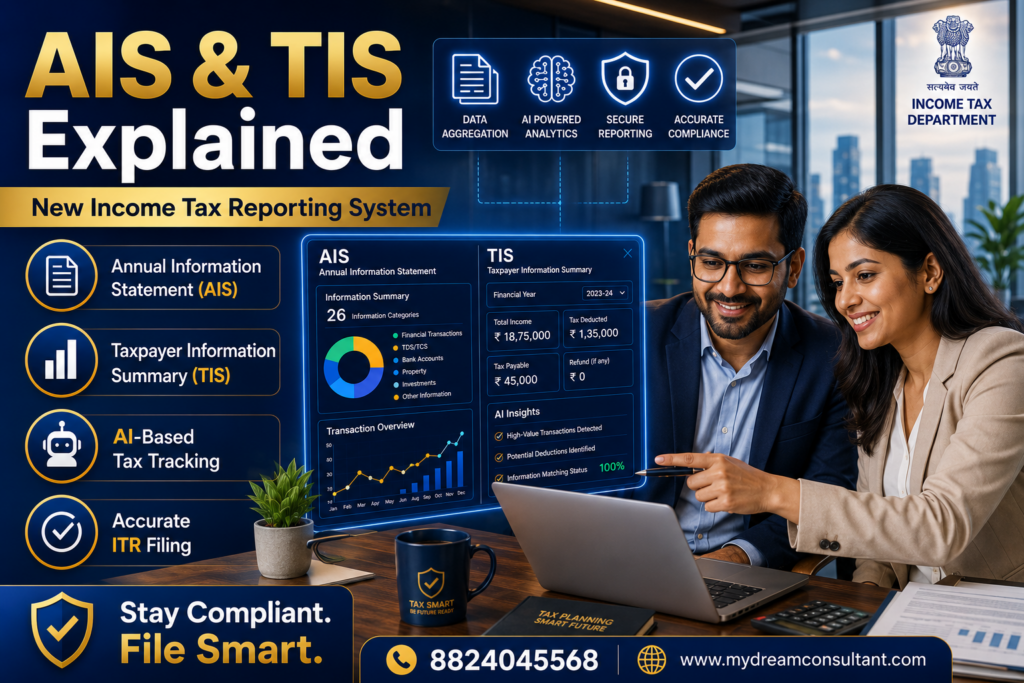
Introduction The Income Tax Department has become increasingly technology-driven in recent years. With the introduction of Artificial Intelligence (AI), data analytics, and digital reporting systems, taxpayers are now expected to disclose their income more accurately than ever before. One of the most important developments in this transformation is the introduction of the Annual Information Statement (AIS) and Taxpayer Information Summary (TIS). Many taxpayers are hearing these terms for the first time and often wonder: What is AIS? What is TIS? Why are they important? Can AIS help the Income Tax Department track my transactions? What happens if my ITR does not match AIS? If you are planning for ITR Filing in Jaipur, searching for Income Tax Consultants, or looking for the Best CA in Jaipur, understanding AIS and TIS is essential for accurate tax compliance. In this guide, we will explain AIS and TIS in simple language with practical examples. What is AIS? AIS stands for Annual Information Statement. It is a comprehensive statement provided by the Income Tax Department that contains details of various financial transactions associated with your PAN. The purpose of AIS is to give taxpayers complete visibility of information available with the Income Tax Department before filing Income Tax Returns. Think of AIS as a financial report card that shows the department what it already knows about your income and transactions. Start Your Company In Just A Click —-! Click Here !—- What Information Does AIS Contain? AIS may contain details such as: Salary Income Salary reported by employers. Bank Interest Interest earned from: Savings accounts Fixed Deposits (FDs) Recurring Deposits Dividend Income Dividends received from shares and mutual funds. Share Market Transactions Information relating to: Purchase of shares Sale of shares Capital gains transactions Mutual Fund Investments Purchase and redemption of mutual fund units. Property Transactions Sale and purchase of immovable property. TDS and TCS Details Tax Deducted at Source and Tax Collected at Source. Foreign Remittances Certain international transactions and remittances. High-Value Transactions Significant financial activities reported by banks and financial institutions. What is TIS? TIS stands for Taxpayer Information Summary. It is a summarized version of AIS. While AIS provides detailed transaction-level information, TIS provides a simplified summary that taxpayers can use while preparing their Income Tax Return. In simple words: AIS = Detailed Financial Data TIS = Simplified Tax Summary Difference Between AIS and TIS AIS TIS Detailed transaction report Summary of transactions Shows complete information Shows summarized values Helps verify financial records Helps in ITR filing Includes transaction-wise details Includes category-wise totals Both are important and should be reviewed before filing your return. Why AIS and TIS Were Introduced The Income Tax Department introduced these systems to: Improve transparency Reduce tax evasion Minimize reporting errors Simplify return filing Increase voluntary compliance Today, advanced AI systems can compare your ITR with AIS data and identify mismatches instantly. Real-Life Example 1: Unreported FD Interest Rohit earns salary income and also has several Fixed Deposits. While filing his return, he reports salary income but forgets to include FD interest. However, the bank has already reported the interest income to the Income Tax Department. The FD interest appears in AIS. As a result, a mismatch occurs and Rohit may receive a communication from the department. This is why reviewing AIS before filing is extremely important. How AIS Helps Taxpayers Many people assume AIS only helps the Income Tax Department. In reality, it also benefits taxpayers. Advantages include: Better Accuracy Helps ensure all income sources are reported. Fewer Notices Reduces chances of mismatches and scrutiny. Easier Tax Filing Provides a ready reference for income details. Improved Compliance Makes tax filing more transparent and accurate. Real-Life Example 2: Capital Gains Reporting Priya invested in shares and mutual funds. During the year, she sold several investments and earned profits. While preparing her ITR, she checked AIS and found all major transactions reflected there. This helped her calculate capital gains accurately and avoid reporting mistakes. What Happens if AIS and ITR Do Not Match? A mismatch does not automatically mean a penalty. However, it may lead to: Clarification requests Tax notices Additional verification Delayed refund processing Common mismatch situations include: Unreported interest income Missing capital gains Incorrect dividend reporting Property transaction discrepancies This is one reason many taxpayers seek assistance from the Top CA in Jaipur and experienced Income Tax Consultants. Can AIS Track Your Transactions? To a significant extent, yes. Various institutions report information to the Income Tax Department, including: Banks Employers Mutual fund houses Stock brokers Property registrars Financial institutions This information may eventually appear in AIS. Therefore, taxpayers should ensure that all income and transactions are reported accurately. Real-Life Example 3: Property Sale Amit sold a property during the financial year. The transaction was reported through property registration records. When he checked AIS, the property transaction was already reflected. This reminded him to calculate and report capital gains correctly while filing his return. How to Check AIS and TIS Taxpayers can access AIS and TIS through the Income Tax portal. Generally, the process involves: Logging into the Income Tax portal. Accessing the AIS section. Reviewing detailed financial information. Comparing the data with personal records. Using TIS while preparing ITR. If discrepancies are noticed, taxpayers can provide feedback through the portal. Common Mistakes Taxpayers Make Ignoring AIS Completely Many people file returns without reviewing AIS. Not Reporting Interest Income Savings and FD interest are commonly missed. Ignoring Dividend Income Dividend income should be disclosed properly. Wrong Capital Gains Reporting Investors often make errors in gain calculations. Depending Solely on Form 16 Form 16 may not include all income sources. Why Professional Assistance Is Helpful AIS can contain a large amount of financial data. Many taxpayers find it difficult to understand: Capital gains reporting Mutual fund taxation Foreign income disclosures Property transactions Business income reporting Professional guidance helps ensure accurate reporting. This is why many people search for: Best CA in Jaipur Top CA in Jaipur ITR Filing in Jaipur Income Tax Consultants ITR Filing Near Me