
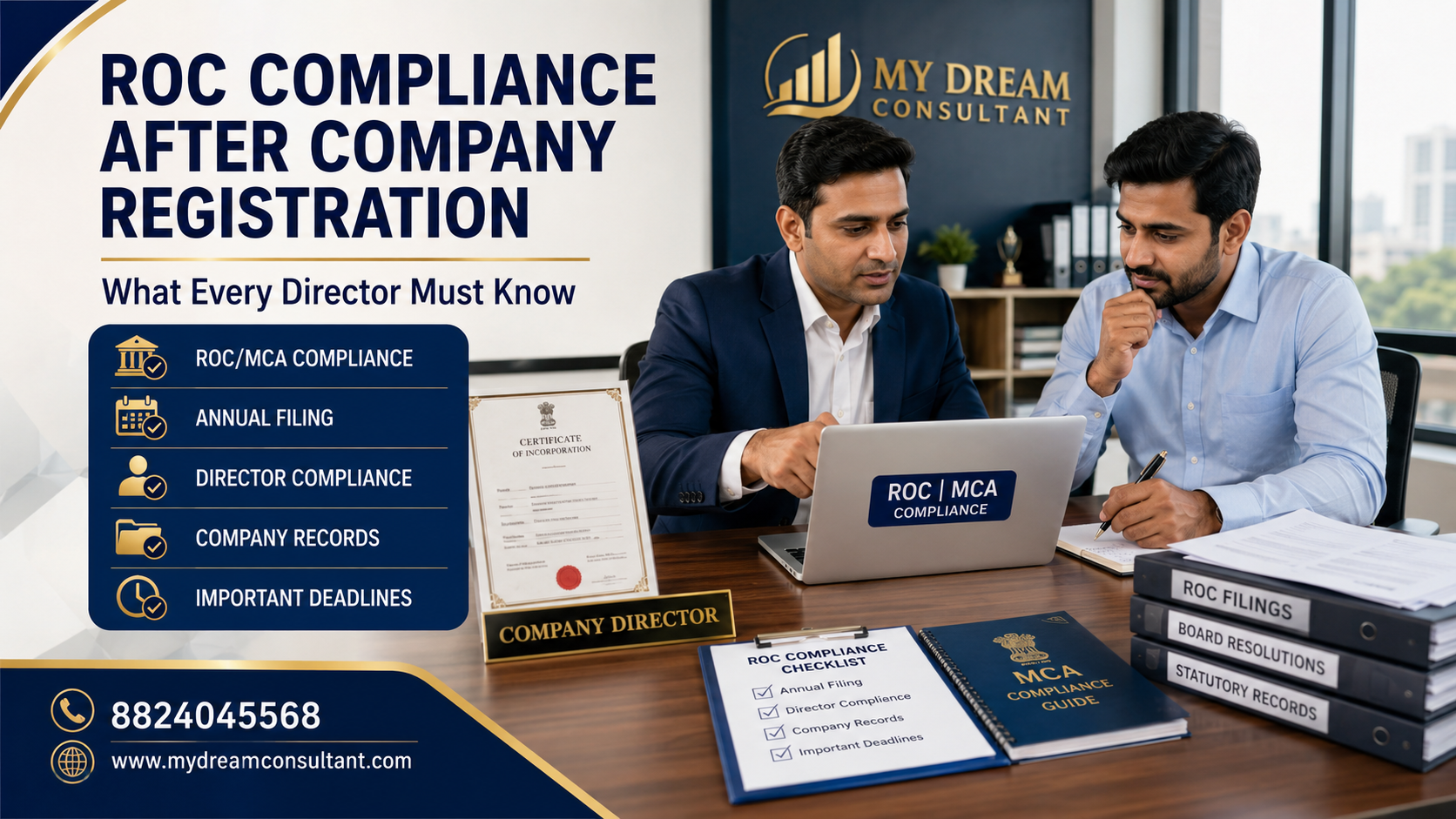
Registering a company is only the beginning of your business journey. Once a company is incorporated, its directors also take responsibility for keeping the company compliant with applicable corporate laws.
Many new business owners focus on registration but overlook what comes next. ROC compliance, accounting records, annual filings, board meetings, statutory registers, tax filings and other applicable compliances need regular attention.
This guide explains the basics in simple language so that directors can understand what they should track after company registration.
SEO Information
SEO Title: ROC Compliance After Company Registration: Guide
Meta Title: ROC Compliance After Company Registration | Director Guide
Meta Description: Learn ROC compliance after company registration, including annual filings, documents, timelines, director duties and practical tips for Indian companies.
URL Slug: roc-compliance-after-company-registration

Focus Keyword: ROC Compliance After Company Registration
Secondary Keywords
- ROC Annual Compliance
- MCA Compliance
- Company Compliance
- ROC Filing
- Annual ROC Filing
- Private Limited Company Compliance
- MCA Annual Filing
- Company Annual Return
- AOC-4 Filing
- MGT-7 Filing
- MGT-7A Filing
- DIR-3 KYC
- Company Compliance Services
- ROC Compliance Jaipur
Long-Tail Keywords
- ROC compliance after company registration
- ROC annual compliance for private limited company
- annual compliance requirements for private limited company
- what compliance is required after company registration
- ROC filing requirements for newly incorporated company
- company annual compliance in India
ROC Compliance After Company Registration – What Every Director Must Know
Introduction
Getting a Certificate of Incorporation can feel like the finish line. In reality, it is the beginning of your company’s compliance journey.
After incorporation, directors need to ensure that the company maintains proper books and records, completes applicable statutory filings, follows meeting requirements and keeps its information updated with the Ministry of Corporate Affairs (MCA).
The exact requirements depend on the company’s type, size, activities and applicable exemptions. Therefore, directors should not assume that every company has exactly the same compliance checklist.
If you have recently completed Private Limited Company Registration, understanding your ongoing obligations can help you avoid missed filings and unnecessary compliance problems.
Why ROC Compliance Matters
ROC compliance is important because a registered company is expected to continue meeting its legal and reporting obligations after incorporation.
Regular compliance helps you:
- Keep the company’s MCA records updated
- Maintain proper corporate records
- Avoid unnecessary additional fees and penalties
- Support smooth banking and financial processes
- Maintain credibility with investors and business partners
- Keep directors informed about the company’s statutory position
- Make future changes, funding or restructuring easier
The Companies Act requires companies to maintain books of account and relevant records.
What Is ROC Compliance?
ROC compliance refers broadly to filings, records, returns and other statutory requirements that a company must complete with the Registrar of Companies (ROC) under the Companies Act and applicable rules.
Some requirements are annual, while others arise because of specific events or transactions.
For example, a company may have to deal with:
- Annual financial statement filing
- Annual return filing
- Director-related filings
- Auditor-related filings
- Registered office changes
- Changes in directors
- Changes in share capital
- Charges created with lenders
- Certain resolutions and agreements
- Other event-based MCA filings
The applicable forms and requirements can change, so the current MCA requirements should always be checked before filing.
Important ROC Compliance Requirements
- Maintain Proper Books of Account
A company must maintain proper books of account and relevant records as required under the Companies Act.
These records help directors understand the company’s financial position and also form the foundation for financial statements and statutory reporting.
The Companies Act specifically requires companies to maintain books of account and relevant papers and provides for their preservation.
- Prepare Financial Statements
At the end of the financial year, the company needs to prepare its financial statements in accordance with applicable requirements.
Depending on the company, these may include:
- Balance Sheet
- Statement of Profit and Loss
- Cash Flow Statement, where applicable
- Notes to accounts
- Other required statements
The financial statements must comply with applicable accounting and legal requirements.
- File Financial Statements with ROC
Companies generally file their financial statements with the ROC through the applicable MCA form, such as AOC-4 or another applicable version/form.
The MCA identifies AOC-4 as the form for filing financial statements and related documents with the Registrar.
The exact form depends on the company’s circumstances.
- File the Annual Return
Companies are also required to file their annual return in the applicable form.
Depending on the company’s classification, this may include MGT-7 or MGT-7A, as applicable.
Annual return information can include details relating to the company’s registered office, shareholding, directors, members and other prescribed information.
- Complete Director-Related Compliance
Directors should keep their MCA records updated.
For example, DIR-3 KYC requirements may apply to directors and should be monitored according to the applicable rules and MCA requirements.
Directors should also ensure that changes in directorship or other prescribed particulars are reported within the applicable time.
What About the First Year of a New Company?
A newly incorporated company should not assume that it has no compliance obligations simply because it has not started generating revenue.
Depending on the incorporation date and circumstances, the company may still need to:
- Maintain accounting records
- Complete applicable auditor-related requirements
- Hold required meetings
- Maintain statutory registers
- Prepare financial statements
- Complete applicable annual filings
- Meet tax and other regulatory requirements
No business activity does not automatically mean no compliance.
This is one of the most common misunderstandings among first-time entrepreneurs.
ROC Compliance Calendar – What Directors Should Track
| Compliance Area | Typical Nature |
| Books of Account | Ongoing |
| Board Meetings | As applicable |
| Statutory Registers | Ongoing |
| Financial Statements | Annual |
| ROC Financial Statement Filing | Annual |
| Annual Return | Annual |
| Director KYC | As applicable |
| Auditor-related filings | As applicable |
| Change in Directors | Event-based |
| Change in Registered Office | Event-based |
| Share Capital Changes | Event-based |
| Charge-related filings | Event-based |
Important: The exact due dates and applicability depend on the company and the relevant provisions. Directors should verify the current MCA requirements rather than relying on a generic calendar.
ROC Compliance vs GST Compliance
These two are often confused.
ROC/MCA compliance primarily relates to the company’s corporate and statutory obligations under company law.
GST compliance relates to Goods and Services Tax and may include registration, returns, invoices, payments and other GST requirements where applicable.
A company may therefore have both ROC compliance and GST compliance.
They should be managed separately but coordinated as part of the company’s overall compliance system.
Documents and Records You Should Maintain
A company should maintain appropriate corporate and financial records, which may include:
- Certificate of Incorporation
- MOA and AOA
- PAN and TAN
- Board meeting records
- General meeting records
- Statutory registers
- Share certificates
- Accounting records
- Bank statements
- Invoices and supporting documents
- Financial statements
- Tax records
- ROC filing acknowledgements
Maintaining these records properly makes future compliance much easier.
Government Fees and Professional Fees
ROC filing costs can include applicable government filing fees and additional fees for delayed filings, depending on the form and circumstances.
Professional fees are separate and vary according to:
- Company type
- Number of filings
- Transactions during the year
- Complexity of the company’s affairs
- Additional compliance requirements
- Whether there are pending or delayed filings
There is no single ROC compliance fee that applies to every company.
How Much Time Does ROC Compliance Take?
There is no fixed timeline for all ROC compliance because different filings have different statutory due dates.
For annual compliance, directors should ideally begin preparing well before the deadline.
A good internal system is:
Books updated → Accounts prepared → Audit, where applicable → Board approval → AGM, where applicable → ROC filing
Keeping everything until the last week can increase the risk of errors and delays.
Common ROC Compliance Mistakes
- Treating registration as the end of compliance
Incorporation is only the beginning.
- Missing annual filing deadlines
Delayed filings can result in additional fees and other consequences.
- Ignoring a dormant or inactive company
A company does not automatically become free from compliance simply because it has little or no business activity.
- Not maintaining statutory records
Corporate records should be maintained properly throughout the year.
- Forgetting director KYC requirements
Directors should monitor applicable KYC requirements and deadlines.
- Filing incorrect information
Incorrect corporate information can create problems during future filings or transactions.
- Mixing ROC and tax compliance
MCA filings, income tax and GST are different compliance areas.
Practical Tips for Directors
A simple compliance system can make a major difference.
Keep a Compliance Calendar
Record every applicable deadline in one place.
Maintain Monthly Accounts
Don’t wait until March to organize the year’s accounting records.
Keep MCA Details Updated
Changes in directors, registered office, share capital and other prescribed information may require timely filings.
Keep Documents Organized
Create separate folders for:
- MCA
- GST
- Income Tax
- Accounting
- Banking
- Contracts
- Licences
Take Professional Advice When Needed
If your company has investors, loans, foreign transactions, related-party transactions or complex structures, professional compliance advice becomes even more important.
Real-Life Example
Consider a newly incorporated technology company in Jaipur.
The founders successfully completed Private Limited Company Registration and immediately focused on getting clients. Six months later, they realized that several corporate records and compliance tasks had not been properly tracked.
The problem was not the company registration itself. The issue was the absence of a post-incorporation compliance system.
A simple compliance calendar, regular bookkeeping and professional review could have helped them stay organized from the beginning.
The lesson: Don’t wait for the first compliance deadline to think about compliance.
Latest Legal Updates
Corporate compliance requirements in India can change through amendments, rules, MCA notifications, circulars and changes to electronic filing requirements.
For example, MCA’s filing ecosystem includes forms such as AOC-4, MGT-7/MGT-7A, DIR-12, DPT-3 and other event-based filings.
Therefore, directors should check the current MCA requirements applicable to their company rather than relying on an old compliance checklist.
Frequently Asked Questions
- What is ROC compliance?
ROC compliance refers to applicable statutory filings, records and reporting requirements that companies must meet with the Registrar of Companies.
- Is ROC compliance mandatory after company registration?
Applicable ROC compliance generally continues after incorporation. The exact requirements depend on the company’s type and circumstances.
- What is AOC-4?
AOC-4 is used for filing a company’s financial statements and related documents with the ROC, subject to the applicable requirements.
- What is MGT-7?
MGT-7 is an annual return form used by companies where applicable. Certain companies may use MGT-7A instead, depending on the applicable classification.
- Do small companies have ROC compliance?
Yes. Small companies may have different or reduced requirements in certain areas, but they should still identify and complete their applicable statutory compliances.
- Does a company with no business need annual compliance?
Not necessarily. Lack of business activity does not by itself remove all statutory obligations.
- Is GST filing the same as ROC filing?
No. GST compliance and ROC compliance are separate regulatory obligations.
- What happens if ROC filings are delayed?
Delayed filings may attract additional fees and, depending on the nature of the default, other consequences under applicable law.
- Can a director manage ROC compliance without professional help?
Some businesses may manage routine compliance internally, but professional assistance can be useful where filings are complex or the company has multiple statutory obligations.
- How can I check my company’s ROC compliance status?
Company information and certain filing details can be accessed through the MCA’s online services. A professional can also review the company’s compliance position and identify pending requirements.
Key Takeaways
- Company registration is only the first step.
- ROC compliance continues after incorporation.
- Financial statements and annual returns are important parts of annual compliance.
- Director-related requirements should also be monitored.
- Event-based changes can trigger additional MCA filings.
- GST and income-tax compliance are separate from ROC compliance.
- Maintaining proper records throughout the year makes compliance easier.
- Always verify current MCA requirements before filing.
Conclusion
ROC compliance after company registration is not something directors should leave until the last minute.
A company may start small, but its statutory responsibilities still need attention. Regular accounting, proper documentation, timely filings and a clear compliance calendar can help directors manage these responsibilities more effectively.
If you have recently completed Company Registration in Jaipur or anywhere in India, setting up a proper compliance system from the beginning can save you considerable time and trouble later.
#ROCCompliance
#ROCAnnualCompliance
#MCACompliance
#CompanyCompliance
#ROCComplianceIndia
#PrivateLimitedCompany
#PrivateLimitedCompanyCompliance
#CompanyRegistration
#MyDreamConsultant