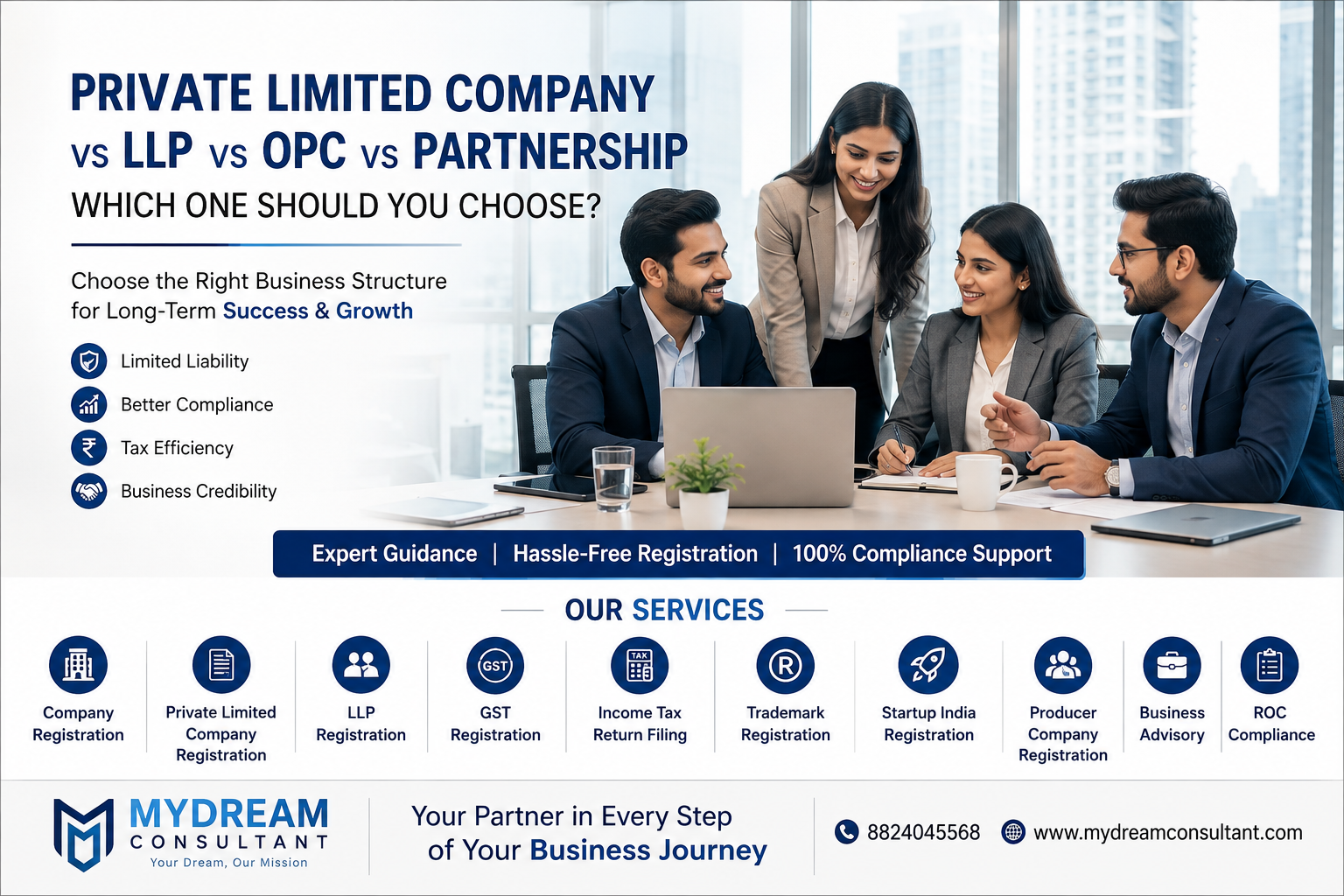
Starting a business is an exciting journey, but before you begin, you need to answer one important question:
Which business structure is right for you?
Many entrepreneurs are confused about whether they should register a Private Limited Company, LLP (Limited Liability Partnership), One Person Company (OPC), or Partnership Firm. Each business structure has different legal requirements, tax implications, compliance responsibilities, and growth opportunities.
In this guide, we’ll help you understand the key differences so you can make an informed decision.

Why Choosing the Right Business Structure Matters
Your business structure affects:
- Legal liability
- Taxation
- Investment opportunities
- Annual compliance
- Business credibility
- Future expansion
Choosing the wrong structure today may lead to unnecessary costs and compliance issues later.
- Private Limited Company
A Private Limited Company is one of the most preferred business structures for startups and growing businesses.
Best For:
- Technology startups
- Manufacturing businesses
- E-commerce companies
- Businesses planning to raise investment
Advantages
- Limited liability protection
- Separate legal identity
- Better credibility
- Easy to attract investors
- Business continuity
Limitations
- Higher compliance requirements
- Annual ROC filings are mandatory
Start Your Company In Just A Click
—-! Click Here !—-
- Limited Liability Partnership (LLP)
An LLP combines the flexibility of a partnership with the benefit of limited liability.
Best For:
- Professionals
- Consultants
- Service providers
- Small and medium businesses
Advantages
- Limited liability
- Fewer compliance requirements
- Easy management
- Cost-effective
Limitations
- Difficult to raise equity investment
- Less preferred by venture capital investors
- One Person Company (OPC)
An OPC is designed for solo entrepreneurs who want the benefits of a company without having multiple shareholders.
Best For:
- Freelancers
- Individual entrepreneurs
- Small startups
Advantages
- Single owner
- Limited liability
- Separate legal identity
- Professional image
Limitations
- Suitable mainly for single promoters
- Compliance requirements similar to a company
- Partnership Firm
A Partnership Firm is one of the oldest and simplest forms of business in India.
Best For:
- Family businesses
- Local trading businesses
- Small enterprises
Advantages
- Easy to start
- Low registration cost
- Simple management
Limitations
- Unlimited liability
- Limited funding opportunities
- Lower business credibility
Quick Comparison
| Feature | Pvt Ltd | LLP | OPC | Partnership |
| Separate Legal Entity | ✔ | ✔ | ✔ | ✘ |
| Limited Liability | ✔ | ✔ | ✔ | ✘ |
| Investors Preferred | ✔ | Limited | Limited | ✘ |
| Compliance | High | Medium | Medium | Low |
| Best For | Startups | Professionals | Solo Founder | Small Business |
How to Choose the Right Business Structure
Choose a Private Limited Company if you want to scale your business and attract investors.
Choose an LLP if you’re running a consultancy, professional practice, or service-based business.
Choose an OPC if you’re starting alone and want limited liability.
Choose a Partnership Firm if you are running a small family or local business with minimal compliance needs.
Common Mistakes to Avoid
- Choosing a structure only because it’s cheaper.
- Ignoring future funding plans.
- Not considering annual compliance costs.
- Registering without professional advice.
- Delaying GST or other mandatory registrations.
Real-Life Example
Rahul and Priya planned to start a software company in Jaipur. Initially, they considered registering a Partnership Firm because it was simple and affordable. After consulting professionals, they realized they wanted to seek investor funding in the future. They chose a Private Limited Company, which helped them build credibility with clients and investors while supporting their long-term growth plans.
This example shows why selecting the right business structure at the beginning can save time, money, and future complications.
Frequently Asked Questions
Which is better: LLP or Private Limited Company?
A Private Limited Company is generally better for businesses planning to raise investment, while an LLP is suitable for professional and service-based businesses.
Can one person register a company?
Yes. A One Person Company (OPC) allows a single entrepreneur to register a company.
Which business structure has the least compliance?
A Partnership Firm generally has the lowest compliance requirements.
Is GST registration compulsory?
GST registration depends on your turnover and business activities. It is not mandatory in every case.
Can I convert an LLP into a Private Limited Company later?
Yes, subject to the applicable legal provisions and procedures.
Conclusion
There is no single business structure that suits every entrepreneur. The right choice depends on your business goals, investment plans, ownership structure, compliance preferences, and future expansion strategy.
If you’re unsure which option is best for your business, it’s always wise to seek professional advice before registering your entity.
Need Help with Company Registration?
At My Dream Consultant, we provide end-to-end assistance for:
- Company Registration in Jaipur
- Private Limited Company Registration
- LLP Registration
- OPC Registration
- Partnership Firm Registration
- Startup India Registration
- GST Registration
- Trademark Registration
- ROC Annual Compliance
- FSSAI License
- MSME Registration
Our team helps you choose the right business structure and complete the registration process smoothly so you can focus on growing your business.
Contact My Dream Consultant today and take the first step toward building your business with confidence.