
Introduction
Have you ever wondered how the Income Tax Department knows about your bank interest, stock market investments, mutual fund transactions, property purchases, or high-value financial activities?
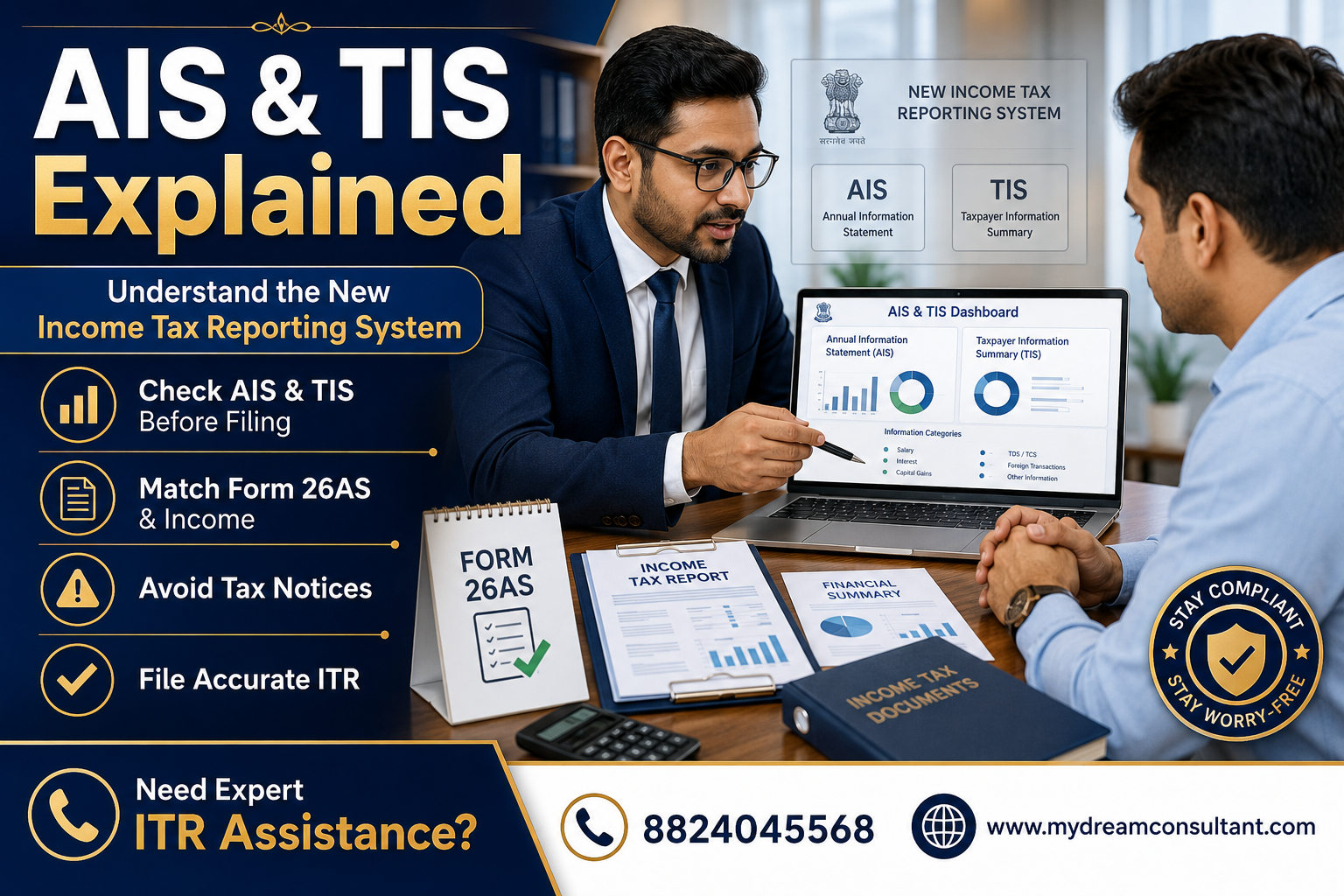
The answer lies in the Annual Information Statement (AIS) and Taxpayer Information Summary (TIS)—two powerful tools introduced by the Income Tax Department to improve transparency and make tax filing more accurate.
Many taxpayers still rely only on Form 16 or Form 26AS while filing their Income Tax Return (ITR). However, with the introduction of AIS and TIS, taxpayers now have access to a much more detailed record of their financial transactions. Ignoring these reports while filing your ITR can lead to income mismatches, delayed refunds, or even Income Tax notices.
Whether you are a salaried employee, business owner, freelancer, investor, or professional, understanding AIS and TIS has become essential for accurate tax compliance.
This is why many taxpayers prefer taking guidance from experienced Income Tax Consultants, the Top CA in Jaipur, or the Best CA in Jaipur for accurate ITR Filing in Jaipur and hassle-free tax compliance.
In this blog, we’ll explain AIS and TIS in simple language, their differences, why they matter, and how they help you file an accurate Income Tax Return.

What is AIS (Annual Information Statement)?
The Annual Information Statement (AIS) is a detailed statement available on the Income Tax e-Filing Portal.
It contains information about your financial transactions reported by various organizations during the financial year.
AIS provides a comprehensive view of your financial activities beyond just TDS information.
It may include details related to:
- Salary Income
- Interest from Savings Accounts
- Fixed Deposit Interest
- Dividend Income
- Mutual Fund Transactions
- Share Market Transactions
- Property Purchase & Sale
- Rent Received
- Foreign Income (where applicable)
- Tax Deducted at Source (TDS)
- Tax Collected at Source (TCS)
- High-Value Financial Transactions
- Refund Information
AIS helps taxpayers verify whether all income has been reported correctly while filing their ITR.
Start Your Company In Just A Click
—-! Click Here !—-
What is TIS (Taxpayer Information Summary)?
The Taxpayer Information Summary (TIS) is a simplified version of AIS.
Instead of showing every transaction in detail, TIS provides summarized values of your income and financial information.
It is mainly used by taxpayers to estimate their taxable income before filing their return.
TIS helps reduce confusion by presenting consolidated information in an easy-to-understand format.
Difference Between AIS and TIS
| AIS | TIS |
| Detailed financial information | Summarized financial information |
| Shows individual transactions | Shows consolidated figures |
| Helps verify reported transactions | Helps calculate taxable income |
| Useful for reconciliation | Useful for tax planning |
| More comprehensive | Easier to understand |
Both reports complement each other and should be reviewed before filing your Income Tax Return.
Why Are AIS and TIS Important?
The Income Tax Department uses advanced technology and Artificial Intelligence (AI) to compare the information available in AIS and TIS with the Income Tax Return filed by taxpayers.
If there is any mismatch, the department may issue a notice asking for clarification.
Checking these statements before filing your ITR helps you:
- Report accurate income
- Claim correct TDS credit
- Avoid tax notices
- Receive faster refunds
- Maintain proper tax compliance
Real-Life Example 1
Rahul is a salaried employee.
He filed his Income Tax Return using only Form 16 provided by his employer.
Later, he received an Income Tax notice because he forgot to include Fixed Deposit interest reflected in his AIS.
If he had checked AIS before filing, he could have avoided the notice.
Information Available in AIS
AIS contains information from multiple reporting sources.
Some common entries include:
Salary
Salary reported by your employer.
Bank Interest
Interest earned on savings accounts and fixed deposits.
Dividend Income
Dividends received from shares or mutual funds.
Capital Gains
Transactions related to shares and mutual funds.
Property Transactions
Purchase or sale of immovable property.
Foreign Remittances
Certain foreign transactions wherever applicable.
Tax Payments
Advance tax, self-assessment tax, TDS, and TCS.
Information Available in TIS
TIS generally summarizes:
- Salary
- Interest Income
- Dividend Income
- Capital Gains
- Business Income
- Rental Income
- Foreign Income
- Taxes Paid
- Refund Details
It provides estimated values that can be used while preparing the Income Tax Return.
How to Access AIS and TIS
Taxpayers can access both reports through the Income Tax e-Filing Portal after logging into their account.
Before filing your ITR, download and review these statements carefully.
Real-Life Example 2
Priya invested in mutual funds during the financial year.
She redeemed a few units and earned capital gains.
Since she forgot about the transaction, she initially excluded it while preparing her ITR.
Fortunately, she reviewed her AIS before filing and noticed the reported transaction.
She updated her return accordingly and avoided future complications.
Common Mistakes Taxpayers Make
Ignoring AIS
Many taxpayers never check AIS before filing.
This increases the risk of missing income.
Reporting Only Form 16 Income
Salary is not always your only income.
Interest, dividends, and investments should also be reported.
Missing Capital Gains
Many investors forget to disclose gains from shares and mutual funds.
Incorrect TDS Claims
Always verify TDS with AIS, TIS, and Form 26AS.
Ignoring High-Value Transactions
Large financial transactions appearing in AIS should not be ignored.
Benefits of Reviewing AIS and TIS Before Filing ITR
Reviewing these reports helps you:
- Avoid Income Tax notices
- Identify missing income
- Verify TDS credits
- Reduce filing errors
- Receive refunds faster
- Improve tax accuracy
- Maintain complete compliance
Real-Life Example 3
Amit runs a consulting business.
He receives payments from multiple clients.
One client deducted TDS but forgot to provide the certificate immediately.
While reviewing AIS, Amit noticed the TDS entry and claimed the credit correctly while filing his ITR.
Without checking AIS, he could have missed the tax credit.
AIS vs Form 26AS
Many taxpayers think AIS has replaced Form 26AS.
This is incorrect.
Form 26AS mainly contains:
- TDS
- TCS
- Advance Tax
- Self-Assessment Tax
AIS provides much more information, including:
- Investments
- Interest
- Dividends
- Property Transactions
- Foreign Income
- High-Value Transactions
Both reports should be reviewed together before filing your return.
How Professional Tax Consultants Help
Understanding AIS and TIS can sometimes be confusing, especially when multiple income sources are involved.
Professional tax consultants can help you:
- Review AIS and TIS
- Match transactions
- Identify missing income
- Correct reporting errors
- Select the correct ITR form
- Claim eligible deductions
- Maximize TDS credits
- Avoid Income Tax notices
This is why many taxpayers search online for:
- Top CA in Jaipur
- Best CA in Jaipur
- ITR Filing in Jaipur
- Income Tax Consultants
- ITR Filing Near Me
Professional guidance ensures your return is accurate and fully compliant.
Conclusion
AIS and TIS have transformed the way taxpayers file Income Tax Returns in India. They provide a clear picture of your financial transactions and help you report your income accurately.
Before filing your ITR, always review your AIS, TIS, and Form 26AS to ensure that all income, investments, and taxes are correctly reflected. A few extra minutes spent reviewing these statements can help you avoid notices, penalties, and unnecessary stress.
If you are looking for the Best CA in Jaipur, Top CA in Jaipur, trusted Income Tax Consultants, or expert assistance with ITR Filing in Jaipur, professional guidance can make your tax filing simple, accurate, and hassle-free.
Remember, accurate reporting today ensures peace of mind tomorrow.
Frequently Asked Questions (FAQs)
- What is AIS?
AIS (Annual Information Statement) is a detailed report showing your financial transactions and income reported to the Income Tax Department.
- What is TIS?
TIS (Taxpayer Information Summary) is a summarized version of AIS that provides consolidated income figures for easier tax filing.
- Is checking AIS mandatory before filing an ITR?
While not legally mandatory, reviewing AIS is highly recommended to ensure your ITR matches the information available with the Income Tax Department.
- Can AIS help me avoid Income Tax notices?
Yes. Reviewing AIS helps identify missing income and mismatches before filing your return.
- Is AIS the same as Form 26AS?
No. Form 26AS mainly contains TDS, TCS, and tax payment details, while AIS includes a broader range of financial information.
- Can I report errors found in AIS?
Yes. The Income Tax portal allows taxpayers to submit feedback if they believe certain information in AIS is incorrect.
- Why should I compare AIS, TIS, and Form 26AS before filing?
Comparing all three helps ensure accurate income reporting, correct tax credit claims, and reduces the risk of notices.
- Should I consult a tax professional for AIS and TIS reconciliation?
Yes. If you have multiple income sources, investments, or business income, an experienced tax consultant can help reconcile your records and file an accurate Income Tax Return.
#IncomeTaxIndia
#IncomeTax
#ITRFiling
#IncomeTaxReturn
#AIS
#TIS
#IncomeTaxConsultants
#TaxConsultant
#TaxAdvisor
#CAinJaipur
#BestCAinJaipur
#TopCAinJaipur