
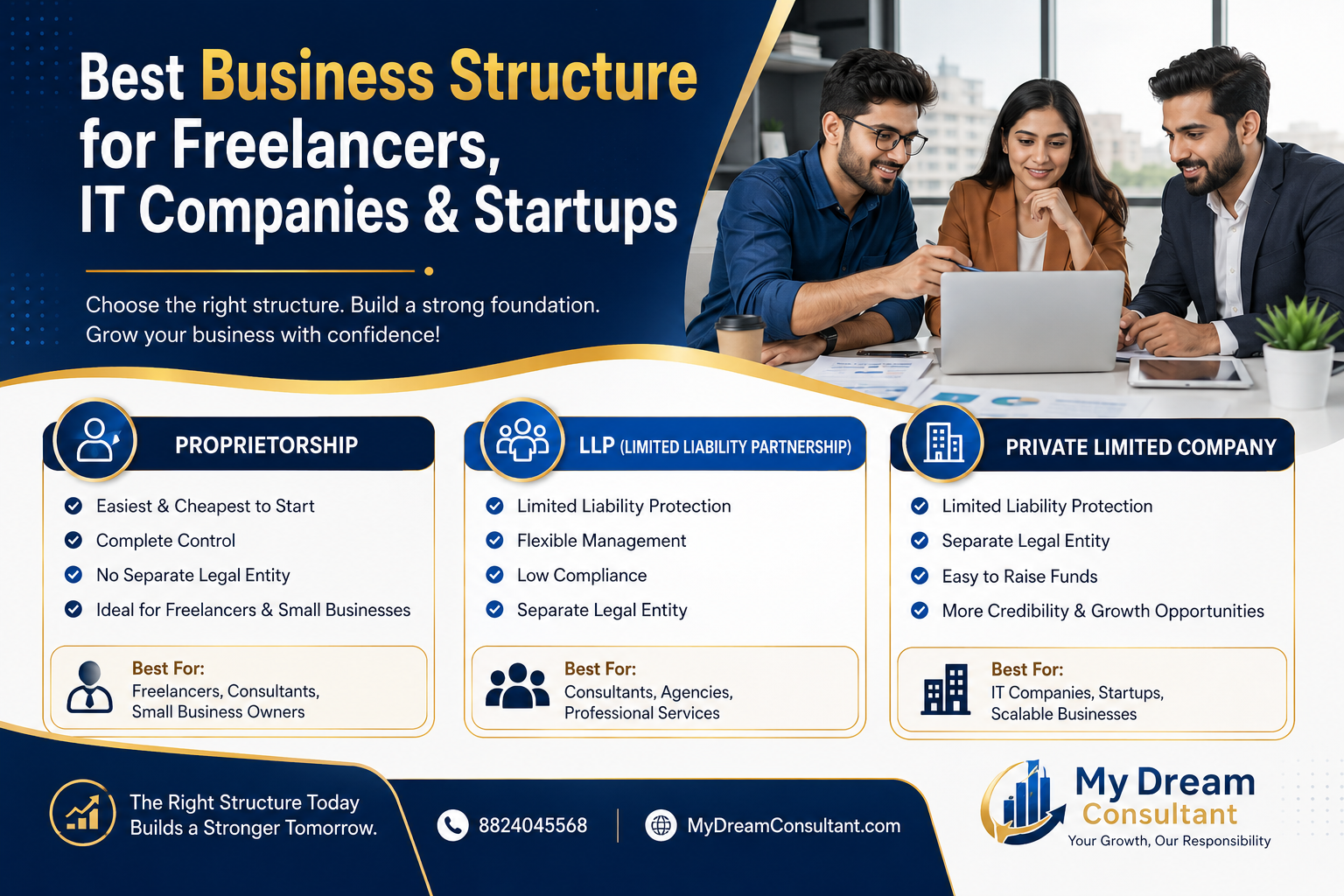
Starting a business is exciting, but one decision can have a long-term impact on your finances, compliance, liability, and growth: choosing the right business structure.
A freelancer working alone may not need the same structure as a technology startup planning to raise investment. Similarly, two IT professionals starting together may find an LLP more suitable than operating as an informal partnership.
So, what is the best business structure for freelancers, IT companies and startups in India?
The answer depends on your number of founders, business activity, investment plans, liability concerns, taxation, compliance requirements and future growth plans.
In this guide, let’s understand the major options in simple language.

Why Choosing the Right Business Structure Matters
Many entrepreneurs focus on getting their business started quickly and think about the structure later. This can create unnecessary complications.
Your business structure can affect:
- Ownership and decision-making
- Personal liability
- Tax and accounting requirements
- Business credibility
- Ability to raise funds
- Investor participation
- Compliance requirements
- Banking and contracts
- Future expansion
For example, a freelancer earning income from professional services may prefer a simpler structure, while a startup looking for investors may need a structure that can accommodate multiple shareholders.
The right structure should match both your current business and your future plans.
Main Business Structures in India
For freelancers, IT companies and startups, the commonly considered structures include:
- Sole Proprietorship
- Partnership Firm
- Limited Liability Partnership (LLP)
- One Person Company (OPC)
- Private Limited Company
Each has its own advantages and limitations.
1. Sole Proprietorship – Simple Option for Freelancers
If you are working alone as a freelancer, consultant, designer, developer, content creator or independent professional, a sole proprietorship may be one of the simplest ways to start.
There is no separate company entity in a traditional proprietorship. The business and owner are closely connected.
Suitable for:
- Freelancers
- Individual consultants
- Independent professionals
- Small service providers
- Home-based businesses
- Small-scale entrepreneurs
Advantages
- Simple setup
- Relatively fewer formalities
- Direct control over the business
- Suitable for small operations
Limitations
The proprietor generally has unlimited personal liability for business obligations. It may also be less suitable when you want to bring in equity investors or create a more formal corporate structure.
Example
Suppose Rahul is a freelance web developer in Jaipur. He works with several clients and does not have any partners or employees. His business is relatively small and he wants to keep administration simple.
A proprietorship could be an option for him to consider.
However, if Rahul plans to build a technology company and raise funding in the future, he should evaluate whether another structure would be more appropriate.
2. Partnership Firm – For Two or More People
If two or more people want to start a business together, they can consider a partnership firm, subject to applicable law.
It can be useful for businesses where the partners want to share:
- Investment
- Profits
- Responsibilities
- Business decisions
Suitable for:
- Small businesses
- Family businesses
- Professional ventures
- Businesses with a small number of partners
However, traditional partnerships generally do not provide the same limited-liability framework as an LLP.
This is an important consideration when business risk is significant.
3. LLP – A Flexible Option for Professional Businesses
A Limited Liability Partnership (LLP) combines elements of partnership-style management with limited liability.
An LLP can be considered by businesses where two or more partners want to work together while maintaining a more formal structure.
Suitable for:
- IT service companies
- Consulting firms
- Professional firms
- Agencies
- Small businesses with multiple founders
- Businesses where partners actively manage operations
Key advantages
- Separate legal identity
- Limited liability, subject to applicable law
- Partnership-style flexibility
- Suitable for multiple partners
- Generally less complex than a private company in some respects
Example
Imagine two software developers and one UI/UX designer decide to start an IT services business.
They want to share profits and responsibilities but don’t currently plan to raise venture capital.
An LLP could be one structure they evaluate.
However, if they plan to bring in multiple investors and issue equity shares, a Private Limited Company may be more suitable.
4. OPC – For a Solo Entrepreneur
An One Person Company (OPC) is designed around a single member and can be considered by certain entrepreneurs who want a corporate structure while operating individually.
It can be relevant for:
- Solo consultants
- Individual professionals
- Independent business owners
- Entrepreneurs who want a company structure
An OPC can provide a separate legal identity and limited-liability framework, subject to applicable law.
But there is an important point
If your business is expected to add co-founders, shareholders or investors, you should compare OPC with a Private Limited Company before incorporation.
Your business may start with one person today but look very different two or three years from now.
5. Private Limited Company – Popular for Growth-Oriented Startups
For startups and businesses with ambitious growth plans, a Private Limited Company is often one of the structures considered.
It can be particularly relevant when the founders want:
- Multiple shareholders
- Equity-based ownership
- External investment
- Structured management
- Long-term scalability
Suitable for:
- Technology startups
- IT companies
- SaaS businesses
- Product companies
- E-commerce businesses
- Businesses planning external funding
- Growth-oriented startups
Example
Consider three founders developing a SaaS product.
They expect to:
- Hire employees
- Acquire customers across India
- Raise angel investment
- Bring in institutional investors
- Expand internationally
In such a situation, a Private Limited Company may be worth considering because its corporate structure can accommodate multiple shareholders and equity investment.
Freelancers vs IT Companies vs Startups
Here’s a simple comparison:
| Business Type | Structure to Consider |
|---|---|
| Solo freelancer | Proprietorship / OPC |
| Independent consultant | Proprietorship / OPC |
| Two-person IT venture | LLP / Private Limited |
| Professional partnership | LLP |
| Small IT service business | LLP / Private Limited |
| Technology startup | Private Limited |
| Startup seeking investors | Private Limited |
| SaaS/product startup | Private Limited |
| Solo founder with corporate structure | OPC |
| High-growth startup | Private Limited |
This is only a starting point. The final choice should depend on the actual circumstances of the business.
LLP vs Private Limited Company
One of the most common questions from entrepreneurs is:
“Should I choose LLP or Private Limited Company?”
There is no universal answer.
LLP may be considered when:
- There are multiple active partners
- The business is professionally managed by partners
- External equity funding is not a major immediate goal
- Partners prefer a flexible management structure
Private Limited Company may be considered when:
- You plan to raise equity funding
- You want multiple shareholders
- You expect rapid growth
- You want a structured corporate framework
- You plan to bring in investors
The decision should be based on your business model and future plans, not simply on registration cost.
What About GST Registration?
Choosing a business structure and obtaining GST Registration are separate matters.
GST registration requirements depend on factors such as:
- Business activity
- Turnover
- State and place of supply
- Nature of transactions
- Applicable GST provisions
Therefore, don’t assume that incorporation automatically means GST registration is mandatory.
A professional should review your business circumstances before deciding.
Other Registrations You May Need
Depending on your business activity, you may also need:
GST Registration
For businesses meeting applicable GST requirements.
Trademark Registration
Useful for protecting an eligible brand name, logo or other trademarkable elements.
Startup India Registration/Recognition
Eligible startups can explore applicable Startup India recognition benefits.
MSME Registration
Eligible businesses may consider Udyam Registration.
FSSAI License
Required for businesses engaged in applicable food-related activities.
ROC Annual Compliance
Companies and LLPs have ongoing compliance requirements after registration.
Common Mistakes Entrepreneurs Make
1. Choosing Based Only on Cost
The cheapest structure today may not be the most suitable for your future.
2. Ignoring Future Investors
If you’re building a startup, consider how future investment could affect your ownership structure.
3. Confusing LLP With Partnership
An LLP has a different legal framework from a traditional partnership.
4. Ignoring Compliance
Registration is not the end of the process. Ongoing accounting, tax and statutory compliance also matter.
5. Choosing a Structure Without Understanding Liability
Always understand how business liabilities can affect the owners or partners.
How to Choose the Right Structure
Before registering your business, ask yourself these questions:
1. How many founders do I have?
One person and three founders may require completely different approaches.
2. Do I need investors?
If yes, evaluate structures that can accommodate your funding plans.
3. How much business risk exists?
Higher-risk businesses should carefully consider liability protection.
4. How quickly do I plan to grow?
A small freelance operation and a high-growth startup have very different needs.
5. How much compliance can I manage?
More formal structures generally involve ongoing compliance responsibilities.
6. Will I add partners or shareholders later?
Think beyond the first year.
A Practical Example
Let’s take three entrepreneurs.
Priya – Freelancer
Priya works as a freelance graphic designer and earns from multiple clients. She works alone and has a relatively simple business model.
She may consider a proprietorship or OPC, depending on her requirements.
Arjun & Karan – IT Consultants
They provide software development services together and want to share profits and responsibilities.
They may compare LLP vs Private Limited Company.
Startup Team – Three Founders
Three founders are developing an AI-based SaaS product and expect to raise external funding.
A Private Limited Company may be worth evaluating for their growth strategy.
The key lesson is simple:
Different businesses need different structures.
Final Thoughts
There is no single best business structure for freelancers, IT companies and startups.
For a freelancer, simplicity may be important. For an IT partnership, liability and flexibility may matter more. For a startup seeking investors, scalability and equity ownership can become major considerations.
Before starting Company Registration in Jaipur or anywhere in India, understand the implications of your chosen structure.
At MyDream Consultant, entrepreneurs can get guidance for:
- Company Registration
- Private Limited Company Registration
- LLP Registration
- OPC Registration
- Startup India Registration
- GST Registration
- Trademark Registration
- MSME Registration
- ROC Annual Compliance
- Business advisory
Choose a structure that supports where your business is going—not just where it is today.
#BusinessStructure
#CompanyRegistration
#CompanyRegistrationJaipur
#PrivateLimitedCompany
#LLPRegistration
#OPCRegistration
#CompanyFormationIndia
#StartupIndia
#StartupConsultantJaipur
#ITCompany