
Crypto tax in India 2026: 30% tax, 1% TDS and ITR reporting
"Bhai, I only made ₹40,000 on crypto this year, surely that's tax-free?" We hear some version of this every week. The honest answer is no. Crypto tax in India is simple on paper, but it's strict, and a few rules surprise almost everyone.
Here's the whole thing in plain language: how much tax you pay, what the 1% TDS is, why your losses don't help, and how to show crypto in your income tax return without getting a notice later.
How crypto tax in India works, in one minute
The law calls crypto, NFTs and similar tokens virtual digital assets (VDAs). When you sell, swap or spend them, these rules apply:
| Rule | What it means for you |
|---|---|
| Flat 30% tax on gains | Plus 4% cess (and surcharge at high incomes), whatever your slab |
| Only cost of buying is deductible | No deduction for exchange fees, internet, laptop or anything else |
| Losses don't count | A loss on one coin can't reduce gains on another, or any other income |
| No carry forward | This year's crypto loss is gone; it can't be used next year |
| 1% TDS on sales | Deducted by the buyer or exchange above a yearly threshold |
| Report in Schedule VDA | Every transfer goes in your ITR (ITR-2 or ITR-3) |
These rules came in from 1 April 2022 under section 115BBH (tax) and section 194S (TDS) of the Income-tax Act, 1961. Returns for FY 2025-26 still follow that Act. From tax year 2026-27, the new Income-tax Act, 2025 carries the same system forward, with the TDS now under section 393.
The 30% tax: a worked example
Say you're a salaried person in Jaipur (an example, not a real client). During the year you made these trades:
- Bought Coin A for ₹1,00,000 and sold it for ₹1,60,000. Gain: ₹60,000.
- Bought Coin B for ₹50,000 and sold it for ₹30,000. Loss: ₹20,000.
- Paid about ₹1,500 in exchange fees.
Most people would think the taxable amount is ₹60,000 minus ₹20,000 minus ₹1,500, so about ₹38,500. It isn't.
| Amount | |
|---|---|
| Gain on Coin A | ₹60,000 |
| Loss on Coin B | Ignored |
| Exchange fees | Not deductible |
| Tax at 30% | ₹18,000 |
| Cess at 4% | ₹720 |
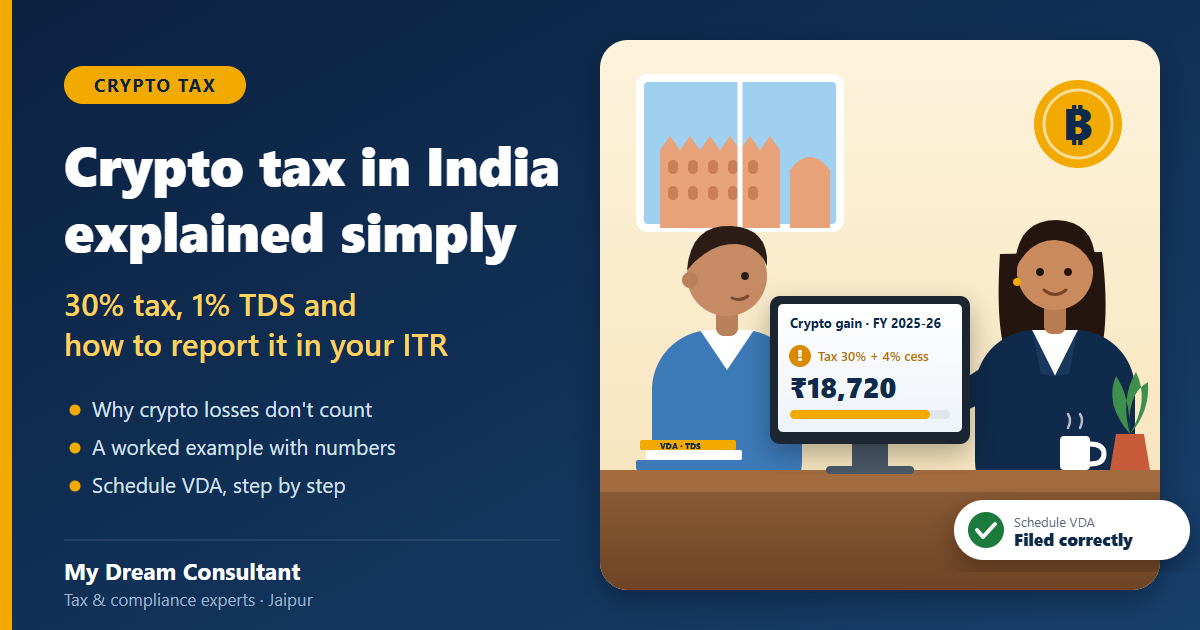
| Total tax on crypto | ₹18,720 |
| Less TDS already cut (1% of ₹1,60,000) | ₹1,600 |
| Still to pay | ₹17,120 |
That's why so many people get a shock at return time. The loss on Coin B doesn't help at all.
Why crypto losses don't help you
This is the rule that hurts the most. The law says no loss from transferring a VDA can be set off against any other income, and it can't be carried forward. In practice:
- A loss on one coin can't cut the tax on another coin's gain.
- Crypto losses can't be set off against salary, business income or stock market gains.
- An unused loss simply lapses at the end of the year.
So if you made ₹60,000 on one coin and lost ₹60,000 on another, you still pay tax on ₹60,000. It feels unfair, but that's the law as it stands.
The 1% TDS on crypto, explained
Every time you sell crypto, the buyer is supposed to deduct 1% TDS on the sale value. On an Indian exchange, the exchange does this for you automatically.
A few things to know:
- Thresholds: TDS applies once the payments cross ₹10,000 in a year for most buyers, or ₹50,000 for "specified persons" (mainly individuals and HUFs without business or professional income above the audit limit).
- P2P trades: If you purchase crypto directly from another person, you may have to deduct the 1% TDS and deposit it. Under the new Act, the form for this is Form 142 (earlier Form 26QF).
- It's not extra tax: TDS is just tax collected in advance. It shows in your AIS and Form 26AS, and you claim it as a credit when you file.
- Foreign exchanges usually don't deduct it. That doesn't mean no tax. You still owe the full 30%, and you must report it yourself.
How to report crypto in your ITR
This is where most notices start, so do it carefully.
- Pick the right form. ITR-1 and ITR-4 don't allow VDA income. Use ITR-2 if crypto is an investment, or ITR-3 if you trade often and treat it as a business.
- Download your exchange's tax report. Most Indian exchanges give a yearly statement with every buy and sell.
- Fill Schedule VDA. For each transfer, enter the date of purchase, date of sale, cost of purchase and sale value. The return works out the 30% tax.
- Claim the TDS. Match the 1% TDS in your AIS with the amount in your return.
- Check AIS before you file. The department gets data from exchanges. If your AIS shows crypto sales and your return doesn't, expect an email or notice.
Missed crypto in your FY 2025-26 return? You can still file a revised return. Sources differ on the exact last date, so aim to do it before 31 December 2026.
Mistakes we see every season
- Netting off losses against gains. The return may go through, but the tax is wrong, and a demand can follow.
- Leaving out small trades because "it was only ₹5,000". Every transfer counts.
- Forgetting crypto-to-crypto swaps. Swapping one coin for another is a transfer too.
- Ignoring the TDS credit and paying more tax than needed.
- Using ITR-1 out of habit. It will be treated as defective.
- Assuming offshore apps are invisible. They aren't, and the tax applies either way.
What you should do now
- Download the tax statement from every exchange or wallet you used in FY 2025-26.
- Work out the gain on each coin separately, and ignore the losses.
- Check your AIS for crypto sales and 1% TDS.
- If you left crypto out of your return, revise it before 31 December 2026.
- For this tax year, keep a simple record of every buy, sell and swap as you go.
- Set aside 31.2% of any crypto gain for tax, so you aren't caught short.
Frequently asked questions
What is the tax rate on crypto in India?
Gains from transferring crypto (virtual digital assets) are taxed at a flat 30%, plus 4% cess and any surcharge. No deduction is allowed except the cost of buying the asset.
Can I set off my crypto loss against my crypto gains?
No. A loss on one crypto asset cannot be set off against a gain on another, or against any other income, and it cannot be carried forward to later years.
What is the 1% TDS on crypto?
The buyer, usually the exchange, deducts 1% of the sale value when you sell crypto above the yearly threshold. It shows in your AIS and Form 26AS, and you claim it as a credit in your return.
Which ITR form do I use if I have crypto income?
ITR-1 and ITR-4 can't be used. Most people use ITR-2 if crypto is an investment, or ITR-3 if they trade as a business. Report the details in Schedule VDA.
Does the new Income-tax Act 2025 change crypto tax?
The rules continue in the same way. Returns for FY 2025-26 still follow the 1961 Act, and from tax year 2026-27 the new Act carries forward the 30% tax and 1% TDS, with TDS now under section 393.
Need help with your crypto tax?
Send us your exchange statements. Our team in Jaipur will work out the tax coin by coin, match your TDS with your AIS, and file or revise your income tax return with Schedule VDA done properly.
Call or WhatsApp +91 88240 45568 (chat on WhatsApp) or email [email protected]. Office: G-2, Ground Floor, Business Center, Dhoodh Mandi, Subhash Nagar, Jaipur 302016 (Mon–Sat, 8am–8pm).
Crypto assets are unregulated and can be highly risky. This post explains tax and legal rules only and is not investment advice.
This article is for general information and is not professional advice. Rules can change; please check your specific case with a qualified professional.