
Why You Received an Income Tax Notice & What to Do Next

Introduction Receiving an Income Tax notice can make anyone anxious. The moment people see an email or message from the Income Tax Department, questions immediately arise: Did I make a mistake? Am I being penalized? Will I have to pay extra tax? What should I do now? The first thing to understand is this — receiving an Income Tax notice does not always mean you have done something wrong. In many cases, notices are issued for simple reasons like missing information, mismatch in income reporting, incorrect ITR filing, delayed filing, or verification issues. With the Income Tax Department using advanced AI-based tracking systems, AIS, TIS, Form 26AS, and digital compliance tools, income mismatches are detected faster than ever. This is why many taxpayers now seek guidance from experienced Income Tax Consultants, the Best CA in Jaipur, or experts offering ITR Filing in Jaipur to avoid notices and stay compliant. In this blog, we will understand why you may receive an Income Tax notice and what steps you should take next. What is an Income Tax Notice? An Income Tax notice is an official communication sent by the Income Tax Department to a taxpayer. The notice may ask you to: Provide clarification Correct information Submit missing documents Pay pending tax Respond to mismatched transactions Not every notice is a penalty notice. Some are simply informational or compliance-related. Start Your Company In Just A Click —-! Click Here !—- Common Reasons for Receiving an Income Tax Notice Let’s understand the most common reasons. Mismatch Between ITR and AIS / Form 26AS One of the most common reasons is mismatch in reported income. Your filed ITR may not match data available with the department from: AIS TIS Form 26AS Banks Employers Brokers If income shown in these records differs from your ITR, a notice may be generated. Real-Life Example 1 Rahul filed his ITR using only Form 16. However, he forgot to include FD interest income. Since the bank had already reported the interest to the Income Tax Department, AIS showed extra income. Result: Rahul received a notice asking for clarification. High-Value Transactions The Income Tax Department tracks major financial transactions such as: Large cash deposits Property purchases Credit card spending Foreign travel expenses Stock market transactions Mutual fund investments If your transactions appear high compared to declared income, the department may seek clarification. Real-Life Example 2 Priya reported annual income of ₹8 lakh. During the same year, she purchased property worth ₹70 lakh. The transaction triggered scrutiny because declared income did not justify the purchase. She received a notice requesting source details. Not Filing ITR Even if tax is deducted through TDS, non-filing can attract notices. This especially happens when: TDS exists in Form 26AS Large transactions are recorded Income exceeds filing threshold The department may ask why the return was not filed. Incorrect ITR Form Choosing the wrong ITR form is a common mistake. For example: Business income filed in salary form Capital gains ignored Rental income incorrectly reported Wrong filing can trigger compliance issues. Claiming Excess Deductions Claiming deductions without valid proof can attract scrutiny. Examples include: Fake investment declarations Incorrect HRA claims Inflated deductions Unsupported exemptions Always keep documentation ready. Mismatch in TDS Credit Many taxpayers claim TDS credit incorrectly. Common issues include: Wrong TAN Missing TDS entries Duplicate claims Incorrect amount claimed This often leads to tax notices. Real-Life Example 3 Amit claimed full TDS credit based on salary records. However, employer reporting had errors. The mismatch resulted in an automated notice. After correction, the issue was resolved. Late ITR Filing Late filing can trigger: Penalty Interest Compliance notices Timely filing reduces risk. This is why many people search for ITR Filing Near Me or professional tax assistance before deadlines. Income from Shares, Crypto, or Mutual Funds Not Reported Many taxpayers forget to disclose: Capital gains Dividend income Trading income Crypto profits Since brokers report many transactions digitally, omissions can trigger notices. Types of Income Tax Notices Different notices serve different purposes. Common notice categories include: Defective Return Notice Errors found in filed return. Scrutiny Notice Detailed examination of return. Demand Notice Tax payable after assessment. Refund Adjustment Notice Refund adjusted against dues. Non-Filing Notice ITR not filed despite taxable income. What Should You Do After Receiving a Notice? Do not panic. Follow these steps. Step 1: Read the Notice Carefully Check: Notice section Assessment year Response deadline Reason for notice Understanding the exact issue is critical. Step 2: Verify Whether Notice is Genuine Always verify notices through the official Income Tax portal. Avoid fraud emails or fake messages. Step 3: Gather Required Documents Collect relevant documents such as: PAN Aadhaar Form 16 Bank statements AIS Form 26AS Investment proofs Property records Documentation helps build your response. Step 4: Compare Data with Your ITR Review your filed return. Check for: Missing income Wrong deduction TDS mismatch Calculation errors Many issues can be identified quickly. Step 5: Consult a Professional Tax Expert This is often the safest step. Experienced Income Tax Consultants can help: Understand the notice Draft replies Prepare documentation Respond accurately Avoid penalties That is why many taxpayers search for: Top CA in Jaipur Best CA in Jaipur ITR Filing in Jaipur Income Tax Consultants before replying to notices. What Happens If You Ignore a Tax Notice? Ignoring a notice can lead to serious consequences. Possible outcomes include: Penalties Interest Refund blockage Additional tax demand Assessment proceedings Legal complications Responding on time is very important. Real-Life Example 4 Rohit ignored a notice thinking it was unimportant. Months later, penalty and interest were added. A small mismatch became a bigger financial issue. Professional help could have saved him time and money. How to Avoid Income Tax Notices You can reduce notice risk by following simple habits. File ITR on Time Avoid last-minute filing. Report All Income Include every income source. Check AIS & TIS Cross-verify before filing. Use Correct ITR Form Wrong form causes issues. Maintain Documents Keep proofs safely. Seek Expert Guidance Professional filing reduces mistakes.
Income Tax Department’s AI Tracking System: Are Your Transactions Safe
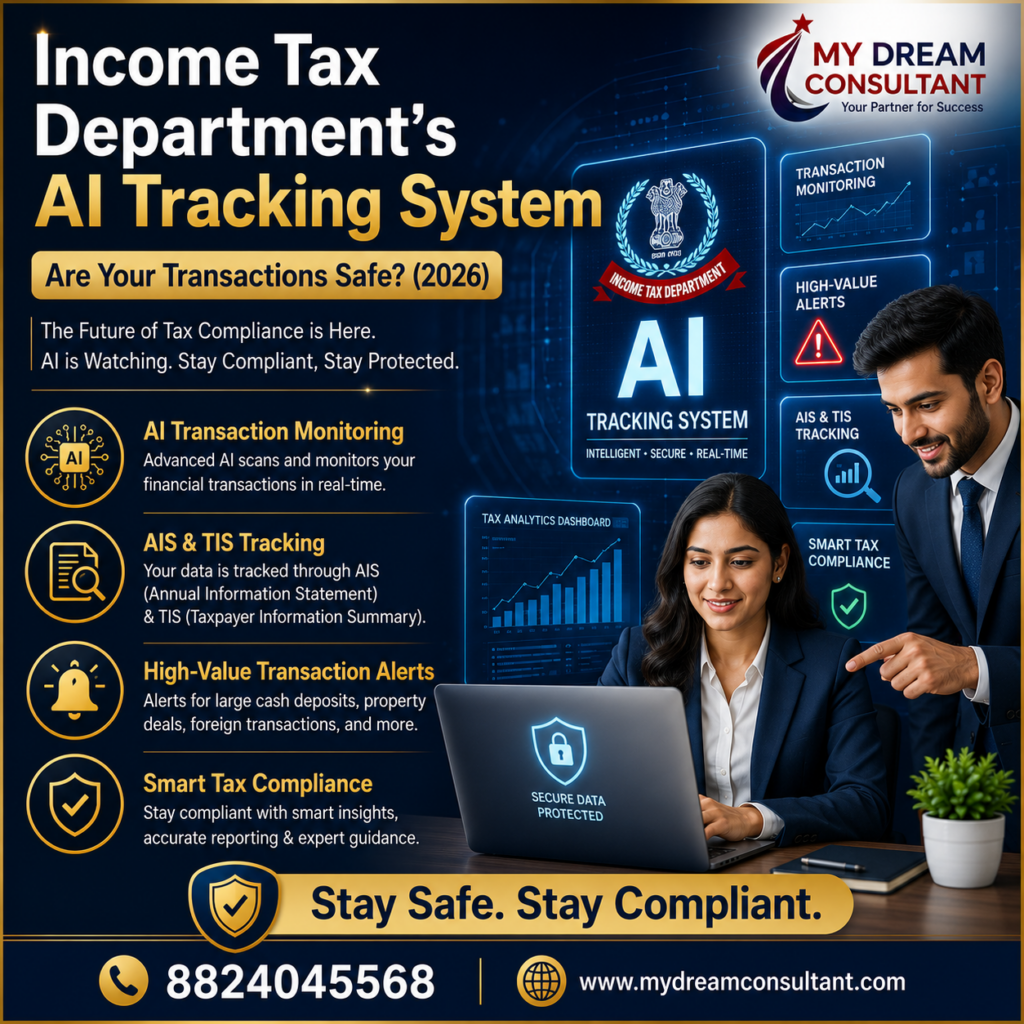
The Income Tax Department in India is becoming smarter and more technology-driven every year. In 2026, Artificial Intelligence (AI) and advanced data analytics are playing a major role in tracking financial transactions, identifying tax evasion, and monitoring suspicious activities. Many taxpayers still believe that small mismatches or hidden transactions cannot be detected. But the reality is very different today. The Income Tax Department can now track: Bank transactions Credit card spending Property purchases Share market investments Foreign remittances Online business income Cryptocurrency transactions This has made proper tax compliance more important than ever before. In this blog, we will explain how the AI tracking system works, what transactions are monitored, real-life examples, and how taxpayers can stay safe and compliant. What Is the Income Tax Department’s AI Tracking System? The AI Tracking System is an advanced digital monitoring mechanism used by the Income Tax Department to identify: Unreported income Fake deductions High-value transactions Suspicious financial activities Tax mismatches The system collects information from multiple sources and automatically compares it with your Income Tax Return (ITR). This technology helps the government: ✔ Reduce tax evasion✔ Increase transparency✔ Improve tax collection✔ Detect fraudulent filings Start Your Company In Just A Click —-! Click Here !—- How Does the AI Tax Monitoring System Work? The system gathers data from: Banks Stock brokers Mutual fund companies Property registrars Credit card companies GST records Foreign remittance reports Cryptocurrency exchanges All these transactions are linked with: PAN number Aadhaar Bank accounts The AI system automatically analyzes your financial profile and compares it with your declared income. What Transactions Are Being Tracked? The Income Tax Department now monitors several high-value transactions. ✔ Large Cash Deposits Heavy cash deposits in savings or current accounts may trigger alerts. ✔ Property Transactions Buying or selling property is closely monitored. ✔ Credit Card Spending Luxury expenses and high spending patterns are analyzed. ✔ Share Market & Mutual Fund Investments Large investments or gains are automatically reflected in records. ✔ Foreign Remittances Money transferred abroad is also monitored carefully. ✔ Cryptocurrency Transactions Crypto trading is now under strict observation. Real-Life Example 1: High Credit Card Spending Suppose a person files ITR showing annual income of ₹5 lakh. But the same person: Spends ₹12 lakh through credit cards Travels internationally multiple times Purchases luxury products The AI system may identify a mismatch between lifestyle and declared income. This could lead to: Income Tax notice Scrutiny Demand for explanation Real-Life Example 2: Property Purchase Mismatch A taxpayer buys a property worth ₹80 lakh but files very low income in ITR. The transaction automatically reflects in government databases linked to PAN. The department may ask: Source of funds Loan details Income proof This is one of the most common cases handled by experienced income tax consultants and the top CA in Jaipur. Real-Life Example 3: Share Market Gains Not Reported A salaried employee earns profits from stock market investments but forgets to report capital gains in ITR. Since brokers already report transactions to the government, the AI system can detect the mismatch. This may result in: Tax demand Penalty Revised return requirement AIS & TIS: The Backbone of AI Monitoring The government has introduced: AIS (Annual Information Statement) TIS (Taxpayer Information Summary) These statements contain detailed records of: Interest income Investments TDS Property deals Foreign remittances Stock market transactions Before filing ITR, taxpayers must carefully review AIS and TIS. This is now an essential step during ITR filing in Jaipur and across India. Why AI Monitoring Is Increasing The government wants to: Increase tax compliance Prevent black money transactions Encourage digital transparency Improve revenue collection AI systems can process lakhs of financial records much faster than manual checking. Are Honest Taxpayers Safe? Yes. Honest taxpayers generally do not need to worry. If you: ✔ Report all income correctly✔ File ITR on time✔ Maintain proper records✔ Avoid fake deductions then there is usually no problem. The system mainly targets: Tax evasion Undisclosed income Fake expenses Suspicious transactions Common Mistakes Taxpayers Should Avoid ❌ Ignoring AIS/TIS Many people file returns without checking AIS details. ❌ Hiding Bank Interest Even FD interest is tracked today. ❌ Not Reporting Capital Gains Share market and mutual fund profits must be disclosed properly. ❌ Fake Deduction Claims Wrong deduction claims may trigger scrutiny. ❌ Delayed ITR Filing Late filing may create compliance issues and penalties. How to Stay Safe Under the AI Tax System ✅ Maintain Proper Documentation Keep: Bank statements Investment proofs Property papers Loan documents ✅ File Accurate ITR Ensure all income sources are disclosed. ✅ Match AIS Before Filing Always compare your ITR with AIS/TIS records. ✅ Take Professional Guidance Complex transactions should be handled carefully. This is why many taxpayers search for: “Best CA in Jaipur” “ITR filing near me” “Income tax consultants” “Top CA in Jaipur” before filing returns. Why Professional Tax Guidance Matters More in 2026 Income tax filing is no longer simple for many taxpayers. Professional experts help: ✔ Correct ITR filing✔ Tax planning✔ Capital gains calculation✔ Notice handling✔ AIS/TIS reconciliation✔ Compliance support Working with experienced professionals can help avoid costly mistakes. Future of AI in Income Tax Department In coming years, AI monitoring is expected to become even more advanced. Possible future developments: Real-time transaction tracking Automated scrutiny notices Faster refund processing Better fraud detection Integrated financial profiling Digital compliance will become increasingly important for every taxpayer. Conclusion The Income Tax Department’s AI tracking system is transforming the Indian tax ecosystem. The days of hiding transactions or ignoring tax compliance are gradually disappearing. Today, almost every major financial transaction is digitally traceable. However, honest taxpayers who maintain transparency and proper records do not need to panic. The best approach is: File accurate returns Report all income Match AIS/TIS Maintain proper documentation Take professional guidance when needed Proper compliance today can help avoid future notices, penalties, and stress. Frequently Asked Questions (FAQs) 1. Can the Income Tax Department track bank transactions? Yes, high-value and suspicious transactions can be monitored through banking systems linked
How to Repatriate Money After Property Sale in India (NRI Guide 2026)

Selling property in India is only half the process for NRIs—the next crucial step is repatriating (transferring) the sale proceeds abroad. Many NRIs face confusion due to RBI rules, tax compliance, and documentation requirements. This complete guide will help you understand the legal process, limits, documents, and tax implications for smooth fund repatriation. 🌍 What is Repatriation? Repatriation means transferring money from India to your country of residence. 👉 For NRIs, this typically involves transferring funds from an NRO account to a foreign bank account after selling property. 💼 Is Repatriation Allowed for NRIs? Yes, NRIs are allowed to repatriate funds under RBI (Reserve Bank of India) guidelines, subject to certain conditions. ✔ Up to USD 1 million per financial year ✔ Applicable to sale proceeds, rent, and other income Start Your Company In Just A Click —-! Click Here !—- 🧾 Step-by-Step Process to Repatriate Money ✅ Step 1: Deposit Sale Proceeds in NRO Account Property sale amount must be credited to your NRO account Ensure proper documentation of transaction ✅ Step 2: Calculate Tax Liability Capital gains tax must be calculated TDS should be verified Excess TDS can be claimed as refund 👉 Proper tax planning with the best NRI tax consultant in India helps avoid unnecessary deductions. ✅ Step 3: Obtain CA Certificate (Form 15CB) Chartered Accountant certifies: Tax paid Source of funds Compliance with tax laws 👉 This is a mandatory step handled by the top NRI tax consultant in Jaipur. ✅ Step 4: File Form 15CA Online Submit Form 15CA on Income Tax portal Declaration for remittance of funds ✅ Step 5: Submit Documents to Bank Provide the following to your bank: Form 15CA & 15CB PAN Card Property sale documents Bank statements TDS certificates ✅ Step 6: Transfer Funds Abroad Bank processes remittance Funds transferred to your foreign account 👉 Smooth execution is ensured with the best NRI tax consultant in Jaipur. 📊 Important Rules for Repatriation Limit: USD 1 million per financial year Applies to: Property sale proceeds Rental income Other earnings in India 💰 Tax Implications on Repatriation Tax must be paid before repatriation Capital gains tax applicable DTAA can help avoid double taxation 👉 Expert guidance from the top NRI tax consultant in India ensures tax-efficient transfers. ⚠️ Common Mistakes NRIs Should Avoid ❌ Not paying tax before remittance ❌ Missing Form 15CA/CB ❌ Incomplete documentation ❌ Ignoring DTAA benefits ❌ Delays in filing returns 👉 Avoid these issues by consulting the best NRI tax consultant in India. 🏢 Why You Need a Professional NRI Tax Consultant Repatriation involves tax laws, FEMA regulations, and banking compliance. A professional helps: ✔ Accurate tax calculation ✔ Documentation handling ✔ Faster bank processing ✔ DTAA benefit planning ✔ Hassle-free fund transfer 👉 Choosing the top NRI tax consultant in Jaipur ensures a smooth and compliant process 🔍 SEO Keywords Included (High Ranking) This blog is optimized for: NRI Repatriation of Funds India How to Transfer Money Abroad from India NRI NRO to Foreign Account Transfer Best NRI Tax Consultant in India Top NRI Tax Consultant in India Best NRI Tax Consultant in Jaipur Top NRI Tax Consultant in Jaipur NRI Property Sale Repatriation Form 15CA 15CB NRI NRI Tax Planning India ✨ Final Thoughts Repatriating money after property sale in India is a structured process that requires proper compliance with RBI and tax regulations. With the right planning and expert guidance, NRIs can transfer funds smoothly without delays or penalties. Partnering with the best NRI tax consultant in India ensures that your funds are transferred legally, efficiently, and with minimum tax burden. 📞 Call to Action Planning to transfer your property sale funds abroad? Connect with the top NRI tax consultant in Jaipur for expert assistance and hassle-free repatriation. 👉 Contact us today for personalized NRI advisory! #NRIRepatriation#NRIIndia#NRITaxation#PropertySaleIndia #RepatriationOfFunds#NRIPropertySale#Form15CA#Form15CB #JaipurConsultant#CAinJaipur#TaxConsultantJaipur #BestNRITaxConsultant#TopNRITaxConsultant
How Technology Is Changing GST Compliance: AI, Auto-Filing & e-Way Bills Explained
Introduction GST compliance has always been a challenging task for businesses in India. From understanding GST amendments to filing returns on time, many businesses struggle with errors, penalties, and complex procedures. But today, technology is transforming GST compliance like never before. Tools powered by Artificial Intelligence (AI), auto-filing systems, and digital platforms for e-way bills are making GST compliance faster, smarter, and more accurate. In this blog, we’ll explore how technology is reshaping GST compliance, with real-life examples, practical insights, and expert tips from top CA for GST registration and compliance. 1. The Traditional Challenges of GST Compliance Before technology-driven solutions, businesses faced several problems: Manual data entry leading to errors Difficulty in understanding GST amendments Late GST return filings and penalties Complex reconciliation of invoices Time-consuming e-way bill generation Dependence on accountants for every small task Even businesses that completed online GST registration often struggled with ongoing GST compliance. Start Your Company In Just A Click —-! Click Here !—- 2. Role of Artificial Intelligence (AI) in GST Compliance ✅ What AI Does in GST Artificial Intelligence is helping businesses automate and optimize GST processes. AI-based tools can: Detect errors in GST returns Match invoices automatically Predict tax liabilities Identify compliance risks Suggest corrections before filing ✅ Real-Life Example Imagine a medium-sized trading company in Jaipur. Earlier, the company used spreadsheets to manage GST data. Due to manual mistakes, they received multiple GST notices. After adopting AI-based GST software, the system automatically flagged mismatched invoices and incorrect tax rates. As a result, their GST return filings became accurate, and notices reduced drastically. This is why many businesses today prefer working with the best CA for GST registration who uses advanced technology tools. 3. Auto-Filing of GST Returns: A Game Changer ✅ What Is Auto-Filing? Auto-filing systems automatically prepare and file GST returns using data from invoices, bank statements, and accounting software. ✅ Benefits of Auto-Filing Saves time and effort Reduces human errors Ensures timely GST return filings Improves GST compliance Helps businesses adapt quickly to GST amendments ✅ Real-Life Example A startup offering digital services used to spend 2–3 days every month preparing GST returns manually. After integrating auto-filing software, their GST returns were prepared within minutes. Now, they focus more on business growth instead of paperwork. This is why online GST registration is no longer enough—businesses need smart systems for continuous compliance. 4. Digital Transformation of e-Way Bills ✅ What Are e-Way Bills? An e-way bill is a mandatory document for the movement of goods worth more than a specified value under GST law. ✅ How Technology Is Improving e-Way Bills Modern platforms allow: Automatic generation of e-way bills Integration with billing software Real-time tracking of shipments Bulk e-way bill creation Error-free documentation ✅ Real-Life Example A logistics company transporting goods across states used to face frequent delays due to incorrect e-way bills. After adopting integrated e-way bill software, they started generating error-free e-way bills instantly. This improved delivery timelines and reduced compliance risks. 5. Impact of Technology on GST Amendments GST laws change frequently due to new GST amendments. Technology helps businesses stay updated by: Automatically updating tax rates Alerting businesses about new GST amendments Adjusting compliance processes in real time For businesses, this means less confusion and better compliance with changing GST rules. 6. Benefits of Technology-Driven GST Compliance Technology is not just simplifying GST compliance—it is transforming the entire tax ecosystem. ✅ Key Benefits Faster GST compliance Accurate GST return filings Reduced penalties and notices Better financial planning Transparency and accountability Easy integration with online GST registration systems This is why businesses today prefer working with top CA for GST registration who combine expertise with technology. 7. Future of GST Compliance in India In the coming years, GST compliance will become even more digital with: AI-powered tax assessments Real-time GST reporting Fully automated GST return filings Smart compliance dashboards Advanced analytics for tax planning Businesses that adopt technology early will have a strong competitive advantage. FAQs – Technology and GST Compliance How does AI help in GST compliance? AI helps in invoice matching, error detection, risk analysis, and automated GST return filings, making compliance faster and more accurate. Is auto-filing of GST returns safe? Yes, if you use reliable software and consult the best CA for GST registration, auto-filing is secure and highly efficient. Can small businesses use technology for GST compliance? Absolutely. Even small businesses can benefit from online GST registration tools, auto-filing software, and digital e-way bill systems. How do GST amendments affect businesses? GST amendments change tax rates, rules, and compliance requirements. Technology helps businesses adapt quickly without manual effort. Do businesses still need a CA for GST compliance? Yes. Technology supports compliance, but expert guidance from top CA for GST registration ensures accuracy and strategic tax planning. Conclusion Technology is revolutionizing GST compliance in India. From AI-powered tools to auto-filing systems and digital e-way bill platforms, businesses now have smarter ways to manage GST. However, technology alone is not enough. The combination of advanced tools and expert guidance from the best CA for GST registration ensures seamless GST compliance and stress-free GST return filings. If businesses embrace digital solutions and stay updated with every GST amendment, GST compliance will no longer be a burden—but a strategic advantage. #GSTCompliance#GSTTechnology#GSTReturns#AutoFiling#AIinGST#DigitalGST#EWayBill#GSTAutomation#SmartTax#GSTIndia #TopCAforGSTRegistration#BestCAforGSTRegistration#OnlineGSTRegistration
✅ GST Notice Received? Step-by-Step Guide to Respond (Complete Guide for Businesses)

Introduction Receiving a GST notice can be stressful for any business owner. Many people panic when they see an official notice from the GST department, assuming it means heavy penalties or legal trouble. But the truth is — most GST notices are issued for simple reasons like mismatched returns, late filings, or minor errors. If you respond correctly and on time, the issue can often be resolved smoothly. In this blog, we will explain: What a GST notice means Common reasons for GST notices A step-by-step process to respond Real-life examples Expert tips for GST compliance FAQs Whether you handle GST yourself or with the help of a top CA for GST registration, this guide will help you understand everything in simple language. ✅ What is a GST Notice? A GST notice is an official communication sent by the GST department to a taxpayer regarding: Errors in GST returns Non-filing of returns Tax discrepancies Refund issues Suspected tax evasion Compliance with GST amendments The notice is usually sent through: GST portal Email SMS Start Your Company In Just A Click —-! Click Here !—- ✅ Common Reasons for Receiving a GST Notice Here are the most common reasons why businesses receive GST notices: 1️⃣ Mismatch in GST Returns Difference between GSTR-1, GSTR-3B, and GSTR-2B data. 2️⃣ Late or Non-Filing of Returns Failure to file GST return filings on time. 3️⃣ Incorrect Input Tax Credit (ITC) Claim Claiming excess or ineligible ITC. 4️⃣ Difference Between Turnover and Income Tax Data Mismatch between GST turnover and ITR data. 5️⃣ Errors After GST Amendment Not following new GST amendment rules. 6️⃣ Suspicious Transactions Unusual sales or ITC claims. ✅ Types of GST Notices Understanding the type of notice is important before responding: 📌 Show Cause Notice (SCN) 📌 Notice for mismatch in returns 📌 Demand notice 📌 Scrutiny notice 📌 Assessment notice 📌 Notice for cancellation of GST registration ✅ Step-by-Step Guide to Respond to a GST Notice ✅ Step 1: Read the GST Notice Carefully First, understand: Reason for notice Section of GST law mentioned Deadline for reply Amount demanded (if any) 💡 Tip: Don’t ignore the notice — delay can lead to penalties. ✅ Step 2: Verify Your GST Data Check the following: GSTR-1 GSTR-3B GSTR-2B Books of accounts Invoices Compare the data to identify the issue. ✅ Step 3: Identify the Exact Error Common errors include: Wrong invoice details Duplicate entries Missing invoices Wrong tax rate ITC mismatch This step is crucial for proper GST compliance. ✅ Step 4: Consult a GST Expert or CA If the issue is complex, consult the best CA for GST registration or a GST consultant. A professional can: Interpret the notice correctly Draft a proper reply Avoid legal risks ✅ Step 5: Prepare a Proper Reply Your reply should include: Explanation of the issue Supporting documents Corrected data Legal justification (if required) ✅ Step 6: Submit the Reply on the GST Portal Steps to reply online: Login to GST portal Go to Services → User Services → View Notices and Orders Select the notice Upload reply and documents Submit This process is part of online GST registration and compliance management. ✅ Step 7: Pay Tax, Interest, or Penalty (If Required) If the notice is valid, pay: Tax amount Interest Penalty Timely payment can reduce additional penalties. ✅ Step 8: Keep Records for Future Reference Maintain: Reply copy Challans Supporting documents This helps in future audits and assessments. ✅ Real-Life Examples of GST Notices 📌 Example 1: ITC Mismatch Rahul runs a trading business in Jaipur. He claimed ₹1,50,000 ITC in GSTR-3B, but his GSTR-2B showed only ₹1,10,000. 👉 Result: GST notice for excess ITC claim. ✅ Solution: Rahul revised his records and paid the extra ITC with interest. The issue was resolved without penalties. 📌 Example 2: Non-Filing of Returns A small startup failed to file GST returns for 6 months due to lack of awareness of GST amendments. 👉 Result: Notice for cancellation of GST registration. ✅ Solution: With the help of a top CA for GST registration, the startup filed pending returns and paid late fees. The registration was restored. 📌 Example 3: Turnover Mismatch A manufacturing company reported ₹80 lakh turnover in GST returns but ₹1.2 crore in income tax returns. 👉 Result: Scrutiny notice from GST department. ✅ Solution: The company submitted explanations and supporting documents to justify the difference. ✅ Tips to Avoid GST Notices in the Future ✔ File GST returns on time ✔ Regularly reconcile GSTR-1, GSTR-3B, and GSTR-2B ✔ Follow latest GST amendments ✔ Maintain proper invoices ✔ Take professional help for GST compliance ✔ Use reliable accounting software ✅ Why Professional Help Matters in GST Compliance GST laws change frequently due to GST amendments. A professional CA can help you with: Online GST registration Accurate GST return filings ITC reconciliation GST audits Notice handling That’s why many businesses prefer working with the best CA for GST registration to avoid legal issues. ✅ FAQs on GST Notice ❓1. Is it compulsory to reply to a GST notice? Yes. Ignoring a GST notice can lead to penalties, interest, or cancellation of GST registration. ❓2. What happens if I miss the deadline? You may face additional penalties or legal action. Always respond within the given time. ❓3. Can I reply to a GST notice online? Yes. Most GST notices can be replied to through the GST portal. ❓4. Can a GST notice be wrong? Yes. Sometimes notices are issued due to system errors or misunderstandings. Proper documentation can resolve such cases. ❓5. Should I hire a CA to respond to a GST notice? If the notice is complex, it is highly recommended to consult a GST expert or CA. ✅ Conclusion Receiving a GST notice is not the end of the road — it is simply a call to review your compliance. If you understand the notice, verify your records, and respond correctly, most issues can be resolved easily. To avoid future problems, focus on timely GST
Common GST Mistakes Businesses Still Make After Latest GST Amendments

Introduction Goods and Services Tax (GST) has simplified India’s indirect tax system, but it has also become more dynamic with frequent amendments. Every year, the government introduces new rules related to Input Tax Credit (ITC), return filing, e-invoicing, refunds, and compliance systems. However, even after the latest GST amendments, many businesses continue to make common GST mistakes. These errors can lead to penalties, loss of ITC, notices from the GST department, and even cash flow problems. In this blog, we will explain the most common GST mistakes businesses still make, real-life examples, and how to avoid them. Whether you are a startup, MSME, or established business, this guide will help you strengthen your GST compliance. Latest GST Amendments: Why Businesses Are Getting Confused Recent GST updates have significantly changed compliance requirements. For example: From October 2025, businesses must actively verify invoices in the Invoice Management System (IMS) instead of relying on auto-populated ITC. Manual verification and acceptance/rejection of invoices have become necessary to claim correct ITC. E-invoices must be uploaded within 30 days of issuance, failing which they may be rejected automatically. New rules have tightened compliance timelines and improved ITC control mechanisms. Due to these changes, many businesses unknowingly commit GST mistakes. Start Your Company In Just A Click —-! Click Here !—- ✅ Top Common GST Mistakes Businesses Still Make 1️⃣ Claiming Incorrect Input Tax Credit (ITC) One of the biggest mistakes businesses make is claiming ITC without proper verification. Why it happens? Supplier has not filed GSTR-1 Invoice not reflected in GSTR-2B Wrong classification of eligible ITC Latest update impact Since IMS now requires invoice-level verification, blindly claiming ITC can lead to reversals and penalties. Real-life example A trader claims ITC on an invoice without checking whether the supplier uploaded it. Later, the GST department disallows the credit and imposes interest and penalties. 2️⃣ Late or Incorrect GST Return Filing Many businesses delay filing GST returns or make errors in GSTR-3B and GSTR-1. Common mistakes: Missing deadlines Incorrect tax calculation Mismatch between GSTR-1 and GSTR-3B Why it is risky? Late filing leads to: Late fees Interest on tax Blocking of ITC Also, corrections after filing have become stricter due to compliance tightening. 3️⃣ Ignoring Invoice Reconciliation After the latest amendments, invoice reconciliation has become mandatory. Common errors: Not reconciling GSTR-2B with purchase records Ignoring mismatches Accepting wrong invoices Real-life example A manufacturing company fails to reconcile invoices monthly. After audit, it finds excess ITC claimed and receives a GST notice. 4️⃣ Non-Compliance with E-Invoicing Rules Many businesses still ignore e-invoicing requirements. Latest rule: E-invoices must be uploaded within a fixed timeline; otherwise, they may be rejected. Common mistakes: Late uploading of invoices Wrong invoice details Non-generation of IRN 5️⃣ Wrong GST Rate or HSN Code Businesses often apply the wrong GST rate or HSN code. Impact: Underpayment or overpayment of tax Notices from GST department Refund complications Real-life example A retailer applies 5% GST instead of 18% on a product. During assessment, he is asked to pay differential tax with interest. 6️⃣ Ignoring Reverse Charge Mechanism (RCM) Many businesses forget to pay GST under RCM. Latest update: Self-invoicing timelines under RCM have been revised to ensure timely tax payment. Common mistakes: Not issuing self-invoices Not paying tax under RCM Wrong ITC claims 7️⃣ Poor Record-Keeping Businesses often fail to maintain proper GST records. Consequences: Difficulty in audits Loss of ITC Compliance issues 8️⃣ Not Updating Accounting Systems After GST Changes GST rules evolve regularly, but many businesses do not update their accounting software or processes. Example After IMS implementation, businesses that didn’t update their systems faced ITC mismatches and filing errors. 9️⃣ Missing Refund Rules and Restrictions Many exporters and businesses make mistakes in GST refund claims. Latest update: New restrictions have been introduced on refunds of unutilized ITC and IGST in certain cases. 🔟 Relying on Inexperienced Consultants Choosing the wrong advisor can lead to serious GST errors. That’s why businesses should consult a top CA for GST registration or the best CA for GST registration to ensure proper compliance. ✅ How to Avoid Common GST Mistakes ✔ Regular reconciliation of invoices ✔ Timely GST return filings ✔ Proper documentation ✔ Updated accounting systems ✔ Professional guidance from experts ✔ Strong GST compliance strategy ✅ Real-Life Business Case Study Case Study: Small Trading Firm A Jaipur-based trading firm failed to reconcile GSTR-2B with purchase records. It claimed excess ITC of ₹2 lakh. After audit, the GST department demanded tax with interest and penalty. Lesson Proper GST compliance and expert guidance could have prevented the loss. ✅ Importance of Professional GST Support To avoid GST mistakes, businesses should take help from: Top CA for GST registration Best CA for GST registration Experts in online GST registration Professionals for GST return filings Professional support ensures: Error-free compliance Maximum ITC benefits Zero penalties ✅ FAQs – Common GST Mistakes After Amendments Q1. What is the most common GST mistake businesses make? The most common mistake is claiming incorrect ITC without proper verification. Q2. How do GST amendments affect businesses? GST amendments change compliance rules, ITC procedures, return filing systems, and documentation requirements. Q3. What happens if GST returns are filed late? Late filing results in penalties, interest, and blocking of ITC. Q4. How can businesses avoid GST mistakes? By maintaining proper records, filing returns on time, reconciling invoices, and consulting experts. Q5. Why is GST compliance important? GST compliance helps businesses avoid penalties, improve credibility, and maintain smooth operations. ✅ Conclusion Even after years of GST implementation, many businesses still make common GST mistakes due to frequent amendments and complex rules. With new systems like IMS, stricter ITC rules, and updated compliance requirements, businesses must be more careful than ever. To stay safe from penalties and financial losses, businesses should focus on strong GST compliance, timely GST return filings, and expert guidance from professionals. If you want to grow your business smoothly, don’t treat GST as a burden—treat it as a system that needs proper planning and expert