
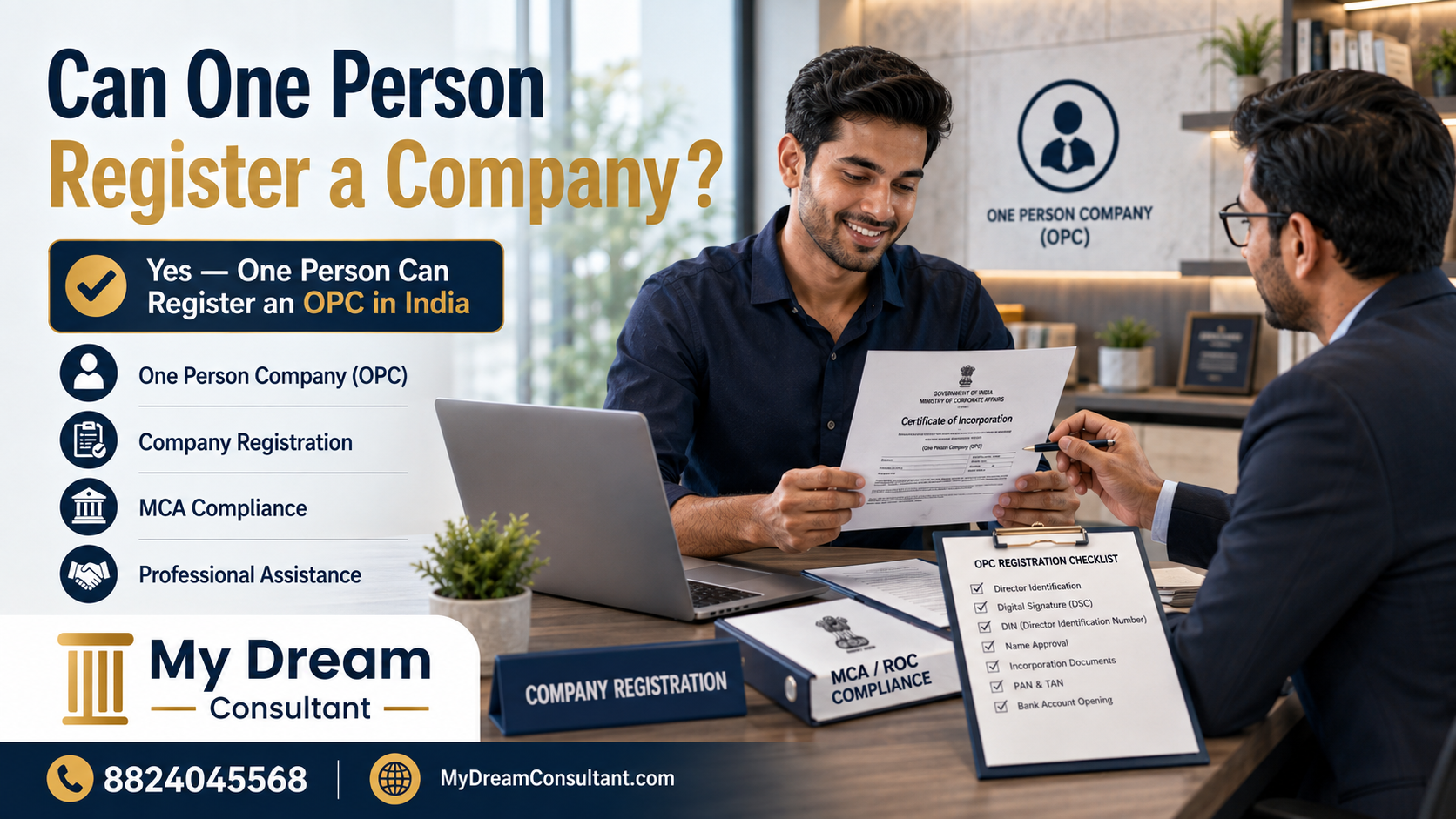
Yes. A single person can register a company in India through an OPC, subject to the applicable legal requirements.
Under the Companies Act framework, an OPC is a company with only one member. MCA’s incorporation instructions specifically require nominee-related documents for an OPC, including the nominee’s consent and identity/residential proof.
This makes an OPC an option for entrepreneurs who want to start and control a business individually while using a corporate structure.
But there is an important question:
Is OPC the right structure for your business?
Not necessarily.
If you expect multiple owners, outside equity investment or rapid expansion, a Private Limited Company may be worth considering instead.

What Is a One Person Company?
A One Person Company (OPC) is a company structure designed around a single member.
Unlike a traditional partnership, there is no requirement for multiple members to own the company.
An OPC can offer:
- Single-member ownership
- Separate legal identity
- Limited liability, subject to applicable law
- Formal corporate structure
- Business continuity through the nominee mechanism
The OPC incorporation process includes specific nominee requirements. MCA’s SPICe+ instructions state that consent of the nominee and the nominee’s identity and residential proof are required for OPC incorporation.
Who Should Consider an OPC?
An OPC may be considered by:
- Solo entrepreneurs
- Freelancers building a formal business
- Independent consultants
- Professionals
- Small business owners
- Individual service providers
- Entrepreneurs who want a corporate structure
For example, imagine Amit, a Jaipur-based digital consultant.
He is currently the only owner of his business and does not want a partner. He wants a formal corporate structure and wants to separate his personal and business affairs as permitted by law.
An OPC could be one structure for him to evaluate.
Who May Prefer a Private Limited Company?
An OPC may not be ideal if your business is already planning for multiple shareholders or significant equity investment.
A Private Limited Company may be more appropriate when you plan to:
- Add multiple shareholders
- Raise equity investment
- Bring in co-founders
- Build a larger management structure
- Scale the business significantly
Therefore, don’t select an OPC simply because you are currently the only founder.
Think about where your business could be three to five years from now.
OPC vs Private Limited Company
| Feature | OPC | Private Limited Company |
|---|---|---|
| Members | Single member | Multiple members |
| Separate legal identity | Yes | Yes |
| Limited liability | Generally available, subject to law | Generally available, subject to law |
| Suitable for solo founder | Yes | Can be structured with more than one member |
| Multiple shareholders | Not as an OPC | Yes |
| Equity funding | More limited | Generally more suitable |
| Corporate compliance | Applicable | Applicable |
| Best suited for | Certain solo entrepreneurs | Growing businesses/startups |
The “better” structure depends on the entrepreneur’s business model and long-term plans.
OPC Registration Process in India
The incorporation process is generally completed through the MCA’s online incorporation system.
Step 1: Decide the Business Structure
First, determine whether OPC is actually suitable for your business.
Step 2: Select a Company Name
Choose a name that complies with applicable naming requirements and does not conflict with existing company or trademark considerations.
MCA’s name rules contain provisions regarding names that are too similar to existing companies.
Step 3: Obtain Digital Signature
The proposed subscriber/director generally needs the required digital signing facility for electronic incorporation filings.
Step 4: Prepare Documents
Prepare identity, address, registered-office and nominee-related documents.
Step 5: File Incorporation Forms
The incorporation application is submitted through the applicable MCA electronic filing process.
Step 6: MCA Review
MCA examines the application and may raise a resubmission requirement if corrections or additional information are needed.
Step 7: Certificate of Incorporation
Once approved, the company receives its Certificate of Incorporation and related identification details.
Eligibility for OPC Registration
Eligibility should always be checked against the current Companies Act and applicable rules at the time of incorporation.
The incorporation documentation specifically requires nominee information for an OPC.
An entrepreneur should also check:
- Whether they satisfy the applicable member eligibility
- Nominee requirements
- Director requirements
- Registered-office requirements
- Name availability
- Restrictions applicable to the proposed business activity
Because rules can change, professional verification is advisable before filing.
Documents Required for OPC Registration
Common documents may include:
For the Proposed Member/Director
- PAN
- Identity proof
- Address proof
- Photograph
- Mobile number
- Email address
For Registered Office
Depending on the situation:
- Address proof
- Utility bill
- Rent/lease agreement, where applicable
- Owner’s NOC, where applicable
For Nominee
MCA incorporation instructions specifically provide for:
- Nominee consent
- Nominee identity proof
- Nominee residential address proof
The exact documentation can vary depending on the applicant’s circumstances.
How Much Does OPC Registration Cost?
There is no single fixed cost that applies to every OPC registration.
The total cost may depend on:
- Government filing fees
- Stamp duty
- Authorized capital
- State-specific charges
- Digital signature requirements
- Professional fees
- Additional services required
Professional fees also vary between service providers and according to the complexity of the incorporation.
For an accurate quotation, the proposed business structure and documentation should be reviewed first.
How Long Does OPC Registration Take?
There is no guaranteed fixed timeline.
The actual time can depend on:
- Document readiness
- Name approval
- MCA processing
- Resubmission requirements
- Government processing time
- Complexity of the application
A properly prepared application can help reduce avoidable delays.
Benefits of One Person Company
1. Single Ownership
The business can be owned by one member.
2. Corporate Identity
The business operates through a registered company structure.
3. Limited Liability Structure
The member generally receives limited liability protection, subject to the applicable law and circumstances.
4. Professional Image
A registered corporate structure may help create a formal image with clients, vendors and financial institutions.
5. Business Continuity
The nominee mechanism provides a framework for continuity in specified circumstances.
What About GST Registration?
OPC registration and GST Registration are separate matters.
GST registration depends on factors such as:
- Business activity
- Turnover
- Place of supply
- Applicable GST provisions
Therefore, registering an OPC does not automatically mean that GST registration is mandatory in every situation.
What About Startup India Registration?
An OPC may explore Startup India Recognition if it meets the applicable eligibility conditions.
However, company incorporation and Startup India recognition are separate processes.
Similarly, other registrations may be applicable depending on the nature of the business, such as:
- MSME Registration
- FSSAI License
- Trademark Registration
- GST Registration
OPC Compliance After Registration
Registering the company is only the beginning.
An OPC must comply with applicable corporate requirements, which may include:
- Maintaining books of account
- Preparing financial statements
- Applicable annual filings
- Maintaining required records
- Income-tax compliance
- Other applicable statutory requirements
The exact compliance obligations depend on the company’s circumstances.
This is why ROC Annual Compliance should be considered when calculating the overall cost of running an OPC.
Common Mistakes Entrepreneurs Make
Mistake 1: Choosing OPC Without Considering Future Growth
If you plan to bring in investors or multiple owners soon, evaluate your options carefully.
Mistake 2: Ignoring the Nominee Requirement
Nominee documentation is an important part of OPC incorporation.
Mistake 3: Choosing a Similar Company Name
Company name availability and similarity rules should be checked before filing.
Mistake 4: Looking Only at Registration Cost
The cheapest registration option is not necessarily the most suitable structure.
Mistake 5: Forgetting Post-Incorporation Compliance
A company needs ongoing compliance after incorporation.
Mistake 6: Assuming GST Is Automatically Required
GST applicability depends on the relevant GST provisions and business circumstances.
Practical Tips Before Registering an OPC
Before starting the registration process:
✔ Decide your long-term business structure.
✔ Check company name availability.
✔ Check trademark considerations separately.
✔ Keep your identity and address documents ready.
✔ Finalize your registered office details.
✔ Discuss the nominee requirement in advance.
✔ Understand annual compliance costs.
✔ Identify whether GST, FSSAI, MSME or other registrations apply.
✔ Keep a compliance calendar after incorporation.
Real-Life Example
A Solo Entrepreneur in Jaipur
Neha is a freelance marketing consultant in Jaipur. She has been working independently for several years and now wants to formalize her business.
She does not currently have a co-founder and wants a corporate structure.
Instead of automatically choosing an OPC, she compares:
- OPC
- Private Limited Company
- LLP
After considering her future plans, ownership requirements and expected growth, she chooses the structure that best matches her current and future needs.
The lesson: The right question isn’t simply “Can one person register a company?”
The better question is:
“Which business structure is right for my business today and tomorrow?”
Latest Legal Considerations
MCA’s incorporation system uses electronic forms and linked filings for company incorporation. The SPICe+ instruction kit provides specific documentation requirements for OPCs, including nominee consent and nominee identity/address proof.
MCA also provides a mechanism for conversion between OPC and private/public company structures through applicable procedures and forms, subject to the relevant legal requirements.
Because corporate rules and filing procedures can be amended, entrepreneurs should verify the current MCA requirements before submitting an application.
Frequently Asked Questions
1. Can one person register a company in India?
Yes. A single person can incorporate an One Person Company (OPC), subject to applicable legal requirements.
2. What is an OPC?
OPC stands for One Person Company. It is a company structure designed around a single member.
3. Can one person start a Private Limited Company?
A Private Limited Company has requirements relating to its members and directors. A person starting alone should evaluate whether OPC or another structure is more appropriate based on the applicable law and their plans.
4. Is an OPC suitable for a startup?
It can be suitable for certain solo founders, but startups planning multiple shareholders or equity investment should compare OPC with a Private Limited Company.
5. Is a nominee required for an OPC?
Yes, nominee-related documentation is part of OPC incorporation. MCA’s SPICe+ instructions require nominee consent and identity/residential proof.
6. How much does OPC registration cost?
The cost varies based on government fees, stamp duty, capital, professional charges and other applicable costs.
7. How long does OPC registration take?
The timeline varies depending on documentation, MCA processing and whether any resubmission is required.
8. Does an OPC need GST Registration?
Not automatically. GST registration depends on the applicable GST provisions and the business’s circumstances.
9. Can an OPC be converted into another company structure?
Conversion is possible subject to the applicable Companies Act provisions and MCA procedures. MCA provides an INC-6 process for certain OPC conversions.
10. Does an OPC have annual compliance?
Yes. An OPC remains subject to applicable corporate, accounting, tax and other statutory requirements.
11. Can an OPC register a trademark?
Yes. Trademark registration is a separate intellectual-property process and may be considered for protecting a suitable brand name.
12. Can I register an OPC from Jaipur?
Yes. Company incorporation is handled through the MCA’s electronic system, so an entrepreneur based in Jaipur can apply subject to the applicable requirements.
Key Takeaways
- Yes, one person can register a company in India through an OPC, subject to applicable requirements.
- OPC provides a corporate structure for a single member.
- Nominee requirements are an important part of OPC incorporation.
- OPC is not automatically the best choice for every solo entrepreneur.
- Compare OPC with Private Limited Company and other structures before registering.
- GST, FSSAI, MSME and Trademark Registration are separate registrations and depend on applicability.
- ROC and other compliance requirements continue after incorporation.
- Consider both your current needs and future growth plans.
Conclusion
Can one person register a company? Yes. But choosing the right company structure requires more thought than simply counting the number of founders.
An OPC can be a useful structure for certain solo entrepreneurs who want to operate through a formal company. However, if you expect investors, co-founders or significant expansion, a Private Limited Company or another structure may be more suitable.
The best approach is to compare your ownership, funding, liability, compliance and growth requirements before making the decision.